LS&A staff briefed on results of forums
The University Record, May 10 , 1999 By Jane R. Elgass
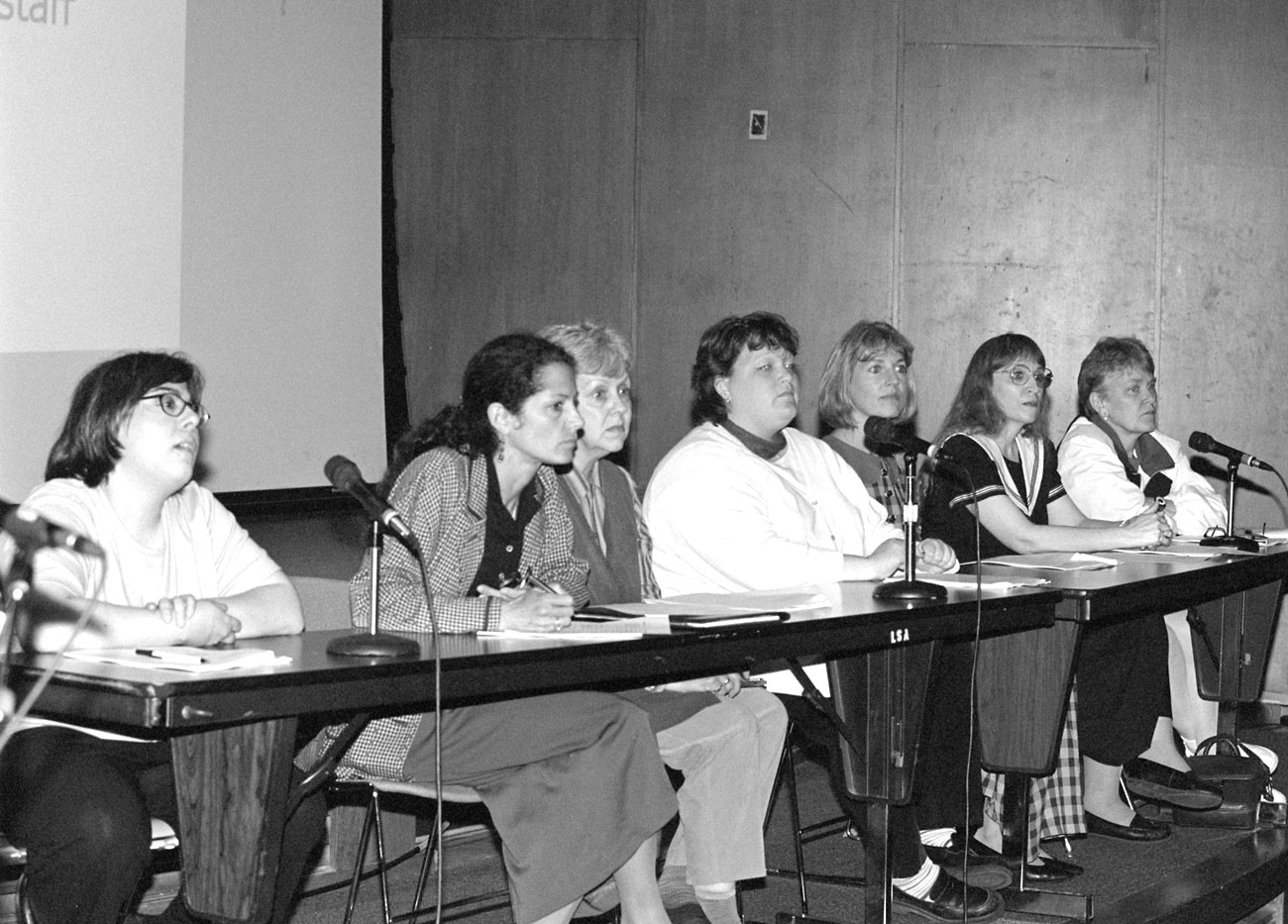
Access to the tools that will help them excel in their work, recognition for the work they do and problems caused by increasing workloads are among major concerns aired by LS&A staff members in a series of open forums that were conducted in January and February.
Results of the 28 forums were unveiled May 5 at the first of two LS&A Staff Town Meetings, attended by about 160 individuals.
Jane Johnson, one of two emcees at the meeting, noted that “there was a tremendous amount of positive energy” exhibited by forum participants, who did not come in with a lot of criticism but rather ideas for solutions and a desire “to work collectively to improve life in the College.” Johnson, an administrative assistant in the Department of English, organized the forum project and also served as a group facilitator. She was joined in hosting the Town Meeting by E. Karen Clark, LS&A manager of human resources services.
About 26 percent–228 persons–of LS&A staff participated in the forums, a counterpoint to faculty focus groups conducted in the fall. Staff volunteers who served as facilitators and note-takers received training from Human Resource Development.
Staff were able to attend a forum with individuals from their job family or could opt for attending a forum whose participants represented several job families. All forums had several common questions related to barriers to getting work done and “connectedness” to LS&A, with individual forums covering five topic areas: LS&A administration and services, unit level leadership, student academic services, environment for staff, and computer technology and technical support.
Johnson noted several overall themes, in addition to those above, that emerged from the forums:
Clark cited two similarities in responses of faculty and staff:
Here’s a quick look at some of the issues identified in discussing barriers to getting work done and whether or not staff feel “connected” to the College:
Issues raised and solutions suggested in the topic areas:
Facility repairs and furniture replacement need to be attended to more quickly.
Staff would like more opportunities for training and networking, including time to practice what they learn in classes and information about training opportunities and funding sources. A policies and procedures manual that units could customize should be developed.
Flexible work schedules and appointment of individuals to closed-end positions during peak times would help improve the work climate, as would stress reduction and customer service training for Dean’s Office staff.
A mentor system for training in new systems and in computer skills would be helpful for long-term staff.
The frequent turnover of administrators means “staff carry the burden of insuring procedural continuity.” New chairs and directors need training and documentation of LS&A policies and procedures. Faculty supervisors and key administrators should receive supervision and conflict management training.
The staff classification system needs updating and clarification, opportunities for promotion within departments should be provided and merit increases should be tied to evaluations. In addition, staff would like to see creation of a tool for “bottom-up” evaluation of unit leadership.
Communication could be improved through implementation of regular department staff meetings or cluster meetings within departments, as well as networking across departments and among those with jobs with similar tasks.
More faculty support and leadership is needed relative to undergraduate issues, and the number of advising and student service positions in units should be increased. The importance of serving students needs to be communicated at all levels.
More faculty are needed to teach core courses and attention should be paid to coordinating key courses with sequencing when faculty are granted leaves and sabbaticals.
Advisers need better office space and GSIs need more office space.
Among the negatives in this area are lack of compensation for additional work and responsibilities; the perception that one must leave a unit in order to get promoted; and loss of staff to outside industry, which is now offering similar benefits with fewer frustrations.
Suggestions for improvement include conducting a salary study of outside organizations and other academic institutions, compensating staff for team work, offering incentives that will encourage staff to stay in their positions, providing written information about the merit system, clarifying overtime policies, and compensating staff for additional training or attaining a higher skill level.
Staff should be treated with the same respect as faculty and all staff should be treated fairly and equally. Leadership should provide support when a staff member has to say “no” to a faculty member.
Staff cited the need for an advocate, “someone they can go to when they have a problem with a supervisor or faculty administrator,” the report stated.
The physical environment also affects one’s job performance, with staff indicating a need for a “break” room and periodic checks of offices and workstations relative to ergonomics and lighting. Some raised health concerns related to renovation projects.
Staff prefer direct communication if there is a problem and noted that evaluations written by individuals not familiar with the staff member’s work are not helpful.
Providing interview and training models would help address some staff transition issues. Staff also suggested establishment of a Staff Exploratory, similar to the Faculty Exploratory that offers information technology training.
New staff should be provided with procedures manuals. Training should be provided on dealing with multiple bosses and balancing customer needs with job demands.
“Because of the rapid growth in this area,” the report notes, “many concerns center on the shortage of personnel and training. The need to fund more computer support staff positions was a recurring theme. Staff should catch up proportionally with the hardware/software investments the College has made.”
Many computer staff support personnel feel disconnected and have poor morale due to low salaries, increasing workloads and lack of input on decisions.
Creation of a transition relief team would provide support when local positions are vacant. Better feedback on the status of service requests is needed. The College should hire a Y2K coordinator and provide unit tech support people with funding to deal with Y2K issues.
Training of one person in each department to provide basic computer support, and recognition of that role in job descriptions, would relieve the pressure on other technical support staff.
A Web coordinator and team should be appointed to help units create and maintain their sites.
“Get the best Web person, the best Mac person, the best data support person, the best tech support person to act as central coordinators for these areas at the College level,” the report states.
Lack of basic skills make changes to new systems and software difficult.
A software manual library and a primer on the Web and copyright laws would be helpful. There is a need for basic training in e-mail attachments and use of shared drives.
A second Town Meeting will be held 3—4:30 p.m. May 13 in Auditorium A. Angell Hall.
The report on the staff forums is on the Web at www.lsa.umich.edu/dean/bud/.
Top priorities
LS&A staff members were asked to name their top priorities for improving the work environment. Unranked, within LS&A they are:
Suggestions for improvements at the University level included increased parking access and decreased parking costs and such non-salary benefits as better dental coverage, family care days, more liberal support for continuing one’s education, on-site day care, inclement weather days, half day off Dec. 24 and Martin Luther King day off, and fitness classes.
Forum facilitators
The following LS&A staff served as note-takers and facilitators for the 28 forums that were held in January and February:
Judith Carothers, academic services secretary, Romance languages and literatures; Jennifer Eshelman, student services assistant, Asian languages and cultures; Jane Johnson, Dean’s Office and English; Katherine Johnson, associate editor, Romance languages and literatures; Dorothy Marschke, student services assistant, history; Julie Mattucci-Clark, academic secretary, and Lara Nelson, administrative associate, both from sociology; Robin Sarris, administrative manager, and Katherine Teasdale, student services associate, both from English; Janice Williams, executive secretary, political science; and Cheryl Zello, secretary, Museum of Zoology.
Human Resource Development provided training for the facilitators. HR/AA Consulting also assisted with the project.