Observatory rededicated May 21
The University Record, June 7 , 1999 By Mary Jo Frank
Office of the Vice President for Communications
The University of Michigan Detroit Observatory reminds us of an important aspect of human life—the desire of people to see and understand more clearly, noted President Lee C. Bollinger at the rededication ceremony for the building last month. “This telescope is one generation’s effort to see better, in this case asteroids and comets,” he added.
Bollinger, one of several speakers at the May 21 event celebrating restoration of the University’s first scientific research laboratory and oldest campus building in its unaltered form, talked about the resonance of the Observatory and the Regents’ decision earlier that morning to create the Institute for the Study of Biological Complexity and Human Values.
“When you look at this building, you can feel its power. Launching the life sciences institute is an effort at the end of the century to do what [President Henry P.] Tappan was doing in the 1850s,” Bollinger said.
Vice President for Research Fawwaz T. Ulaby noted that Tappan, in his 1852 inaugural address, unveiled plans for connecting the classical course of education with scientific learning, including construction of a world-class observatory. Tappan’s vision led to the University’s early emergence as a key research center in the United States.
The Observatory, built in 1854, was named in honor of Detroiters who donated a large portion of the funds to build the facility. Equipped with a Fitz refracting telescope and a meridian circle telescope, it became a training laboratory for many prominent astronomers of the 19th century, as well as the site of significant scientific discoveries, including 21 asteroids and two comets.
“The story of the Detroit Observatory is not simply about a building and some old scientific instruments,” Ulaby said. “It’s about people with ideas and the will to make them become reality.”
Among those who figured prominently in the restoration and were recognized at the ceremony were Anne Duderstadt, whose interest in restoring a link between the University and its past led to the establishment of the University’s History and Traditions Committee and the appointment of a University Historian; President Emeritus James J. Duderstadt; Interim President Emeritus Homer A. Neal; and Patricia S. Whitesell, director and curator of the Observatory, who oversaw the restoration project.
“Sandy [Whitesell] has accepted the challenge of this project with great energy, seriousness of purpose, and the kind of care and attention to detail that will serve the University and the larger community of scholars just as Tappan would have wanted,” Ulaby said.
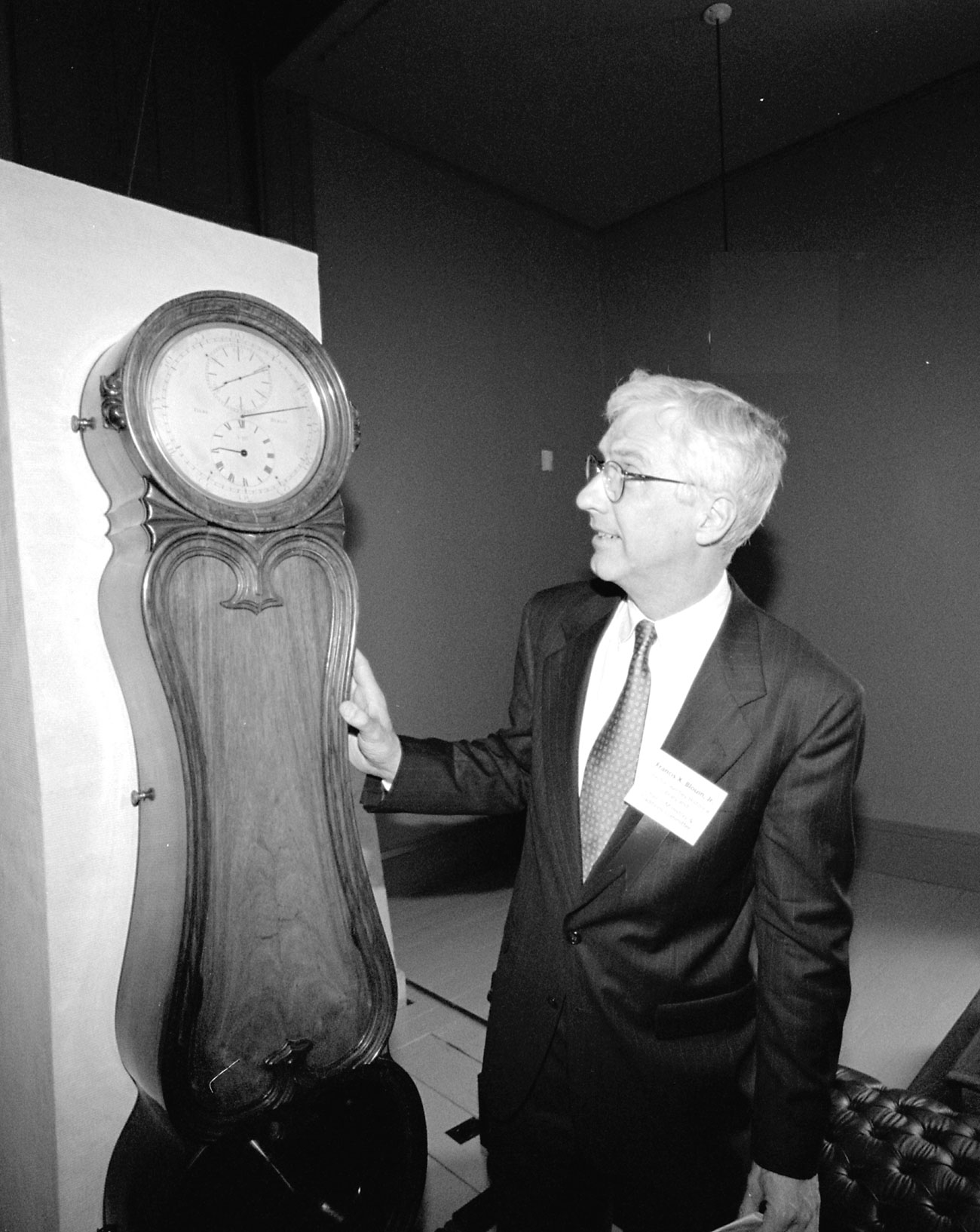
Francis X. Blouin, director of the Bentley Historical Library and chair of the History and Traditions Committee, recalled the day 22 years ago when he first pulled the rope to open the Observatory’s dome to view the moon. “I thought at the time that this is a great treasure.”
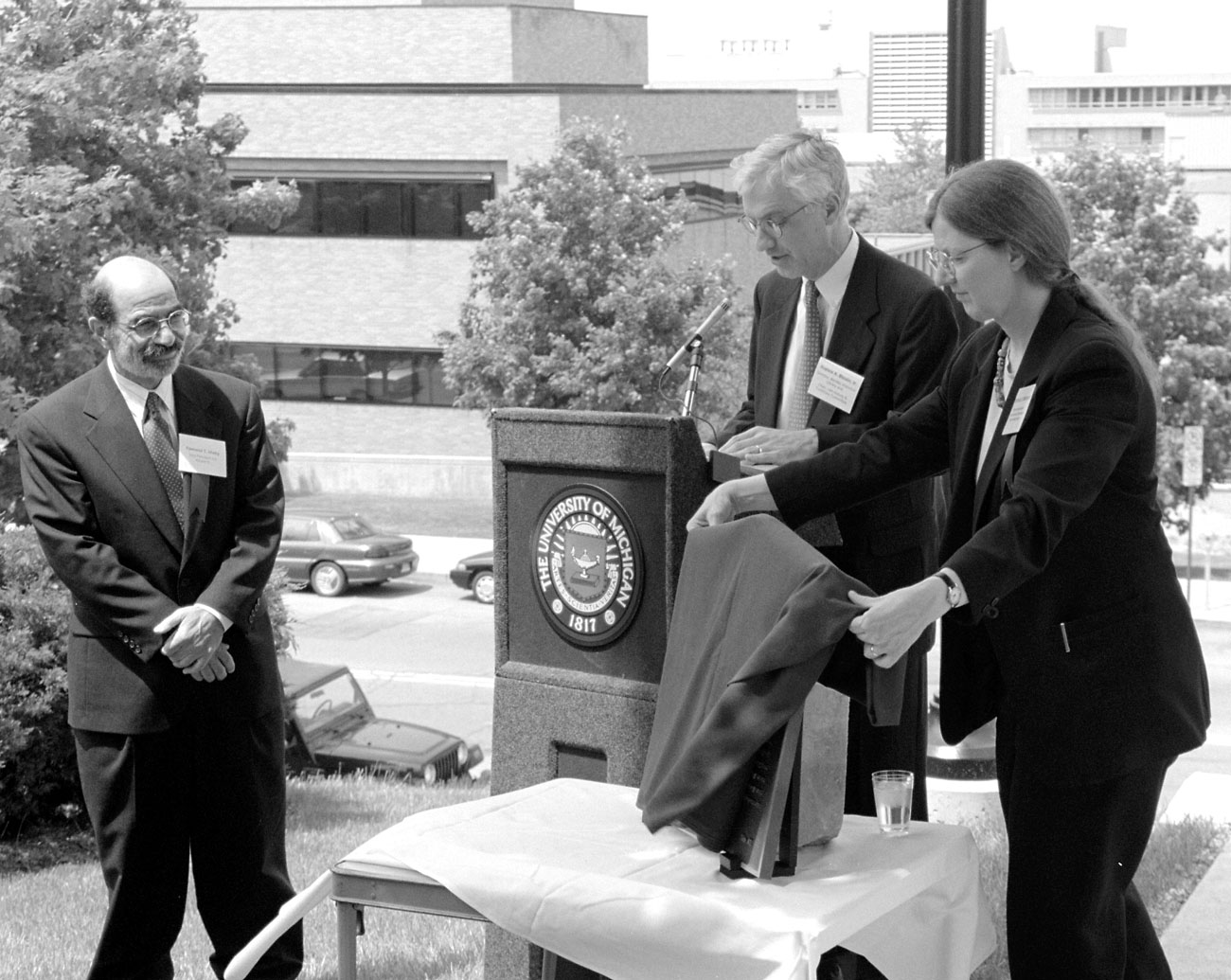
Blouin presented History and Traditions Committee certificates of recognition to Whitesell and to the Office of the Vice President for Research for restoration of the Detroit Observatory and for publication of Whitesell’s book, A Creation of His Own: Tappan’s Detroit Observatory.
Also honored were Plant Operations’ shops and tradespeople who worked on the restoration; Christopher Ray of Swarthmore, Pa., who restored the Observatory’s refracting telescope; and Gary Ontko of Matheson Painting, who, Whitesell noted, “painted every inch of the Observatory.”
The program also included a tribute to the late David S. Evans of Quinn Evans/Architects of Ann Arbor, and a poem written and read by Julie Ellison, associate vice president for research and professor of English. Ellison’s poem will be published in Michigan Quarterly Review.