Reach Out! staff and volunteers searching for new home
By Theresa Maddix
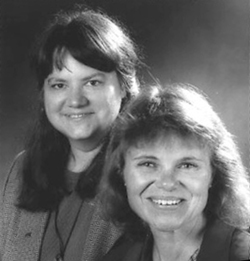
“Our guiding philosophy is that there is no limit to what we can accomplish if we don’t care who gets the credit,” says the Reach Out! Center Web site, www.eecs.umich.edu/~reachout . Begun in 1995 as the K-12 outreach arm of the National Science Foundation (NSF)-funded Center for Ultrafast Optical Science (CUOS), the program has become deeply embedded in the University community.
Despite its successes—after-school mentors, faculty-student interaction, a highly visible Web site, science clubs and workshops, and teacher training—The Reach Out! Center is facing the termination of its main funding source. The nonrenewable NSF grant that created CUOS and is the main provider for Reach Out! ends in January.
Now, instead of K–12 science and mathematics outreach, the chief question on program Director Jeannine LaSovage’s mind is where the project will find a home.
LaSovage and program associate Martha Toth remain cautiously optimistic in their search, and with elementary programs coordinator Debra Hamann, they continue an ambitious program schedule. In May, Reach Out! held its science clubs at area schools, community centers and churches. It offered a career fair for teens, parents and grandparents at the Ann Arbor Neutral Zone, held a Camp Discovery reunion and brought 150 fifth-graders to campus. This summer promises more visits from Detroit-area students, a summer algebra class for high school girls who have experienced difficulty with math and Camp Discovery for children who participate in the school-year science clubs.
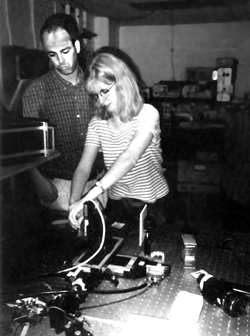
Toth notes the program’s benefits for undergraduates, saying students come in with a sense of “Oh, I’m not a big scientist” and are worried about “imparting scientific knowledge. Reach Out! teaches students to impart the scientific method.”
“And have fun,” interjects LaSovage.
“We use the scientific method,” Toth says, “as a metaphor for life.”
LaSovage says, “Children and young adults realize they can be actors in their own life.”
Eighty volunteer mentors from the past school year are a testament to the program’s success with students. Each of these University students is required to volunteer for a semester and most stay for a year or more. Hamann, a 2000 engineering graduate and former volunteer, says, “Volunteering for a year at a site gives a continuity of people. Choosing a previous volunteer at the site as coordinator helps enhance that continuity. We select someone who’s been there and knows the people.”
The program’s seven student volunteer coordinators work at sites that include George Elementary School in Ypsilanti, Owen Elementary School in Pontiac, and in Ann Arbor: Bethel AME Church, Pioneer High School, the Neutral Zone, and several community and recreation centers at subsidized housing sites.
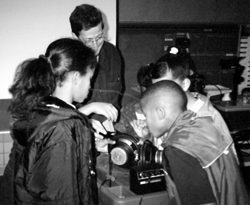
Supplementing the mentoring experience of the Science Clubs are Wandering Wizards, faculty members and other experts who travel from site to site giving demonstrations. Gregory Spooner, assistant research scientist in electrical engineering and computer science, describes his Wizard experience as “great fun. It is important for me to connect with people in the greater community. Reach Out! is an easy way for me to do that. And I like to teach so it’s a natural combination.”
Spooner also has worked with Research Experiences for Teachers (RET) through the outreach office and more recently the Research Experiences for Students (RES) program. He currently mentors one undergraduate student each summer.
For LaSovage, the intergenerational piece of outreach is what she finds rewarding. “By interacting with different parts of campus,” she says, “we’re establishing a family.”