Research expenditures outpace last year; awards slightly behind
By Nancy Connell
News and Information Services
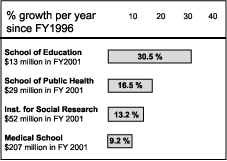
Research spending by the University continued to increase at a robust pace in FY 2001, reaching an all-time high of $592 million, an increase of $46 million, or 8.5 percent. In addition, the FY 2002 fiscal year is off to a strong start. From July 1, 2001 through Nov. 30, research expenditures stand at $257 million, a 10.4 percent increase over the $233 million in expenditures for the same period last year.
“Research expenditures represent a critical measure of the University’s ability to carry out its mission of education, intellectual discovery, addressing the needs of society and contributing to economic growth,” says Fawwaz Ulaby, vice president for research. “I am pleased to report that the University continues to show outstanding performance in its ability to bring in new awards and substantially increase research activity on an ongoing basis. And I must hand the credit for this continued success to the creativity and persistence of the faculty and staff.”
Research awards in FY 2001 totaled $641 million, down slightly from FY 2000, a record-breaking year in which awards soared 38 percent to reach $687 million. FY 2001 awards continue well above the FY 1999 total of $452 million.
So far this year, awards are up dramatically from FY 2001. Through December 2001, awards total $442 million, or 68 percent more than the amount received during the corresponding period last fiscal year.
“A strong research enterprise is vital to our society,” says Interim President B. Joseph White. “The breadth and depth of research at the University of Michigan, and its impact on our mission to educate leaders and innovators, demonstrate our commitment to our state, the nation, and the world.”
Ulaby presented his report to the Regents at their Jan. 17 meeting. He noted that the large increase in funding in FY 2000 caused him to question whether faculty could sustain this high level of activity since awards are cyclical in nature. “Happily, our researchers have cultivated another healthy crop of new awards in fiscal year 2001,” Ulaby said, “and the first half of FY 2002 shows a significant increase over the previous year. This experience offers reason for confidence that the current high level of research expenditures should continue into the foreseeable future.”
Ulaby said that new research awards should exceed annual expenditures in order for the University to sustain its research momentum in the face of increasing costs. In FY 2001 the margin between research awards and expenditures was a healthy $147.2 million ($640.8 million in new awards and $493.6 million in expenditures from externally funded sources).
Paul N. Courant, interim provost, said, “The continued success of the University’s research is a tribute to the commitment and the caliber of our faculty. The culture of multi-disciplinary inquiry that is integral to research today is a particular strength of our faculty, and it is an enormous asset for the University, and for all of its academic programs.”
Ulaby noted that the University has enjoyed record growth in research expenditures even while the number of faculty has not changed significantly. He attributed this success to four major factors:
The research report also notes that the inflation-adjusted growth in U-M research expenditures for FY 2001 was about 4.5 percent, as calculated using the research and development price index. (According to this index, the average rate of inflation over the last five years for higher education research is 3.1 percent.)