Country isn’t free of racism and discrimination
Nearly 40 years ago, Martin Luther King Jr. gave a passionate speech about his dream for the day when his four children would live in a nation that judged them for their character, not for being Black.
“We’re not there yet,” said Dr. Alvin F. Poussaint, speaking on the MLK national holiday. “We’re not free of racism and discrimination.”
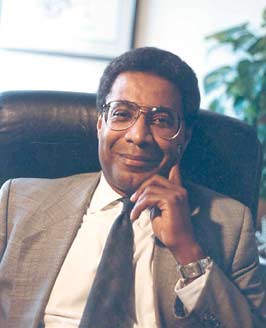
Poussaint, professor of psychiatry and faculty associate dean for Student Affairs at Harvard Medical School, said the University’s efforts to create a diverse environment reminded him of King’s “I have a dream” speech, given Aug. 28, 1963 at the Lincoln Memorial in Washington, D.C. One day, as King hoped, this nation will live in peace, he said.
King’s efforts to liberate the country through non-violent actions, however, will be tested because the United States is threatening war in Iraq, Poussaint said.
Poussaint’s visit was part of the campus-wide symposium honoring MLK. His lecture drew a diverse audience, packing the 485-seat Dow Auditorium in the Towsley Center. The schools of dentistry, medicine, nursing, pharmacy, public health, social work, and the U-M Hospitals and Health Centers sponsored the event.
Poussaint is an expert on the dynamics of racial and ethnic relations in America, and he serves as director of the Media Center of the Judge Baker Children’s Center in Boston. He is known for his work as a media consultant, including his involvement with actor Bill Cosby.
Some of the books Poussaint co-authored include the topics of raising Black children and the suicide and mental health crisis among African Americans. The mental health crisis might be traced back to the days of slavery, when Blacks were made to feel inferior and impure, he said. These negative connotations were imbedded in Blacks’ psyches, resulting in low self-esteem and doubt regardless of any success, Poussaint said. With more than 300 years of slavery and segregation, Poussaint said he wonders how long it would take Blacks to get over these parts of history.
Blacks might feel better about themselves if they felt welcomed, he said. For example, in a waiting room, it wouldn’t hurt to see Black publications, such as Essence or Ebony, on the tables or posters with Blacks, he said.
More MLK stories
Boggs: Affirmative action fight is ‘righteous’>
Athletics cuts ‘not all Title IX’s fault’>
Country isn’t free of racism and discrimination>
CoE kicks off yearlong series of MLK events>
More minorities needed in math fields>
Sarri discusses reasons for plight of poor women>
Gomes: ‘You are on the side of the future’>
Rajmohan Gandhi discusses legacies of his grandfather, King>
Poets address peace, racism and politics>
A day for children>