Coleman: Building bridges important to U-M’s success
State of the University
Crossing her own bridge of sorts into a second full academic year as president, Mary Sue Coleman says building bridges, both physical and metaphorical, is important in attempting to link the University’s many facets.
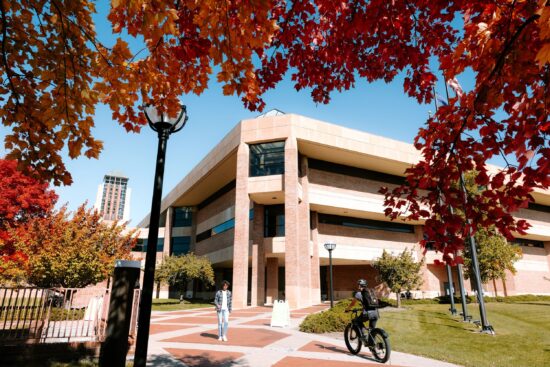
Delivering her “State of the University” address to the Faculty Senate Assembly Sept. 29, Coleman used the recent opening of a new pedestrian bridge across Washtenaw Avenue that connects the Central and Medical campuses as a symbol of the interdisciplinary work she says is the hallmark of the University.
“Bridges are needed for more than geographical connection—we need bridges across disciplines; we need connections among the students throughout our campus; and we must continue to seek ways to link our research and teaching to the world beyond our campus,” Coleman said.
Improving the experience of students, the ongoing expansion of the life sciences on campus and further exploration of U-M’s public role are important steps for the University to take, Coleman said.
“We have a responsibility to our undergraduate students, to connect them to everything Michigan has to offer, and to provide them with fully engaged learning experiences in the classroom, in their learning environments and in the vast wealth of extracurricular activities on our campuses,” she said.
Coleman said critics of the cost of higher education do not take into account the value of a university degree.
“What is the cost of not having high-quality public universities?” Coleman asked. “We simply cannot abandon our commitment to providing broad access to excellent public universities. We are not just training students for careers—we are teaching them how to learn and how to take this talent for learning out to the world.”
The University’s growth in research has been boosted by its commitment to the life sciences, Coleman said. The Life Sciences Institute opened earlier this fall, and the focus continues on recruiting outstanding scientists, she said.
“We are pleased with the progress the institute is making, and although it will take some time to grow to full capacity, I am convinced that it will develop into a dynamic catalyst for research, fully engaged with the rest of the University,” Coleman said. “Our life sciences work will continue to expand and broaden and will touch many aspects of our academic community.”
A public university has a public responsibility, Coleman said. She said U-M has a long and eminent history of providing teaching, research and service and that faculty, staff and students are engaged in the issues of society in greater numbers than before.
“I take great pride in our concerns about human welfare, on which we have impact at the local and global levels,” Coleman said. “Michigan is not simply a great university or a great research university. It is one of the most outstanding public universities in the country. Its public nature is a critical function of our identity.”
Coleman updated Assembly members gathered in the Regents Room of the Fleming Administration Building on important events of the last year and outlined key issues she says the University will face in coming years.
Important events cited by Coleman:
• Dedication of the new site for the Gerald R. Ford School of Public Policy;
• 150th anniversary of the College of Engineering;
• 100th anniversary of the School of Natural Resources and Environment, and celebration of the renovated Dana Building—a model of a “green” facility;
• Top rankings of the University’s colleges and departments;
• $749 million in total research expenditures in fiscal year 2003, an increase of more 14.2 percent from FY2002;
• Filling of key leadership positions.
“As always, I am impressed by the high quality and the variety of the work our faculty has produced, whether in the realm of discovery, research or creativity,” Coleman said. “These explorations by our faculty have a direct impact on all of our students, and are the heart of what makes Michigan such a unique and superb place.”
Coleman revisited decisions by the Supreme Court of the United States that upheld the University’s use of race as one factor in admissions.
“Now, with clear guidance from the court, Michigan will continue to be a national leader in those aspirations for the next generation,” Coleman said. “I am keenly aware that the eyes of the nation are on us, and I am determined that as we develop our new admissions policies, we will create a well-constructed bridge into the future of higher education in our country.”
The University also faces many challenges, Coleman said. The state budget is the most pressing problem, she said as she thanked deans and campus administrators for the productive ways they have dealt with a significant reduction in the state appropriation for the current academic year.
Some of Coleman’s future initiatives:
• Improvement of existing academic facilities and creation of new ones;
• Next year’s launch of the largest capital campaign in University history;
• Continuation of theme semesters, including this fall’s St. Petersburg, Russia, semester and winter’s Brown v. Board of Education.
Coleman concluded by saying that partnership is in U-M’s DNA, and the University needs to use that multidisciplinarity to set it apart and to define the science, research and learning of the future.