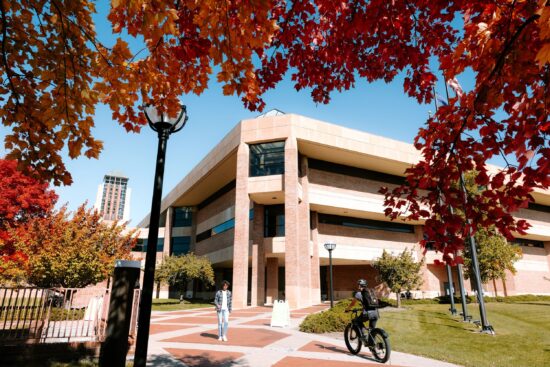
ICPSR celebrates 40th anniversary, offers online data analysis
The world’s largest computerized social science data archive, the Inter-university Consortium for Political and Social Research (ICPSR) at U-M, is celebrating its 40th anniversary with an Oct. 10 symposium on privacy in the information age. The event will feature opening remarks by President Mary Sue Coleman and a keynote address by former U.S. Bureau of the Census Director Kenneth Prewitt.
Part of the Institute for Social Research (ISR), ICPSR recently has expanded access to its mammoth archive of some 50,000 data sets and now offers online analysis of more than 100 studies. Historian Myron Gutmann, director of ICPSR, says the archive’s holdings stretch from 17th century European prices to the 2000 U.S. Census and 2003 media polls, and cover a broad range of disciplines from political science and criminal justice to foreign policy, education, gerontology, sociology, demography, economics, history and law.

Instant, online analysis allows the general public, teachers, journalists and policy wonks to generate color-coded tables showing frequencies, cross-tabs, even multiple regressions and comparisons of correlations—things that used to be the sole purview of academics with advanced statistical training, the right software and membership in a major data archive.
Anyone interested can go through http://www.icpsr.umich.edu to analyze data from the well-known Monitoring the Future Study on the behavior, attitudes and values of teens and young adults, for example. Funded by the National Institute on Drug Abuse, and conducted since 1975 by ISR, Monitoring the Future surveys some 50,000 8th-, 10th- and 12th-grade students every year.
The move is part of a growing trend in academe, with the University of Connecticut’s Roper Center for Public Opinion Research and a growing number of small “boutique” archives that specialize in specific topics, also offering online analysis.
ICPSR Assistant Director Erik Austin says the impetus to expand access to archived information comes from a variety of sources, including federal agencies that want to make sure the data collections they fund are available to the broadest possible range of constituents. Both ICPSR and Roper use the Survey Documentation and Analysis program developed by the University of California, Berkeley. “It’s intuitive and easy to use,” Austin says.