SNRE turns 100, honors ‘green’ Dana Building
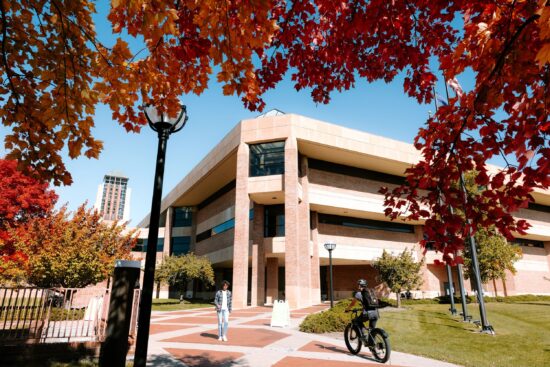
The School of Natural Resources and Environment (SNRE) celebrates its 100th anniversary this month with an event honoring the school’s history and its newly renovated home—the Dana Building—which recently underwent an environmentally sensitive “green” transformation.
The Centennial Celebration will include a rededication and ribbon-cutting ceremony for the new building Oct. 17 in the Ford Commons.
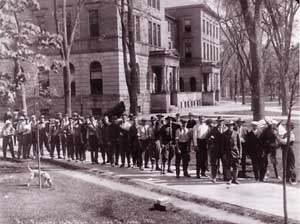
Establishment of the Department of Forestry within LSA in 1903 marked the beginning of what now is SNRE. The department offered the first Master of Forestry degrees, as well as instruction in innovative fields of study such as landscape design.
In 1927, Samuel Dana was appointed professor and the first dean of the school. At his recommendation, the school was renamed the School of Forestry and Conservation, becoming the first of its peers to include conservation in its name. Dana recognized that forestry was more than managing the forest business, and that holistic environmental thinking was required to promote a sustainable society, says SNRE Associate Dean Jim Diana. This theme still permeates the school today, he says.
Diana says Dana’s approach to the environment laid the groundwork for the pioneering environmental activities of the school today. “Because of Dana, the [school’s] early focus on production technology and forest commodities changed to a larger understanding of ecosystems, and using this knowledge to manage resources,” Diana says. “Interdisciplinary work evolved further as environmental problems continued to change in complexity.”
In 1950, the school’s name changed again to the School of Natural Resources, and the word “Environment” was added in 1992 to better reflect the interests of students and faculty.
“SNRE is proud of both its rich history and its interdisciplinary approach,” says its current leader, Dean Rosina Bierbaum. “Centers, initiatives and institutes within the school address challenges such as ecosystem management, sustainable systems, environmental justice, business and environmental management, and the development of minority environmental leaders.”
The school’s centennial celebrates more than academic roots, Bierbaum says. The cornerstone for the Dana Building, originally the West Medical Building, was laid in 1903. The school has occupied the space since 1961, and in 1998, the University decided the unique but aging building needed repairs. “Thus began an extensive renovation project called The Greening of Dana,'” she says.
“Students, staff and faculty pressed for an environmentally conscious renovation to keep in line with the school’s values and history. The $27 million project evolved into a one-of-a-kind building full of renewable resources and recycled products,” Bierbaum says.
Some of the most notable uses of recycled materials include bathroom tiles made from airplane windows, flooring pressed from rubber tires, and brightly colored bathroom stalls and countertops created from 100 percent post-consumer products such as plastic bottles.
Renewable resources such as fast-growing Aspen trees and bamboo plants became ceiling and flooring in the Dana Building. Wheat, newspaper, soy products and sunflower seeds became cupboard and floor panels.
“In many ways, the Dana Building is a metaphor for the school itself,” Bierbaum says. “Though changes have transformed its look and feel through time, the foundation remains solidly unchanged. Similarly, the school’s academic depth and breadth has evolved, but its roots in long-term, interdisciplinary environmental education remain solidly intact.”
|