Ritter: American people partly responsible for war on Iraq
Sept. 11 event
Because of their push for a post-Sept. 11 counter-attack, Americans should take some of the responsibility for the war on Iraq, said Scott Ritter, former chief weapons inspector for the United Nations Special Commission in Iraq.
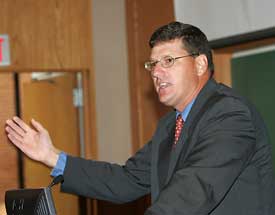
U-M Photo Services)
“We have failed as Americans since 9/11. We have let a fear consume and blind us, and [we] support policies that have made the world we live in a much more dangerous place since 9/11,” he said.
Ritter spoke at a conference held on the third anniversary of the Sept. 11, 2001, terrorist attacks. The Michigan Student Assembly sponsored the all-day event at the Stephen M. Ross School of Business.
According to Ritter, Americans’ desire for a quick counter-attack is in large part responsible for the lack of success in the hunt to find Osama bin Ladin and other members of the Taliban.
“The war on Afghanistan is a conventional war waged against an unconventional enemy. But we needed to see American bombs dropping out of American planes and killing Al Qaeda members,” he said.
Ritter also suggested that weapons inspections in Iraq were a cover for the larger task of removing Saddam Hussein from power.
“I saw men working alongside me who were undercover CIA. The U.S. didn’t want Iraq disarmed, it wanted Saddam Hussein gone,” he said.
Though much was said at the conference about rebuilding relationships with former U.S. allies, Ritter said irreparable damage may have been done to our foreign relations.
“We had the entire world united in the wake of
9/11—the largest coalition we could ask for, without asking,” he said. “America is no longer the shining beacon on the hill. We are the aggressors, we are the bad guys and we are the enemy.”
The conference, which focused on how America and the world have changed since the events of Sept. 11, also included speeches by Sen. Carl Levin (D-Mich.) and Jeffrey Toobin, CNN legal analyst. In addition, members of the University faculty came forward to share their views on post-Sept. 11 America, including Mark Tessler, vice provost for international affairs, director of the International Institute and the Samuel J. Eldersveld Collegiate Professor of Political Science.