AOSS professor studies atmosphere of Saturn moon
Cassini-Huygens mission
As the Cassini-Huygens spacecraft conducts more than 40 fly-bys of Saturn’s largest moon, one of the main scientists involved in studying its messages is Hunter Waite, professor in the Department of Atmospheric, Oceanic and Space Sciences.
Waite is the team leader of NASA’s Cassini Ion and Neutral Mass Spectrometer (INMS) Investigation. The instrument measures positive ions and neutral particles in the atmosphere, and an early fly-by of Titan has turned up some interesting findings.
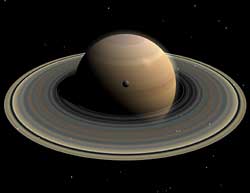
“We saw a lot of complex carbon molecules, and the fact that they were mixed way into the upper atmosphere was surprising,” Waite says. “The major constituent of Titan’s atmosphere is nitrogen, just like in Earth’s atmosphere. It’s a very thick atmosphere, which is surprising for a moon.”
There is a small amount of methane as well. Both methane and nitrogen are dissociated by solar ultraviolet photons and energetic particles from Saturn’s magnetosphere.
This initiates the complex carbon-nitrile chemistry that forms the haze in the lower atmosphere. The upper atmosphere, he says, appears to be as well-mixed with the lower atmosphere returning this organic mixture to the upper atmosphere where INMS was able to observe it.
Another surprise from the late-October fly-by relates to the isotopic composition of carbon and nitrogen in the upper atmosphere. Measurements of the enrichment of the heavy isotopic component of nitrogen indicate that Titan has lost more than three-quarters of its atmosphere over time, Waite says.
However, the lack of enriched heavy isotopes in carbon as opposed to nitrogen suggest that methane is out-gassed continuously from the interior of Titan during the evolution of the atmosphere.
He and other scientists also are exploring whether nitrogen comes into Titan’s atmosphere as nitrogen, or if it comes in as ammonia and then becomes nitrogen.
“Titan is like the early Earth,” he says. “If we learn where the N2 (molecular nitrogen) on Titan comes from, we might gain a better understanding of where our N2 came from.”
In December, the European-built Huygens probe is scheduled to be released from Cassini. It will make a closer inspection of the moon’s surface.
The $3.3 billion mission—a joint project of NASA and European and Italian space agencies—is a four-year study of Saturn. Titan is a key part of that research because it is the only known moon in the solar system with an extensive, thick atmosphere.
During the fly-by that provided Waite and his team with information about the atmosphere, other scientists said they were mystified by areas of bright and dark material on the moon.
While these cameras provide much sharper images than those previously available, it still is difficult to make them out because of the moon’s thick and hazy atmosphere.
Waite hopes many of those mysteries will be solved during later inspections of Titan. More than 40 additional fly-bys are planned.
“There are a lot of very interesting questions that Cassini-Huygens will be able to address,” he says. “We expect to learn a lot more about Titan, and to get some more clues about the early Earth.”