Bartlett’s advice to young researchers: Remember to care for patients
50th Annual Student Biomedical Research Fall Forum
Pick an important research topic—something interesting, fundable and something you can solve in 15 years. Know how to use all the equipment in the lab. Don’t follow research fads. Get funded and stay funded, which means learning how to work with the National Institutes of Health.
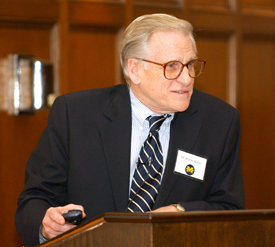
But the most important aspect of being a good researcher, Dr. Robert Bartlett said in a speech to students, is to be a good doctor.
“You still have to take good care of patients every day,” he said. “People tend to forget this side of research.”
Bartlett—professor of surgery, director of critical care and head of the Extracorporeal Life Support Team at the U-M Health System—spoke at the 50th Annual Student Biomedical Research Fall Forum Nov. 4. The forum included poster presentations of original scientific research by undergraduate and medical students who participated in summer programs sponsored by the Undergraduate Research Opportunity Program and the Medical School’s Student Biomedical Research Programs.
The students whose work was presented at the event were selected to receive a funded research opportunity. They have worked with a faculty investigator on projects in fields ranging from anatomical sciences and animal medicine to physiology and surgery.
Some of the projects were: Quality of Life in Adolescents with Epilepsy; Physician and Patient Understanding of Hypertension Risks and Treatment; Healthcare Decision-making in a Guatemalan Village; Bactericidal Effects of Synovial Fluid Against Common Joint Pathogens; and many others.
During his speech, Bartlett spoke about his own work in both research and surgery. He is a pioneer in the development of prolonged extracorporeal circulation, including development of the technique for respiratory failure in newborn infants and children.
His Michigan seminars on neonatal extracorporeal membrane oxygenation (ECMO) influenced the successful worldwide growth of this technology and led to the establishment of the Extracorporeal Life Support Organization.
ECMO has been used most extensively for newborn infants with respiratory failure. In the audience at Bartlett’s speech were two young women he treated—one as an infant, one as a young adult. Both of them are now healthy, and both clear examples of why, as Bartlett said, caring for patients is so important.