How cozy should universities and industry get?
Waggoner Lecture Nov. 17
Are America’s universities jeopardizing their credibility, independence and futures by yoking their biological and medical research too tightly to industry?
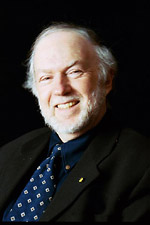
(Photo courtesy UMHS)
Or are the checks and balances imposed by most universities enough to limit industry’s influence, while at the same time allowing the discoveries made in university labs to benefit the general public? Could more limitations or regulations delay the treatments and technologies that might make life better tomorrow?
Those questions will be in the spotlight Nov. 17 at the U-M Health System in a free public lecture by visiting author and scholar Sheldon Krimsky. His most recent book is “Science in the Private Interest: Has the Lure of Profits Corrupted Biomedical Research?”
The lecture is the ninth annual Raymond W. Waggoner Lecture on Ethics and Values in Medicine, named for the late former chair of the Medical School’s Department of Psychiatry who spent much of his career exploring ethical and value-based questions in medicine. He died in 2000 at age 98. Waggoner was a noted psychiatrist, medical administrator and government adviser who was one of the first to see mental illness as both an emotional and physical problem.
Krimsky, a professor in Tufts University’s Department of Urban and Environmental Policy and an adjunct professor at the Tufts Medical School, has built a career examining and commenting on science’s intersection with our broader society, from public science policy to environmental risk.
For more than a decade, Krimsky has examined the real and potential implications of outside financial interests on the part of university-based biomedical researchers, and the involvement of industry in the sponsorship of research and the licensing of university discoveries.
His latest book concludes that the increasing encroachment of private interests on the public scientific sphere threatens the ability of scientists and academic physicians to serve their key historical roles as advisers to government and as public intellectuals who can express opinions and share research freely.
Krimsky decries “conflict of interest management” efforts made by universities to keep the extracurricular private-sector activities of biomedical faculty separate from their academic activities. Only a complete divorce of commerce from academic science will preserve universities’ unique status and societal role, he says.
Krimsky is a fellow of the American Association for the Advancement of Science, and of the Hastings Center on Bioethics. He is the author of nearly 150 articles, reviews, book chapters and editorials.
In addition to “Science in the Private Interest,” published in late 2003, he is the author of several books on risk and risk communication, the recombinant DNA controversy of the 1970s, agricultural biotechnology and the environmental endocrine issue.
The lecture is at 4 p.m. Nov. 17 in the Ford Amphitheater on the second floor of the University Hospital. It is free and open to the public, and Krimsky will take questions from the audience. For more information, call (734) 647-8762.