Jan. 24 symposium to address potential of flu pandemic
This fall’s vaccine shortage focused attention on issues of influenza prevention, but flu experts have been warning for years that the time is ripe for flu pandemic.
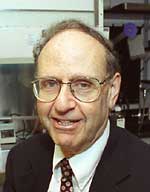
“A pandemic is inevitable. We just don’t know when,” says Dr. Arnold Monto, a noted flu expert and professor of epidemiology at the School of Public Health (SPH). “It would be irresponsible not to prepare as though it were coming soon.”
Monto is helping to organize a day-long symposium Jan. 24 entitled “Pandemic Influenza: Could History Repeat Itself?” When they hear the title, people might think of the infamous flu pandemic of 1918, which killed 40 million people worldwide. But Monto notes that lesser flu pandemics occurred in 1957 and 1968 as well.
Pandemic is not a one-time fluke, he says. Today people travel internationally with much more regularity than when those earlier pandemics struck, which increases the likelihood that a new form of flu could spread around the world before health officials even know what’s happened.
This year, British flu vaccine manufacturer Chiron was to make 46-48 million doses of influenza vaccine for the United States, but was shut down this fall because of contamination concerns. That left the United States short just as vaccination season was about to begin.
Even with full vaccination, however, Monto says pandemic could happen if a new strain of flu began circulating unexpectedly. People would not have built up natural immunity through past exposure to that type of flu, and vaccine only protects against three strains of flu while dozens of variations exist in nature at any given time.
The symposium, co-sponsored by SPH’s Michigan Center for Public Health Preparedness and the Michigan Department of Community Health, will be in the Lydia Mendelssohn room at the Michigan League. It will bring many of the world’s foremost flu experts to campus to discuss the emergence of avian influenza, international and domestic monitoring efforts, influenza immunization development and delivery, and our current state of preparedness to meet the challenge of the next flu pandemic.
Among the confirmed participants are:
• Dr. Ed Thompson, deputy director for public health services, Centers for Disease Control and Prevention (CDC)
• J. Malik Peiris, professor of microbiology, University of Hong Kong, and chief of virology, Queen Mary Hospital, Hong Kong
• Linda Lambert, National Institute of Allergy and Infectious Diseases, National Institutes of Health
• Dr. Keiji Fukuda, Epidemiology and Surveillance Section, Influenza Branch, National Center for Infectious Diseases, CDC
• Dr. Scott Harper, medical officer, Division of Viral and Rickettsial Diseases, National Center for Infectious Diseases, CDC
• Dr. Marcelle Layton, Bureau of Communicable Diseases, New York City Department of Health and Mental Hygiene.
In addition, Howard Markel, the George E. Wantz Professor of the History of Medicine; professor of pediatrics and communicable diseases; and director of
U-M’s Center for the History of Medicine, is scheduled as the luncheon speaker.
The symposium is free and open to the public. For more information, visit http://www.mipreparedness.org or e-mail prepared@umich.edu.