First-year public health students dip into real-world Detroit
The School of Public of Health started its first day of classes by immersing more than 100 students in the biggest health issues of nearby Detroit, one of the nation’s largest cities.
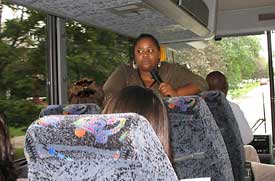
(Photo by Mary Beth Lewis)
Practice Plunge, a Sept. 1 daylong bus trip, is the first known program of its kind in the nation to introduce students to practicing public health in a large city.
Students and faculty made the trip on the day after orientation for an intensive day of meeting local health experts, touring the city and hearing community leaders talk about their work in a large diverse urban area and the creative ways they tackle health issues.
“For too long the profession of public health, as taught by schools of public health, has not included its actual practice,” says Matthew Boulton, the school’s associate dean for practice. “We want students from the beginning of their time with us to see for themselves what needs to be done and how they can make a difference.”
Detroit Health Department Director Phyllis Meadows provided students with the overall picture of how public health works in an urban area.
Eve Mokotoff, who leads the HIV/AIDS program for the state, provided students with an understanding of how HIV/AIDS is being addressed in Michigan. Rounding out the day was a visit to the Warner/Conner Development Coalition and the Detroit Hispanic Development Corp., to learn about the city’s diverse culture.
The goal is to start the academic year by familiarizing students with the major issues impacting public health and to introduce them to state and local leaders and their frontline work, while strengthening the ties between the University and Detroit, where U-M was founded in 1817, Boulton says.
U-M researchers and students conduct numerous research and outreach efforts in the city on an ongoing basis, but Practice Plunge is unusual, he says, since it involves inviting the entire incoming class of a school to participate at once, on their first official day as public health students.