NY Times editor to illuminate Bush’s warrantless wiretaps
2006 Davis, Markert, Nickerson Nickert Academic and Intellectual Freedom Lecture
In late fall 2005 Bill Keller, executive editor of The New York Times, was faced with a decision of when or even whether to publish an article revealing that President George W. Bush secretly had authorized the National Security Agency to conduct warrantless domestic wiretapping on suspected terrorists following the Sept.11, 2001 attacks.
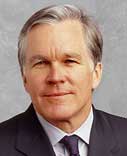
Keller ultimately made the decision to publish the story in the Dec. 16, 2005, edition of the paper. In response, Bush and Vice President Dick Cheney called the newspaper a disgrace, and several members of Congress suggested that it was guilty of treason and demanded the prosecution of its executive editor.
Keller will be on campus to discuss the issues surrounding publication of the original story and the controversy that followed as he presents the 2006 Davis, Markert, Nickerson Academic and Intellectual Freedom Lecture, “Editors in Chains: Secrets, Security and the Press.” He will give the lecture at 4 p.m. Oct. 16 in Honigman Auditorium of the Law School. The event is free and open to the public.
Keller joined The New York Times in 1984 where he has held the positions of domestic correspondent in the Washington, D.C., bureau (1984-86); reporter (1986-88) and bureau chief (1988-91) in the Moscow bureau; bureau chief in the Johannesburg bureau (1992-95); and foreign editor (1995-97), managing editor (1997-2001), op-ed columnist and senior writer (2001-03) and executive editor (July 2003-present) in the New York City bureau. In 1989 he won a Pulitzer Prize for his reporting on the breakup of the former Soviet Union.
The problem Keller faced a year ago is not new, but it was exacerbated for The New York Times, says Charles Eisendrath, associate professor of communication studies, director of the Knight Wallace Journalism Fellows program and former correspondent for Time magazine.
“As more news organizations have cut back the number of their reporters and bureaus, the Times stands more than ever as the journal of record for the U.S. And that puts enormous pressure on its editors, as does the nature of the current terrorist threat. The threat is amorphous, unpredictable and badly understood, so it’s difficult for anyone in Keller’s place to second-guess credible sources,” Eisendrath says.
Tony Collings, former CNN and Newsweek correspondent and now a lecturer in the Department of Communications Studies, applauds Keller’s decision to publish the wiretapping story on grounds of freedom of the press.
“Of course it’s important not to compromise the ability to fight terrorism, but it’s equally important for the public to know that their government may be breaking the law,” Collings says.
The lecture series was established in 1990 by the Senate Advisory Committee for University Affairs (SACUA) to honor three University faculty members, Chandler Davis, Clement Markert and Mark Nickerson, who in 1954 were called to testify before a Congressional Committee on Un-American Activities. All invoked Constitutional rights and refused to answer committee questions about their political associations. As a result of their actions the three were suspended and Nickerson was denied the summer portion of his fiscal year salary. Subsequent hearings and committee actions resulted in different outcomes. Markert was reinstated; Nickerson, a tenured professor and Davis were dismissed from the University.
Peggie Hollingsworth, president of the Academic Freedom Lecture Fund, says Keller’s selection was a natural progression from last year’s lecturer, Floyd Abrams, the noted First Amendment advocate, who has represented the Times in cases where freedom of the press was the central issue.
“We want our speakers to be discussing events and issues central to academic and intellectual freedom that are timely, and the controversy over the wiretapping story came up as we were considering candidates for the lectureship,” Hollingsworth says.
The 2006 Davis, Markert, Nickerson Lecture on Academic and Intellectual Freedom is sponsored by the Academic Freedom Lecture Fund, American Association of University Professors U-M-Ann Arbor Chapter, and the Office of the President, Office of the Vice President for Communications, Law School, LSA, Board for Student Publications, and SACUA.
For more information, go to www.umich.edu/~aflf.