First university employees move to new NCRC
The first group of U-M employees moved into new permanent workspaces last week at the North Campus Research Complex (NCRC), the former Pfizer property purchased by the university in June 2009.
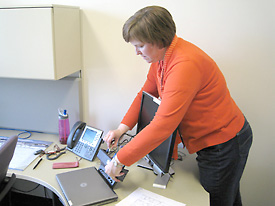
Lisa Kiel, office manager for the Medical School’s Institutional Review Boards, plugs in her computer at her new office in the North Campus Research Complex. Kiel and about 30 other IRBMED employees moved into their new offices last week. Photo by Mary Masson, UMHS Public Relations
This “pioneer” group moved into the office buildings near the southeast corner of Huron Parkway and Plymouth Road. They are all existing university staff in the Medical School’s Institutional Review Board’s office, known as IRBMED.
IRBMED oversees any research involving human participants that is conducted at the Medical School and some other areas of U-M and is responsible for protecting the rights and welfare of research volunteers.
They are among the 300 employees expected to move into NCRC during the month of April, all from units that support the university’s research community in multiple functions.
“Today is a major milestone in the development of the North Campus Research Complex, and we welcome this pioneering group of employees,” says Dr. Ora Hirsch Pescovitz, executive vice president for medical affairs and one of the leading planners for the NCRC site.
“Our first phase co-locates several units that often work together to support the university’s research community. As researchers begin to move to NCRC in coming months and years, they will benefit from having these research support functions close by.”
But Pescovitz says these pioneers are just the tip of the iceberg — the first of thousands of faculty and staff who will use NCRC’s facilities to help redefine research at Michigan in the future.
Moving in during April will be employees from the Michigan Institute for Clinical & Health Research, the development and clinical trials offices for the Comprehensive Cancer Center, the Cancer Center’s Specialized Program of Research Excellence group and the Medical School Office of Research’s Calendar Review and Analysis Office.
All of these units are moving from off-campus buildings leased by the university. U-M has kept some of those leases, as other U-M units move into the vacated space.
These office-based functions were easily moved into the former Pfizer buildings. The Board of Regents approved on Dec. 17 a $1.8 million project for improvements including painting and new carpet in these structures. Other buildings in the NCRC, especially laboratories, will require more preparation and planning before they can be used.
As the first move-in occurs, researchers at U-M currently are submitting proposals to create grassroots faculty teams that will form interdisciplinary research clusters at NCRC.
The university also has identified the first two technology anchors to develop at NCRC. The first is a world-class program in biointerfaces, which includes an interdisciplinary mix of nanotechnology, microfluidics and sensors, cell and tissue engineering and biomaterials and drug delivery. The second is a cutting-edge collaboration in molecular, functional and structural imaging.
The property remains closed to the public except for selected special events. For more information about the planning process for use of the site go to www.umresearchgrowth.org.