Scholarship & Creative Work
New variants found that indicate a predisposition to type 2 diabetes
An international team co-led by scientists from the U-M have discovered 12 more regions on the genome with DNA variants that are associated with increased risk of type 2 diabetes, bringing the number to 38.
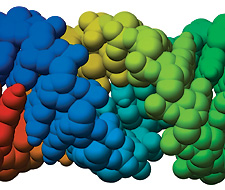
A variant is a place on a string of DNA where one of the “letters,” or nucleotides, differs between people. At most places along the DNA, any two people will have the same letter. The variable places in the DNA are important because some variants can increase predisposition to disease and other conditions, or offer drug targets.
Researchers also wanted to know if people who hadn’t yet developed type 2 diabetes but did have the diabetes variant showed elevated blood glucose levels, a main predictor of diabetes, says study co-leader Laura Scott, associate research scientist at the School of Public Health (SPH).
“What our study suggests is that many of these variants are associated with changes in glucose levels long before people get diabetes,” says study co-leader Michael Boehnke, professor of biostatistics at SPH.
The next step is to take the research beyond genome wide association, which looks at a few million places on the genome, into genome sequencing. This sequencing will allow researchers to assay most of the 3 billion base pairs in the human genome and find less common variants that might be associated with disease.
The paper, “Twelve type 2 diabetes susceptibility loci identified through large-scale association analysis,” appeared online June 27 in Nature Genetics.
— Laura Bailey, News Service
Engineering researchers achieve organic laser breakthrough
Researchers at U-M have achieved a long-sought-after optics phenomenon that could lead to more efficient and flexible lasers for telecommunications and quantum computing applications, among other uses.
The researchers demonstrated polariton lasing for the first time in an organic semiconductor material at room temperature. Their results are published in the June issue of Nature Photonics.
An organic material primarily contains carbon, and sometimes can have biological origin. This is in contrast to inorganic semiconductors such as silicon or gallium arsenide commonly found in modern electronic circuitry.
A polariton is not exactly a particle, but it behaves as if it were. It is a “coupled quantum mechanical state” between an excited molecule and a photon, or particle of light.
“You can think about it as two pendulums side by side tied together with a spring. They have to work together,” says Stephen Forrest, principal investigator. Forrest is the William Gould Dow Collegiate Professor of Electrical Engineering, a professor in the Department of Physics and the university’s vice president for research.
“This is a potential route to a whole bunch of new phenomena for new applications,” Forrest says. “People have been trying to do this for about a decade — to see polariton lasing at room temperature. In my lab, my student Stephane Kena-Cohen took five years to succeed in this discovery.”
The team is working toward building organic lasers that, like many inorganic lasers today, can be excited with electricity rather than light.
The paper is “Room-temperature polariton lasing in an organic single-crystal microcavity.”
— Nicole Casal Moore, News Service
Tiny clays curb big earthquakes
California’s San Andreas fault is notorious for repeatedly generating major earthquakes and for being on the brink of producing the next “big one” in a heavily populated area. But the famously violent fault also has quieter sections, where rocks easily slide against each other without giving rise to damaging quakes.
The relatively smooth movement, called creep, happens because the fault creates its own lubricants — slippery clays that form ultra-thin coatings on rock fragments, geologist Ben van der Pluijm and colleagues at U-M and Germany’s Ernst-Moritz-Arndt Universität Institut für Geographie und Geologie report in the July issue of Geology.
The question of why some fault zones creep slowly and steadily while others lock for a time and then shift suddenly and violently, spawning earthquakes, long has puzzled scientists. Some have speculated that fluids facilitate slippage, while others have focused on serpentine — a greenish material that can alter to slippery talc.
But when van der Pluijm and colleagues analyzed samples of rock from an actively creeping segment that was brought up from a depth of two miles below the surface as part of the San Andreas Fault Observatory at Depth project, they found very little talc. Instead, they found that fractured rock surfaces were coated with a thin layer of smectitic clay, less than 100 nanometers thick, that acts something like grease on ball bearings.
“For a long time, people thought you needed a lot of lubricant for creep to occur,” says van der Pluijm, who is the Bruce R. Clark Collegiate Professor of Geology and Professor of the Environment. “What we can show is that you don’t really need a lot; it just needs to be in the right place. It’s a bit like real estate: location, location, location.”
— Nancy Ross-Flanigan, News Service
Violence likeliest suicide method in veterans with substance use disorder
Veterans with substance use disorders who die by suicide are more likely to use violent means, such as a firearm, rather than nonviolent means, such as a drug overdose, new research from the U-M Health System and VA Ann Arbor Healthcare System suggests.
In a study of more than 5,000 Veterans Affairs patients with substance use disorders, researchers found that, despite having access to potentially lethal substances, 70 percent of those who died by suicide used violent means. The study was reported in the July issue of the Journal of Studies on Alcohol and Drugs.
This research is the largest known study of risk factors for suicide in individuals with alcohol or drug problems and one of the first to examine risk factors for suicide based on method of attempt.
The researchers found that the people who committed suicide by overdose had more — and more severe — mental disorders such as depression or posttraumatic stress disorder than people who used violent means.
“What’s troubling about these findings is that some of the predictors we typically think of as good indicators of suicide risk were not as closely related to violent suicide as nonviolent suicide, although violent suicide was the most common type of suicide,” says lead researcher Mark Ilgen, assistant professor in the Department of Psychiatry and psychologist at the VA Ann Arbor Healthcare System. “It’s potentially scary if there’s a group of patients that is somewhat large in number that we might be missing by paying attention only to psychiatric problems.”
— Jessica Soulliere, UMHS Public Relations
Surveillance colonoscopy should be targeted to high-risk patients
Surveillance colonoscopy is effective and cost-effective when targeted to high-risk patients, according to new research from a U-M physician. However, overuse of the procedure could be excessively costly or even harmful.
“Surveillance colonoscopy is a widely accepted and utilized practice that has the potential to decrease the burden of colorectal cancer. Yet, this practice also carries considerable monetary and resource costs as well as the risk of procedure-related complications,” says the study’s lead author, Dr. Sameer Dev Saini, a clinical lecturer in the Department of Internal Medicine and an investigator for Ann Arbor VA Health Services Research & Development Center of Excellence.
“Despite these concerns, data supporting the long-term effectiveness of surveillance colonoscopy and the choice of optimal surveillance strategy are limited.”
The study was published last month in study in Gastroenterology, the official journal of the American Gastroenterological Association (AGA) Institute.
Current guidelines recommend that patients with colonic adenomas undergo periodic surveillance colonoscopy. But, is doing so cost-effective? Saini and colleagues sought to answer this question by using existing data to make projections about the effectiveness and cost-utility of surveillance.
According to study results, colonoscopy every three years in high-risk patients and every 10 years in low-risk patients (3/10 strategy) was more costly, but also more effective than no surveillance.
A 3/5 strategy (colonoscopy every three years in high-risk patients and every five years in low-risk patients) was considerably more costly, but only marginally more effective. A 3/3 strategy (colonoscopy every three years in both high- and low-risk patients), which may be attractive to gastroenterologists with medico-legal concerns over missed neoplasia, is cost-ineffective and potentially harmful in comparison to less intensive surveillance.
— Mary Masson, UMHS Public Relations