Symposium examines flu as global concern
A cadre of the nation’s leading flu experts gathered at the School of Public Health Friday for a symposium, “Influenza as a Global Concern: Where Do We Go From Here?”
Among the speakers was U-M’s Dr. Arnold Monto, Thomas Francis Jr. Collegiate Professor of Public Health and one of the world’s leading influenza experts. Monto delivered the 36th Thomas Francis Jr. Memorial Lecture 2010, in which he discussed Francis’ legacy in the context of the flu in the 21st century.
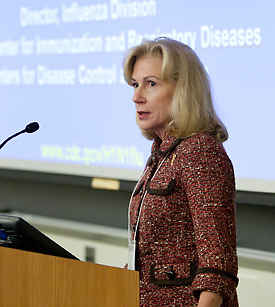
Nancy Cox, director of the Influenza Division, Centers for Disease Control and Prevention, makes a presentation during the symposium “Influenza as a Global Concern: Where Do We Go From Here?” at the School of Public Health. Photo by Scott Soderberg, U-M Photo Services.
Another high profile speaker was Nancy Cox, director of the Influenza Division at the Centers for Disease Control and Prevention, and director of CDC’s World Health Organization Collaborating Center for Surveillance, Epidemiology and Control of Influenza.
Cox delivered news that was both sobering and hopeful. She told the audience in the SPH 1 Auditorium that despite great strides that have been made by researchers like Monto and others, “some very real challenges” remain, namely detecting new potentially pandemic strains early enough, and speeding up vaccine production and delivery. Despite scientists best efforts there is no universal vaccine for the flu, which has always been considered the “holy grail.” This is because the flu is always changing and so it’s a moving target, she said.
Adding to the difficulty in vaccine production is the fact that researchers must make recommendations for the following flu season’s vaccine before that flu season even starts, she said.
There are two big changes underway that Cox says will improve flu response and vaccine production. First scientists are hoping to identify new strains two weeks to one month earlier than they do now, which would close the gap between the time the strain is identified and the actual flu season so researchers would have a better handle on what’s actually happening with the virus, she said. The second change is improving vaccine production enough to knock out 4-8 weeks of production time.
In the pandemic strain of swine flu that emerged in Mexico in February 2009 and then in California in April 2009, there were weeks and weeks of regulatory challenges that delayed getting the vaccine to consumers, Cox said. In the end, only one lab was able to prepare potency testing reagents, which determine how much vaccine goes into a vial. While identification and vaccine production and global collaboration happened fairly quickly because much work had been done to prepare for a pandemic, problems like that must be corrected, she said. The vaccine got to consumers in October.
During his talk Monto recalled being recruited by Michigan in 1965 to research infectious disease in the Tecumseh Study, a communitywide study of disease started by Francis. Three years later Hong Kong flu broke out and Monto vaccinated the majority of children and teens in Tecumseh, eventually showing that “herd immunity” — immunizing a key population — could slow the virus’ spread. But Francis’ real legacy, Monto said, was founding the SPH Department of Epidemiology. Monto’s presentation earned a standing ovation from the audience.
Monto thanked his colleagues for choosing him as the Thomas Francis Jr. Collegiate Professor of Public Health. Monto is only the second person from the SPH Department of Epidemiology to have been given that honor. He said it was particularly special because his colleagues and peers chose him. Previously, a national committee selected the recipient of the professorship.
Cox said journalists constantly ask her what comes next. She always gives the same answer: With the flu, she told the audience, “You can’t predict the future.”