Students gain global leader skills in WDI travel-study course
Twenty-four U-M students recently visited China, India, Honduras and Rwanda to interview hospital employees and other stakeholders in order to gather information about healthcare delivery in those countries.
The students are enrolled in the travel-study course “Provision of Healthcare in Emerging Markets” at the Stephen M. Ross School of Business.
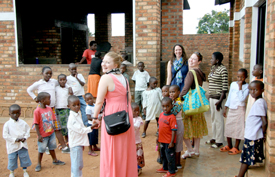
Stephen M. Ross School of Business students Katie O’Hare, Kristin Girouard and Kate Bossart play with children from an orphanage adjacent to Ruli Hospital in Kigali, Rwanda. The students were at the hospital as part of a travel-study course through the Ross School. Photo by Chris Chojnacki.
The William Davidson Institute (WDI) provides financial and administrative support for the travel-study course. It is taught by Paul Clyde, the Andy Andrews Distinguished Adjunct Professor of Business Economics and Public Policy at the Ross School.
The course, which is open to MBA2 and Evening MBA students, is designed to enhance participants’ global leadership capabilities, increase awareness of diverse business issues on the current international landscape and provide on-the-ground experience in a foreign country. The course responds to the increasing need for managers to have an international business perspective that enhances their business and management knowledge.
During the first part of the term, students learned about healthcare in emerging markets through lectures, guest speakers and case discussions. The class discussed different aspects of the business model for a healthcare supplier that was trying to serve the poor in their community in a financially self-sustaining manner. The examples came from Africa, India, China and Latin America, and included guest speakers from Johnson & Johnson and the U-M Medical School.
Students were then divided into small teams and prepared for visits to their selected country. They traveled there in late February and early March.
The five student projects are:
• A team of students worked with Ruli District Hospital in Rwanda on improving the efficiency of the interaction between the hospital and the clinics that refer patients. This project follows on work done last summer as part of a WDI internship. There also will be a WDI intern working with this hospital this coming summer.
• A team of students worked with a mission hospital’s employees in Honduras on their cost structure. Specifically, the team generated actual costs for each unit and identified potential improvements in the operations.
• A student team worked on a start-up clinical support project for diabetes in Hyderabad, India. Building on some work done by a major health care company, the team identified services such as counseling, data and reminders aimed at changing the behavior of diabetic patients. The operation supported the work done by clinicians in the area.
• A team of students worked on Agewell, a new rehabilitation facility in India, designed to support hospitals that have provided clinical services to patients who no longer need the complete care provided by a hospital but do need care that cannot be provided at home. Agewell is founded by Dr. S. Aravind, a Ross School alumnus and a member of the leadership team at Aravind Eye Hospitals.
• A team of students reviewed the operations of a government hospital in China, including gaining an understanding of the relationship between clinical training and clinical services. The final project included a comparison of the operations at the hospital in Kunming, China, and compared it to similar operations in the United States, such as U-M Hospital.
Shannon Saksewski, an Evening MBA student, says her trip to Hyderabad, India, to work on the diabetes project was a great opportunity to potentially make a difference in people’s lives. It also challenged her.
“No amount of reading and discussion can truly prepare someone to understand and enter an unfamiliar business market,” she says. “Speaking with stakeholders, observing processes and participating in the environment are essential components to learning. Thankfully, our hosts were extraordinarily gracious and willing to share their knowledge.”
After the country visits, students will complete the work on their team projects during the second half of the term, which culminates with a final report and presentation.
This is the third consecutive year WDI has supported the Ross School travel-study course. In 2009 students learned about Turkey and traveled to that country as part of the course, “Bridging in a Globalizing World: Turkey and the European Union.” Last winter, Ross students traveled to Moscow and St. Petersburg as part of the course “Marketing in Russia.”