Vietnam in movies and memory
U.S. involvement in what would be known here as The Vietnam War (in Vietnam, “The American War”) began 50 years ago. In 1961, President John Kennedy committed to an American-supported South Vietnamese government under Ngo Dinh Diem. Materiel would be sent along with advisers to help train Army of the Republic of Vietnam (ARVN) soldiers in their fight against communist NVA and Viet Cong (VC) guerrillas. The 12-year war that followed would also be called “the television war,” viewed nightly in American living rooms with news reports detailing brutal skirmishes with VC bands in rice paddies, dense jungles, small hamlets, on Mekong River tributaries. There were daily up-to-date death counts. Understandably, Hollywood filmmakers pretty much waited for the war to wind down before tackling Vietnam.
I went to South Vietnam in October 1962, one year into the war, as an Army Security Agency intercept specialist. My unit, the Third Radio Research Unit (3rd RRU), had been deployed to Saigon in May 1961. As an electronic surveillance team our mission was to intercept VC guerrilla Morse-code and voice transmissions and, using cross-vector direction-finding (DF) strategies, locate VC units and monitor their movements. The intelligence was passed on to American advisers and their ARVN counterparts. When I arrived at the 3rd RRU cantonement area near Tan Son Nhut Airport, it had been named Davis Station in honor of James Davis, a Livingston, Tennessee DF specialist who had been killed on Dec. 22, 1961, by a roadside bomb during a direction-finding mission. Later President Lyndon Johnson proclaimed Davis “the first American soldier killed in the resistance to aggression in Vietnam.” 58,000 more would die before American soldiers withdrew in March 1973.
We 3rd RRU intercept operators and ground-based direction finders rotated on three eight-hour shifts in a windowless “listening post” building, covertly named White Birch. My 3-11 p.m. workday was followed by breakfast at midnight, then an outdoor 16mm movie–the Saigon sky above electric with static. During my year in Saigon, information briefings warned us of possible poison dart and hand grenade attacks. Bombs implanted in bicycle frames frequently exploded near US military locations. Sidewalk cafes disappeared from Saigon streets. Tension in the city grew after a Buddhist bonze (monk) self-immolated by gasoline fire on May 8, 1963, in protest of an increasingly repressive Diem regime.
I escaped harm and returned safely home in October 1963, reuniting with Gail and our six-month-old daughter, Julia. Four months later Wayne Glover, my good buddy and an usher in my wedding, was killed by shrapnel from a bomb placed under our softball bleachers at Davis Station—hard evidence that the VC were broadening their targets.
It would be more than a decade after returning home that I saw an American film I thought had attempted to address the political complexities and personal consequences of the war. When they did start to appear, the Vietnam films came with widely varying narrative forms and thematic intentions. Not surprisingly, given the long and divisive nature of the war, Hollywood films of the 1970s were alternately praised or damned for their dramatic take on Vietnam.
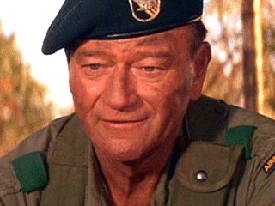
As a veteran I was perplexed by another trend: screenwriters of the 1970s using Vietnam veteran characters as violent, anti-social, even psychopathic antagonists who were “ticking time bombs”: “Welcome Home, Soldier Boys” (1972; plundering and rape); “Roller Coaster” and “Black Sunday” (both 1977; terrorism).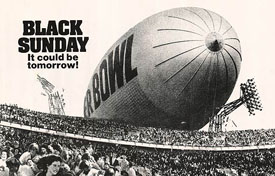
Two ’78 films also explored damage to returned soldiers, one, “Coming Home,” intensely personal in its focus and the other, “The Deer Hunter,” examining Vietnam’s impact on community life.
Hal Ashby’s “Coming Home” told the story of a bitter, guilt-ridden paraplegic veteran and the political and romantic relationship that he develops with the hospital-volunteer wife of a Marine captain (who will also return home from Vietnam scarred by the war). “Coming Home” won high praise for its candid treatment of the sexual possibilities for a disabled, paraplegic soldier. Personally, I found the film a very worthy, early effort to come to grips with some of the painful human consequences, physical and psychological, of Vietnam; it reminded me very much of Fred Zinneman’s “The Men” (1950), a powerful film about a disabled WW-II veteran, also bitter and wheel-chair bound and attempting to adjust to post-war life.
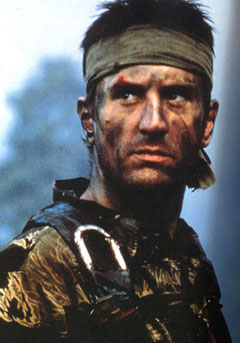
Michael Cimino’s “The Deer Hunter” became the most controversial and perhaps most challenging of the 1970s post-war Hollywood films. Set in a small blue-collar Pennsylvania town, Clairton, the plot takes three steel factory workers and hunting buddies to Vietnam where in a 26-minute sequence they are seen in a search-and-destroy mission which ends with their being taken prisoners and subjected by their VC captors to a terrifying game of Russian roulette. Managing to escape, two of the soldiers return home to Clairton, but the third, Nick, chooses to stay in Saigon after he is lured into a gambling den where men play Russian roulette for big money. Back home, life goes on in Clairton with the usual rituals of everyday life—work, drinking and socializing, deer hunting—playing out under the dark, emotional shadow of Vietnam. The script never touches directly on how the people of Clairton or the two returned soldiers feel about the on-going war. And the filmgoer is left to guess the meaning of the film’s final scene where Nick’s friends, gathered at a bar following his funeral, tentatively sing “God Bless America.” A gesture to convince themselves that Nick’s death in a Saigon game of Russian roulette might have had some larger meaning? Or maybe simply an ironic, cynical lament? We don’t know.
In “The Deer Hunter,” the admixture of naturalism, metaphoric hunting scenes, surreal mountain landscapes—along with the shock device of Russian roulette to symbolize the perceived madness of Vietnam—made the film susceptible to all sorts of critical reaction. Some critics questioned whether Cimino, treating history as recent as Vietnam, could be excused for being so brazenly inventive while ignoring political and moral realities of the war. Peter Arnett, a veteran Vietnam journalist, wrote: “In his artistic selfishness Cimino seems oblivious to the nation’s underlying anxiety about the whole Vietnam experience and its need for explanations.” Arnett and others questioned the film’s vague chronology, which never put the long war into any kind of time perspective. Others, though, defended Cimino’s right to alter and abstract historical events in order to get at deeper artistic truths.
My own reaction to the film was very intense and personal, mainly because it was a first attempt to assay the impact of the war on people who experienced Vietnam and who returned to their families and friends confounded by its meanings. When Lynda (Meryl Streep) first encounters Michael (Robert DeNiro) after his arrival back in Clairton and they struggle to communicate with one another, she picks up a wool sweater she’s knitted for her boyfriend Nick, who remains somewhere in Saigon. She holds it up to DeNiro and says “Too big … well I could fix that though; I mean one thing about wool it’s really a cinch (pause) to fix. Oh, Christ!” She throws her arms around Michael and cries. He replies: “It’s okay, it’s okay, it’s okay.” The complex set of feelings in this scene, expressed so simply and so indirectly, brought tears to my eyes. All of us who came back would struggle to understand a war unlike any other in U.S. history. I accepted Cimino’s treatment of that struggle as a work of art that was imaginative, humanistic and deeply moving.
On the day that “The Deer Hunter” opened, I went to a matinee, and that night I went back with Gail to see it again. Following on the heels of “The Deer Hunter” was Francis Coppola’s “Apocalypse Now” (1979), less symbol-laden than Cimino’s film, perhaps, but structured as an archetypal journey inspired by Joseph Conrad’s classic novel “Heart of Darkness.” Coppola’s protagonist Capt. Benjamin Willard embarks on a riverboat mission from Saigon to Cambodia to kill a once-respected US Army colonel, Kurtz, whose tyrannical command over a colony of defectors has angered his superiors.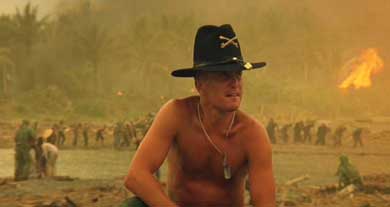
The images of violence and decadence are unforgettable: symphonic displays of US helicopter power, brutal acts against Vietnamese natives, near-pornographic “morale-building” USO entertainment, alcohol, drugs, ever-present news photographers—altogether a very visceral cinematic and narrative take on the absurdities and moral ambiguities of Vietnam.
Roger Ebert called “Apocalypse Now” the best of the Vietnam films, and in his book on great movies named it one of the greatest of all films. Still the film had its detractors. Frank Rich, writing in The New York Times, found the electrifying footage “breathtaking” but the film as a whole “emotionally obtuse and intellectually empty.”
Less potent than Conrad’s original epiphany in “Heart of Darkness” about the horrors that can be inflicted on others by a civilized world, Coppola’s version (with fiery visuals) nevertheless leaves the viewer with knowledge that comes through a passage into the heart of darkness. While I had had none of the experiences like those that unfold on the screen, I was enthralled by Coppola’s grand operatic display of the war and its lunatic underside that could easily have been scripted by Monty Python.

I came away from the film with a sense of the enormous loss incurred in an ill-fated war that was sustained by a political philosophy that advocated winning at any cost. Its impact on me served as my own Conradian-like epiphany. I applauded when it won the Oscar for Best Feature Documentary of 1974, although emcees Bob Hope and Frank Sinatra would read a disclaimer after Davis’ acceptance speech, saying that the film’s message did not necessarily represent the full views of Academy members about the war.
Some years later when I was showing “Hearts and Minds” in my large Art of the Film class, someone tapped me on the shoulder and whispered in my ear: “Don’t ever stop showing this film.” It turned out he too was a Vietnam veteran. The 1970s Hollywood films about Vietnam came under unusually close scrutiny as would heralded works that followed: “Platoon” (1986), “Full Metal Jacket” (1987), “Hamburger Hill” (1987), “Born on the Fourth of July” (1989), “We Were Soldiers” (2002), and dozens more.”Schindler’s List” (1993) and “Saving Private Ryan” (1998) reminded us that there are still great stories to be told about World War II, and the same will surely be true for Vietnam. Maybe a film about the 10,000 heroic women who served in the war, and maybe even one about dedicated soldiers who listened to the VC through headsets in a windowless Saigon building—some of whom also lost their lives in that now distant war.
What are your favorite Vietnam-themed movies? Which ones do you think captured the reality best? Which achieved the most artistically? Share your thoughts in the comments section.