A little spying & kidnapping among friends
On Aug. 2, 1939, in the last weeks before the start of World War Two, Albert Einstein wrote a now-famous letter to President Franklin Roosevelt. He warned that the Germans could use uranium-fueled nuclear fission to produce an “extremely powerful bomb of a new type,” and noted that Germany had halted exports of that element. Einstein did not even mention some of the more alarming news: that Germany had discovered fission the year before, controlled Europe’s only uranium mine and was home to the world’s top theoretical physicist, Nobel laureate Werner Heisenberg. The prospect of a Nazi atomic bomb led FDR to establish what became the Manhattan Project, producing the Hiroshima and Nagasaki weapons.
Einstein’s letter and the weapons it gave birth to are well known. But lost to popular memory is the strange and amazing story of how the United States tried to head off Heisenberg and the Nazis’ efforts. That story started in Ann Arbor, Mich., and moved to France, Switzerland and Germany, drew into its chapters a University of Michigan professor and former Red Sox catcher, and featured friendship, betrayal, and brazen kidnapping and assassination plots.
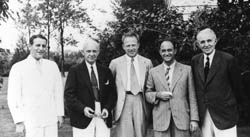
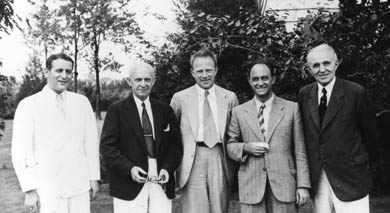
In the summer of ’39, the week before Einstein penned his missive, Heisenberg was in Ann Arbor for the Summer Symposia in Theoretical Physics. The Symposia, hosted on the University of Michigan campus, brought together the brightest minds in European and American physics for a week of instruction and idea-sharing. Lifelong friendships blossomed there, even as the Symposia transformed American physics. Heisenberg was staying at the home of his decades-long friend, U-M physics professor Samuel Goudsmit.
Heisenberg was most famous for his uncertainty principle, stating it is impossible to simultaneously know both the momentum and position of a particle, and had been nominated by Einstein himself for the Nobel prize. Also attending the conference was Italian physicist Enrico Fermi, who would build the world’s first sustaining nuclear chain reaction three years later, necessary for creating plutonium to fuel atom bombs. As for Goudsmit, he was a scientist of international standing, but his interests went beyond physics. One physicist told the New Yorker, “That fellow Goudsmit, he talks physics, but he talks a lot of other things, too.” The professor had even taken a class in criminal detective methods—a skill he would later use against his friend.
In any case, the talk on campus could not be limited to science. As U-M graduate student Max Dresden (PhD Physics ’46) relayed in Physics Today, he was bartending at a party where the gathered math-heads openly wondered how any scientist could function and maintain their integrity in a country like Germany where all standards of decency and humanity had been suspended. Heisenberg responded that he could guide his government to more rational policy, that Germany needed him and it was his obligation to return. At the same party, Italian physicist Edwardo Amaldi looked at Fermi and Heisenberg and whispered to a friend, “See Fermi, see Heisenberg, sitting in a corner. Everyone in this room expects a big war and the two of them will lead fission work on each side, but nobody says.”
Then war came, and Amaldi’s prediction proved correct.
* * *
In late 1942, fellow émigré physicist Hans Bethe told Goudsmit that Heisenberg was going to speak in Switzerland. At Bethe’s request, Goudsmit passed the suggestion that Heisenberg be kidnapped up the chain of command, only to be told, in effect, to shut up. They assumed the scheme had died.The quandary in which the war placed the men’s friendship was made even more stark by the fact that Goudsmit, who was Jewish, appealed to Heisenberg to help his parents avoid deportation to a concentration camp.
Meantime, unbeknownst to the Michigan prof, the idea to grab Heisenberg reached the military head of the Manhattan Project, General Leslie Groves, who agreed something should be done. Soon after, Germans stopped publishing articles on fission in the professional journals. No news was bad news. Groves had little to go on how Germany’s atomic bomb development was progressing, and feared the worst. He asked William “Wild Bill” Donovan to take Heisenberg down. Donovan had created the Office of Strategic Services (OSS), the precursor of the CIA. He jumped at Groves’ idea, calling in one of his best officers from the field, Colonel Carl Eisler, to whom he gave the equivalent of $1.5 million 2011 dollars and free rein to carry out the plan.
Eisler plotted a scheme worthy of Robert Ludlum. He rounded up a dozen soldiers and had them specially trained at an OSS compound in rural Maryland; the plan was to have them fly to Switzerland, stealthily enter Germany, abduct Heisenberg, smuggle him back into Switzerland, fly him over the Mediterranean, then drop him into the water, where he would be recovered by a submarine and sped off to the States. Before Eisler’s dirty dozen could embark, Allen Dulles, the OSS’s Swiss station chief, nixed the project out of concern that the Swiss would renege on their neutrality after they found out the Allies had breached it. But even as the Americans abandoned the plan, their fears heightened that Hitler was close to building a bomb: Nazi propaganda minister Joseph Goebbels started issuing press releases about the “wonder weapon” they were developing, then about their “uranium torpedo.” What could Groves do?
Enter former professional baseball player Moe Berg, a Princeton modern language graduate who’d added a Columbia law degree during his off-seasons. Berg worked his way up from the Toledo Mud Hens to the Boston Red Sox, where it was said he could speak several languages, but couldn’t hit in any of them. In 1942, Berg abruptly quit the Sox and joined the OSS, becoming one of Donovan’s favorites. He went to Italy to find out what the scientists there knew about the German bomb project. Groves made Goudsmit the scientific head of the Alsos Mission, tasked with knowing all things about Heisenberg and the German atomic program—to the point of following Allied troops and apprehending Axis physicists and their documents.
In 1944, Goudsmit relayed Donovan’s order that Berg go to Zurich and listen to Heisenberg at a lecture; if he heard “indisputable evidence that a German bomb was near completion,” he was to kill him—a suicide mission as the physicist was guarded by SS agents and the Swiss police. Berg brushed up on his college German and everything he could find about atomic energy.
Berg entered the Zurich auditorium carrying a shoulder-holstered Beretta pistol and passing himself off as a physics student. He sat in the front row and took copious notes. After the lecture he snaked up to the blackboard, ostensibly to read the scribbled equations, while inching closer to Heisenberg, whom he overheard say, “We are losing the war but how nice it would have been if Germany had won.” Berg stuck with Heisenberg, attending the subsequent dinner and accompanying the physicist back to his hotel, walking just inches away from his target in the dim, wartime-restricted lighting, with the means and opportunity to deprive the Nazis of their biggest-brained physicist. Having heard nothing about fission or a bomb, he passed.
* * *
As the Allies pushed closer to Berlin, they liberated Strasbourg, with the Alsos team close behind. Goudsmit and his cohorts arrived at a lab where they found a pile of documents and personal correspondence between Heisenberg and others. Goudsmit pored over the captured documents, suddenly shouting, “We’ve got it!” The military aide in the room, thinking the professor was talking about the US’s bomb, said, “I know we’ve got it, but do they?” to which Goudsmit replied, “That’s it! They don’t!” In fact, Germany hadn’t even been able to sustain a chain reaction. It was as though the Nazis had set off from Ann Arbor to New York City but had only made it as far as Detroit. A few days before the war ended, Heisenberg was finally apprehended in Bavaria. On his desk was a framed picture of himself with Goudsmit, taken six years earlier in Ann Arbor.
After the war, Heisenberg claimed that Germany hadn’t wanted to build a bomb, issuing a statement that Goudsmit called “a fairy tale” in his 1947 book, Alsos, that they wanted to use atomic energy for peaceful purposes while the Allies used it for destruction. As far as Goudsmit and his cohorts were concerned, it was sour grapes.
Debating the uncertainty of Dr. Heisenberg’s principles continues today, with one side saying he was a sly, brilliant man who malingered to prevent Hitler from getting the bomb, while the other side, echoing Goudsmit, claimed Heisenberg thought a bomb was simply a runaway reactor, a laughable notion to most physicists.
The evidence weighs on Goudsmit’s side, argues Richard Rhodes, the author of The Making of the Atomic Bomb. “The test came after the war,” Rhodes says, “when the German scientists were parked at a bugged country house in England. The news of Hiroshima shocked them. They asked Heisenberg how much uranium was in the bomb and he said tons, meaning he still hadn’t worked out the critical mass. He didn’t know, and I certainly don’t believe he deliberately kept the possibilities secret.”
After the war, Goudsmit and Heisenberg traded some correspondence but were never able to reconcile their versions of history. “I had lost a friend,” Goudsmit said in his 1976 eulogy of Heisenberg, but added that “In the spring of 1973, when he visited Washington, I had a long private discussion with him. I am not sure whether that healed our rift, I just hope that it helped a little.” As for Goudsmit’s parents, despite his appeals to Heisenberg to save them from a concentration camp, he learned after the war that they were murdered in Auschwitz on Feb. 11, 1943.
Correction: An earlier version of this article misidentified dean Edward H. Kraus in the photograph above. We regret the error. This version also corrects some matters of chronology (see comments) and clarifies Goudsmit’s role in the plot.