Animal house
It’s a zoo in here
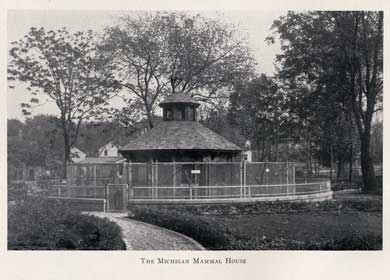
In the summer of 1929, at the corner of Geddes and North University, workmen marked off a space behind the new Exhibit Museum (now the Alexander G. Ruthven Museums Building) and erected a neat brick hexagon with a shingled roof and a cupola.
As soon as a concrete-and-wire fence around the structure was securely in place, zoologists ushered in the first tenants, all Michigan natives — one badger, one red fox, six raccoons, two porcupines, four skunks, and two black bears.
By the following spring an adjoining unit was ready to house nine species of Michigan turtles (including the musk, Blanding, soft shell, box and snapper) and seven species of Michigan snakes, among them the garter, fox, water, hog-nose and blue racer. (The Eastern Massasauga rattler, the state’s only venomous snake, was not invited.)
This was the first and last University of Michigan zoo.
Mapquest
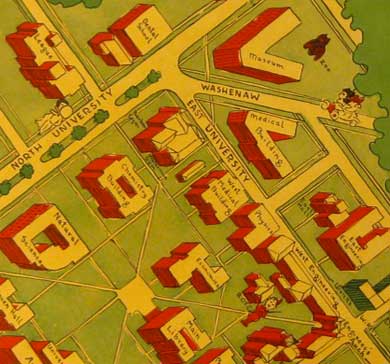
Funds for the zoo came from an anonymous benefactor in Detroit. From the scientific point of view, it was thought to be a good idea to display living Michigan animals to the public. And it was especially nice for the children staying in the South Department of University Hospital (the building now called North Hall, headquarters of ROTC), which was next door, to come over and visit the animals.
The installation went by various official names — the “Animal House” and the “Mammal House” (which obviously didn’t give the reptiles and amphibians their due), but around town it was generally known simply as “the zoo.” It was an immediate and continuing hit.
“While it was impracticable to attempt the recording of attendance,” the director of the Museum of Zoology reported in 1930, “occasional checks for one day showed that hundreds of children and adults were coming … Perhaps the pleasure which the crippled children from the University Hospital have taken before the bear cage alone justifies the effort and expense.”
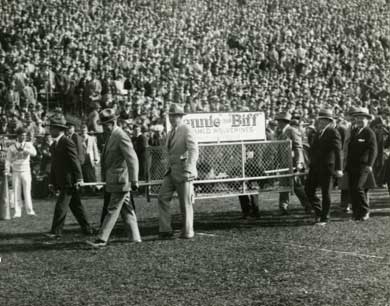
Over time, other animals joined the crew, including coyotes, a pair of opossums, a couple of otters and a wolverine (a species not native to the state) named Biff who had been displayed at Michigan Stadium in a memorably terrible attempt to give U-M a live mascot.
Field tripping
By the standards of modern zookeeping it was apparently not a very nice place for animals to live. The quarters were cramped and artificial, with little to remind the animals of their natural habitats.
But they gave pleasure to human visitors for more than 30 years. In 2006, the Ann Arbor writer Mike Gould published a memoir in The Ann Arbor Observer about visiting the zoo as a baby-boomer kid of the 1950s and ’60s. On Saturday afternoons, he and his brother, walking to campus on Geddes, made a habit of stopping at the zoo on their way to monster-movie matinees at the State or the Michigan. Gould wrote,
“In my later years at Angell Elementary School, a buddy of mine and I got in the habit of visiting the zoo after school. We would go on Fridays because we had learned that was one of the times they fed the animals. We somehow fast-talked our way into the confidences of the grad student who was dispensing the feed, and he allowed us to accompany him on his rounds.
This was pretty cool for a couple of elementary school kids; we got to see the secret sacred back areas of the zoo (and the museum), and got to throw dead mice to the resident predators. I was a budding naturalist at the time, deep into catching frogs and snakes. The museum and its zoo were, for a time, my main places to hang out.”
In 1962 it was decided that the zoo had to go. The space was needed for a $1-million addition to the museum, a research center for the study of animal biosystematics. News of the zoo’s demise was published all over the country, bringing offers of new homes for the remaining animals. Professor Ervin Reimann, director of the museum, accepted an invitation from the little zoo in Grayling, Mich. So the last residents of the University of Michigan zoo — one skunk, five raccoons, two foxes and two black bears — were able to live out their spans on home ground.
Sources and photographs are in the collections of the Bentley Historical Library.
Do you remember the U-M zoo? Tell us your stories in the comments section.