More than 100 gather to celebrate Mars Science Lab landing
As they waited for the scheduled landing of the heaviest and most sophisticated Mars rover, members of the 100-plus crowd at the Space Research Building crossed their fingers, knocked on wood and ate NASA’s good luck snack — peanuts. And it worked.
The Mars Science Laboratory’s unprecedented and precarious landing procedure unfolded as NASA engineers had designed.
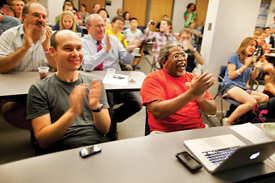
Yuri Popov, left, and Patrick Haggood celebrate the safe landing of the Curiosity Mars Rover during a party at the Space Research Building. Photo by Joseph Xu, College of Engineering.
At the U-M landing party hosted by the Atmospheric, Oceanic and Space Sciences Department (AOSS) and the Space Physics Research Lab (SPRL), attendees erupted in applause and laughter when they got word that the craft arrived safely.
Michigan Engineering scientists, engineers, students and alumni have roles in this historic mission, which will search for evidence that Mars is or ever was capable of supporting microbial life. AOSS professors Sushil Atreya and Nilton Renno are members of the science team. Engineers in the Space Physics Research Lab built the computer controls of the rover’s cornerstone lab, the Sample Analysis at Mars. Teams of Michigan students conducted experiments in 2009 and 2010 to help NASA understand how much dust the rover’s landing process would kick up and how that would affect the rover itself. Read about their experiments and Atreya’s and Renno’s contributions in A Laboratory on Mars, a digital multimedia experience.
When MSL, also known as Curiosity, landed late Aug. 5, Renno emailed his reaction from mission control in Pasadena. It was one word: “Unbelievable!” Meanwhile, at the North Campus party, physics research fellow Brian Nord appropriately raised his arms to signal “touchdown!”
“The craft is three or four times heavier than other rovers and the technical difficulties were incredible,” Nord said.
NASA landed previous rovers on Mars with parachutes and airbags, but because MSL is larger, that strategy wouldn’t work. Instead, the craft was initially slowed with a supersonic parachute. Then a rocket-powered platform took over, braking further as the rover closed in on the surface. In the final stage, the hovering platform lowered the rover to the ground on ropes similar to a sky crane. When the rover’s wheels came to rest on the Martian soil, the platform cut the cords and blasted away to crash at a safe distance.
“Besides the Apollo mission, this is the most complicated thing we’ve done in space,” said Michigan Engineering Associate Dean for Research and Graduate Education Alec Gallimore, who also is a professor of aerospace engineering and attended the landing party. “I’ve always dreamed about sending people to Mars, and, frankly, this gets us one step closer.”
Indeed, space scientists and engineers are relieved and joyful that Curiosity can begin gathering data. AOSS doctoral student Shannon Curry studies the mystery of where Mars’ water went.
“We’re all really deeply invested in these kinds of missions, so this is exciting,” Curry said. “The fact that they used a sky crane made it seem fictional. This has been a technologically defining moment for us going forward. A lot of technology and innovation went into this. If this is the tip of the iceberg for the Mars Exploration Program, I can’t wait for the next 20 years.”