Grounds crews draw praise after winter storm
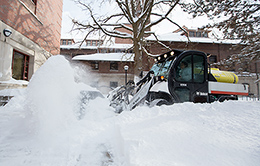
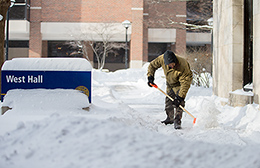
They shoveled, scraped, salted, spread sand and even slept overnight at the Grounds Services facility to make the campus employee- and visitor-friendly in the wake of the post-New Year’s Polar Vortex storm.
The work didn’t go unnoticed. Plant Building and Grounds Services staff has drawn praise from all around campus for helping to keep the university open after 19.8 inches of snow Jan. 1-6 and sub-zero cold.
“Rob, I have tremendous admiration for your staff and the work that you do. What you’ve achieved under difficult conditions is nothing less than stupendous! Thank you for continuing to work on the issues knowing that students are returning,” wrote Vicky Hueter, director of Housing Facilities, to Robert Doletzky, Plant Building and Grounds Services senior supervisor.
John Lawter, associate director of Plant Building and Grounds Services, similarly praised the commitment of staff to keeping the university running during and after the storm. A dozen employees stayed overnight Jan. 5-6, sleeping on air mattresses at the Building Services facility on 2550 Draper Drive. Many others temporarily stayed in town with friends and family.
“They spent the night, and would catch some sleep, working 12 to 16 hours on and eight off to do street clearing where our buses run to help the city out,” Lawter said. This was in addition to clearing student services routes that disabled people depend on, and areas serving the Medical Campus.
Tim Archer, a facility manager with Hatcher Library, wrote, “I just wanted to send you a note to tell you how great campus looked yesterday. I could tell you guys put in a great deal of time and energy to get the campus as cleared as it was. Thanks to you and your crews for a job well done.”
Doletzky, in his 20th year with U-M, said it was among the three worst storms he’s experienced over the period. “Given the rare weather circumstances, achieving passable walks and entryways throughout campus by mid-morning was a major challenge that our crews accomplished. We are very proud of their efforts and commitment.”
During storms, there are 50 full-time staff members to operate snow plows and sidewalk-clearing equipment. Also, 35 temporary staff, mainly students, helped with hand shoveling where needed.
The post-New Year’s storm did demonstrate that it would be useful to bring in more staff to shovel snow when temperatures plunge below zero.
“We will need a better way of recruiting and equipping additional Plant Operations employees for the hand shoveling work. When it gets that cold five-15 minutes exposure can cause frostbite and those crews are the most vulnerable,” Lawter said.
Gary Dootz, administrative coordinator, Kresge Hearing Research Institute, praised workers. “I would like to complement the entire grounds crew on their effort in cleaning the sidewalks and streets during this snow storm and extreme low temperatures. As I rode the bus today the entire campus looked clear. Thank you to your crew for all that you did.”
Doletzky also complimented the grounds crew and mechanics. “Many of you not only worked Sunday (Jan. 5) during the storm, but came in on Saturday prior to the storm to repair broken equipment and get everything ready for the operators. Without you, we would be in big trouble.”
Blowing and drifting snow that blocked some building entrances was a problem, along with frozen fire-suppression lines that burst and caused flooding in some buildings. The sub-zero cold also posed a problem at intersections and sidewalks, as salt is not effective below 10 degrees. The crews switched over to using sand for traction, until the bitter cold temperatures warmed enough so that salt would work.
Lawter said stocks of salt and sand are being replenished by the university’s supplier. More than 2,000 gallons of diesel fuel were used by snow-clearing equipment during the height of the storm.
Moving forward, “I hope we can limit the number of those type of weather events, but when they come, we’re always ready,” Doletzky said.