Under the radar
Editor’s Note: Anne Curzan’s video series is on hiatus, so this month we have a text-only column. Video fans, do not fret, however! View Curzan’s recent Tedx talk, “What makes a word ‘real?'”
Change it up
There are changes in the English language that people notice: the noun impactbecoming a verb; the word literallybeing used to mean “figuratively”; new words such as guesstimate, LOL, and incentivize;and the list goes on.
These language changes steal the linguistic limelight, and speakers can fail to notice the language is changing in other ways too. As a result, these quieter changes often infiltrate our spoken and written language without the barrage of criticism that can accompany changes squarely on the radar.
Let’s look at just a few changes you may not have noticed (out of the hundreds we could choose from).
Must we?
Did you realize the auxiliary verb mustis on the decline? It may already be on your radar that the use of the auxiliary verb shallis waning. We still use the expression “shall we?” but we don’t tend to use shallvery often to talk about the future (“I shall go running tomorrow”) or about obligation (“Any interested party shall file an application”). Less noticed is that we are using mustless and less to talk about obligation, as in “I must run errands this afternoon.” You can see the decline of these two words in this chart from a search of Google Books with the Ngram Viewer:
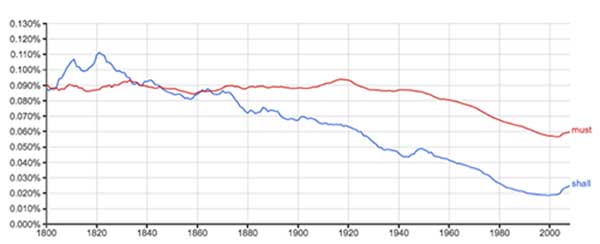
Instead of using mustwe often opt for have to,as in “I have to run errands this afternoon.” Must,at least to me, feels very strong to talk about something as mundane as errands; have toprovides a more neutral expression of obligation, and it is on the rise in British and American usage. I’ll also note here that if we didn’t have such a standardized spelling system in place, this new auxiliary would be spelled hafta. (The use of mustremains quite healthy when expressing the possibility or probability that something is true — e.g., “Her shoes are wet; it must be raining.”)
Re-noun?
A construction that is quietly trending in English is the use of noun modifiers in front of other nouns — that is, constructions in which a noun appears before another noun, and in some cases can express possession without the possessive -s. Consider these relatively common expressions: book cover, reader reaction, student experience/achievement/grades, instructor manual — or something less common and longer, such as the department website logo color.
Very few people seem to have noticed the dramatic rise in the use of the word frustratingas an adjective since the 1930s. (The word derives from the participle of the verb frustrate).The adverb frustratinglydoes not have a citation until 1955 in the Oxford English Dictionary.No one seems to mind this new adverb.
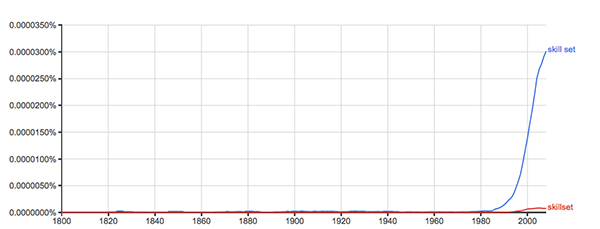
And are any of you feeling concerned about the proliferation of the compound skill set?An astute language observer emailed me about it recently, asking if the word was new because he was noticing it everywhere. Skill setis not completely new; in a preliminary search of Google Books I have found examples back into the 1970s. But the word is suddenly popular, as this chart from the Google Books Ngram Viewer shows:
What an efficient way to talk about sets of skills — and one that seems to have snuck into the language without many of us noticing. And, in case you haven’t noticed, the form snuck(which I snuck into the previous sentence) is sneaking its way into American English as the past tense and past participle of the verb sneak.Very sneaky, as are a vast number of changes underway in the language right in front of our eyes and ears.