Pacifist with a paintbrush
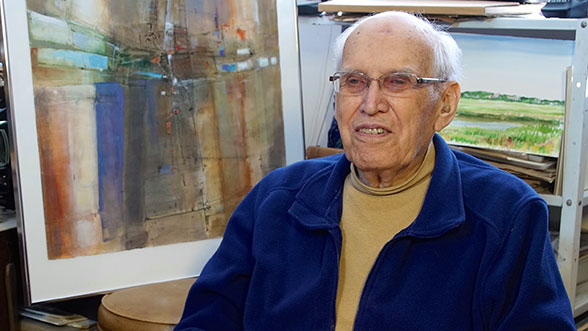
“I’ve had that war with me my whole life. It’s on my mind always.” — William Lewis
World War I, the war that ushered in the modern era, spanned just four years. But for almost a century it has captivated the imagination of William Lewis, an emeritus professor and associate dean of the Stamps School of Art & Design.
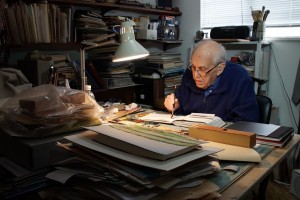
Now the 96-year-old artist has a rare solo exhibition at Work Gallery, called “Fragments of the Great War 1914-18.”
Lewis was born at the end of the war. As a young child, he pored over the images of its devastation and triumphs in the books and magazines that filled his grandparent’s attic. He witnessed the war’s psychological aftermath firsthand in the behavior of his four uncles and father who had fought in the conflict.
For Lewis, “I was a child brought up with some of these men, their books, their photos, their nightmares. Since then, these images have been with me. Fascination? Yes. Revulsion? That, too. It all left a kind of inheritance, one I’ve tried to translate into paintings using various media.”
Some of the images in “Fragments of the Great War” have the violent abstract beauty of J.M. Turner landscapes. Some contain actual letters and medals from the war itself. All are intensely personal, yet mindful of their role as historical messengers. Each piece carries a caption that locates the viewer to a particular time and place.
“Photographs have been an extraordinarily powerful resource — I draw from them, adapt elements of them, and in truth, try to see beyond the image on the print or reproduction,” says Lewis. “Needless to say, there has been much reading to accompany the images all these years.”
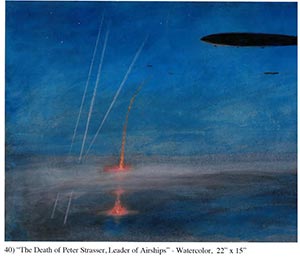
Beyond illuminating a particular event or battle, the works also foreground the role of the war in altering our modern world.
“The development of new technologies and machines for war, as an aspect of the industrial revolution, radically altered western civilization,” says Lewis, a veteran of World War II. “But ultimately, I think of the wars as a failure by governing societies to meet their potential. The wars are a failed attempt to gain a prize, usually through greed rather than intelligent use of knowledge.”
Lewis’ work stands in testimony, not to those profiteers, but to the family men, like his own relatives, whose lives were forever altered by their experiences of the “war to end all wars.”
The exhibit is on display at Ann Arbor’s Work Gallery, 306 State St., through Feb. 21, 2015.
Lewis received his U-M degree in architecture in 1948. He joined the U-M faculty in 1957, and was appointed professor of art in 1964. He has held the position of associate dean in both architecture and art. Today, his son, Clayton Lewis, is the curator of graphic materials at U-M’s William L. Clements Library.