Sustainability crucial for generations to come, coordinator says
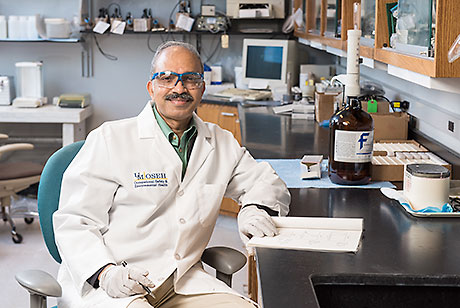
For Sudhakar Reddy, volunteering is more than a passion: it’s central to his philosophy of sustainability.
“In Indian philosophy, after age 50, it’s important to be giving back to your family, friends and society, and those who are deserving. And how do you give back to them? You have to get involved. This is a sustainable approach.”
In 2006, Reddy helped found the Indo-American Eye Care Organization, a non-profit that since its inception has screened more than 70,000 people in India for eye problems. He makes regular trips back to India to facilitate the non-profit’s screenings and educational projects.
“If you have a kid sitting in the classroom and they can’t see the blackboard, they lose interest. So that’s where we come in, with our screenings. A few dollars can change that kid’s life.”
Reddy says that raising awareness is central to the non-profit’s mission. “For a young kid, they may feel that eyeglasses look very strange, and they are very shy about it. So we have to change the culture.”
Reddy, who works as sustainability coordinator at the Office of Campus Sustainability, also is passionate about sustainability in an environmental sense.
“When I go into the lab, there’s so much equipment all plugged in, and not used for days — sometimes months,” he says.
With thousands of such units on the U-M campus, unplugging when they’re not in use can save a few dollars per unit, which can add up to significant savings on an institutional level. This not only makes good economic sense, but also reduces energy use and greenhouse gas emissions, contributing to U-M’s goal to reduce greenhouse gas emissions by 25 percent by the year 2025.
“Sustainability is mostly very intuitive. These things make sense,” Reddy says.
Reddy closely monitors waste and sustainability practices across campus, and administers the “Sustainability Lab Certification Program,” an initiative to promote sustainable practices such as green chemistry, and waste and energy reduction in campus labs.
Reddy has been working with the Office of Campus Sustainability since its establishment in 2009. Before that, he managed a chemical lab at U-M for 15 years. Reddy was born and educated in India, and moved to the United States as a NASA postdoctoral fellow.
“Chemistry was my bread and butter,” he says. And now, his work has come full circle. “With my sustainability work, I’m still doing chemistry.”
The weekly Spotlight features faculty and staff members at the university. To nominate a candidate, email the Record staff at urecord@umich.edu.
In 2012, Reddy was honored for his work in chemistry and sustainability. He was appointed to the governor’s “Green Chemistry Roundtable,” advocating green chemistry with other professionals across Michigan. He also received the Michigan Green Chemistry Governor’s Award in 2013 and I2SL (International Institute for Sustainable Labs) Go Beyond award in 2014 for his work.
In 2011, Reddy helped bring the roundtable’s annual conference to North Campus, hosting Gov. Rick Snyder and President Mary Sue Coleman as honored guests. He is currently planning the conference’s return to North Campus in November 2015.
Reddy says sustainability has taken off as a popular buzzword in recent years, but in practice we should be thinking about sustainability more as a culture.
In other words, sustainability means “choosing to do something more sustainable to pass on to future generations. This is why it’s so important to train our students in sustainability now, so that when they establish the labs of tomorrow, they’ll know what to do.”