The ’50s in your ear
Ahead of its time
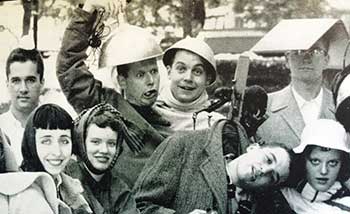
In the mid-1950s, the staff of U-M’s student yearbook, the Michiganensian, tried a gimmick that was, for that era, a spiffy innovation. They recorded events of the year not just in words and images but also in sound.
The results are preserved in two long-play records at the Bentley Historical Library — one for 1953-54, the other for 1956-57 — titled “Michiganensian Presents: Memories in Sound.” Possibly there were others, but those two are all the Bentley has.
Sixty years later, the recordings sound like pure Establishment schmaltz, a version of life at U-M that even a grandmother could endorse. But for anyone who passed through Michigan in the ’50s, the recordings will touch a few mystic chords of nostalgia — guaranteed.
In the video above, we’ve combined some of the most notable sound samples with campus images of the 1950s.
Landmark events
The recording starts with the somber tolling of the Baird Carillon in Burton Memorial Tower, followed by the equally somber tones of Harlan Hatcher, president of U-M from 1951-68. The shot of Hatcher in academic robes comes from his 1951 inauguration. He is shaking hands with U-M Regent Roscoe Bonisteel.
A truly historic image from the era is dated April 12, 1955. Hatcher, Francis Thomas, Jonas Salk, and Basil O’Connor had gathered to announce that U-M’s testing of Salk’s polio vaccine proved “it is safe, effective, and potent.” Thomas was head of the epidemiology department in the School of Public Health at the time; O’Connor was president of the National Foundation for Infantile Paralysis, which evolved into the March of Dimes.
With “the peacetime use of atomic energy” all the rage, U-M also was a national leader in postwar nuclear engineering during Hatcher’s tenure. (The writers of the 1953-54 Michigan Union Opera even borrowed from the headlines with a number called “Up and Atom.”)
The 1953-54 LP also pays tribute to the 1953 Wolverines under Coach Bennie Oosterbaan. This team is little remembered today; they went 3-3 in Big Ten play to tie for fifth place. But on November 21, playing at home, they beat Ohio State, 20-0. The record producers included audio from the day’s final touchdown, a short run by halfback Dan Cline on a handoff from quarterback Lou Baldacci — followed by “The Victors.”
Late ’50s fun
On the later recording, listeners get a sense of the basketball season in spring ’57, as the announcer places center Pete Tillotson (who apparently was in a slump at the time) at the free-throw line. The crowd actually “hushes.” When did you last hear a basketball crowd hush for a free throw? That was just good manners during the era, as in this game against Indiana.
Of course no audio document would be complete without a contribution by the Michigan Men’s Glee Club. Listen as Philip Duey, professor of music and the glee club director from 1947-69, leads the boys in a hurry-up version of “I Want to Go Back to Michigan.”
More music
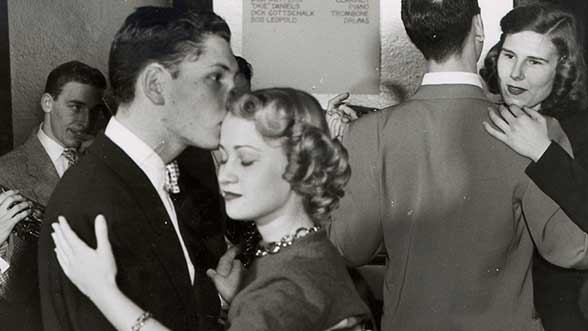
Just before the rock ‘n’ roll revolution, Michigan dances still attracted the likes of jazz giant Duke Ellington, whose band played the annual J-Hop with Buddy Morrow’s band in 1957. Dancing was a popular pastime in the ’50s, whether at formal affairs like J-Hop or at casual weekend get-togethers in off-campus halls like the Little Club.
Finally, the Michiganensian’s 1956-57 record fades out with the lyrics of a ballad sung at Michigan since the 1870s. Does this sound familiar? “Michigan, we bring thee these: Hearts of ours, and songs of dawning, goddess of the inland seas.”
The video above was produced by Levi Stroud at Michigan News. Images are courtesy of U-M’s Bentley Historical Library, The Michigan Daily, the University Musical Society, and the Michiganensian yearbooks of 1953, 1954, 1956, and 1957. The J-Hop group photo is courtesy of the Sigma Alumni Association of Lambda Chi Alpha. Audio comes from “Michiganensian Presents: Memories in Sound” (1953-54 and 1956-57), courtesy of U-M’s Bentley Historical Library.