The writers' workshop
One is the loneliest number

The life of the professional author is in central ways a lonely one. I don’t mean to cry crocodile tears on a writer’s account, but the work is done in isolation and almost always without an immediate response. Even if a book gets published, it’s likely to take a good while to appear, and by then the writer — if he or she be scrupulous — is engaged with yet another project. There’s no reaction — whether great praise, great dispraise, or (the most likely) benign neglect — that’s anything other than a gravitational side-drag upon the forward motion of the work at hand. To receive a fan letter or a good review is, of course, a welcome thing but almost always irrelevant to the labor of writing itself.
I mean by this that the point and counterpoint that we consider the norm of human interaction is denied the writer. Communication — as good a term as any for what most artists hope to achieve — is a two-way street. Every act of artistic creation is a dialogue, not monologue; each stimulus provokes, or should, a measurable response. An actor or musician will know, almost on the instant, how the audience feels about her or his performance; an athlete knows at the close of a race or game if it’s been won or lost. Yet a writer requires months and maybe years to earn a positive or negative reaction.
And when the reaction does come, it is rarely germane to the craft. The fan who writes a letter will tell you her Aunt Sadie also went to Machu Pichu once; the critic who complains that your stallion is a gelding will be riding his own hobby-horse; the friend who feels compelled to praise your work will have read it quickly, more out of duty than desire. The dedicated reader is a rara avis indeed…
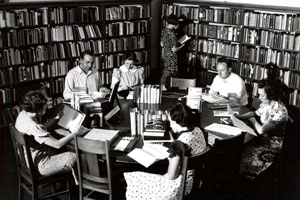
In a writing workshop, however, this is not the case. When your work comes under scrutiny, you have witnesses who pay close attention and offer up their thoughts. If only because these fellow participants hope to have, when their turn comes, an attentive reading, they will provide one for you, and hard on the heels of creation.
There’s risk attached to this; most original work takes time to gestate fully, and too many contradictory suggestions may create confusion. Some young writers cringe at critiques and prefer to work in privacy. But it’s almost always useful to be told, while engaged in a project, that this is a path to follow and that a line to cut. If you trust your colleagues (and no workshop can succeed without trust) you leave the session with advice that helps you power forward through the draft. This too is a comparative rarity and will not be repeated in the “professional” years.
We all are selective as readers. We know on the instant, paging through a magazine or newspaper if we want to read an article; we know rapidly, when standing in a bookstore or in front of a library shelf, which book to pick up and take home. There’s no contractual expectation, further, that we must finish what we start; as an editor once told me, when talking of the “slush pile,” “I’m always looking for a chance to stop reading.” The first line or first page or first chapter may be sufficient to tell us we don’t need to continue; quite often the experience of reading is a distracted one, and attention wanders until we close the book.But in a writing workshop that’s not how we behave. Again, if only because all students hope their own work will be carefully attended to, they’re honor-bound to scrutinize the work of others at the table. You read all the way to the end of the story or chapter under discussion, even if it disappoints you, and formulate a response. In a culture where the skills of composition are largely taken for granted or devalued, it’s inspiriting to share a space with those who share your belief in the craft and practice it together. That “lonely life” described above gets put on hold.
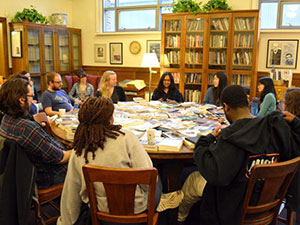
My idea of a successful workshop — with, say, a dozen students — is one that produces 12 separate styles, 12 voices achieved and distinct. My idea of a failed class is one where each participant comes out repeating the instructor and imitating as closely as possible the style of the head of the table. It’s the task of all teachers of writing to recognize and help enable an aspirant author’s particular gift — her subject, his ear for dialogue, her diction, his themes. What we hope to hone is each individual’s talent and word-choice: what sets them apart from the rest.
To have a close-knit group of colleagues give careful consideration to your work is a luxury few practitioners have, and one they mourn when it’s gone. (It’s part of the reason “writers’ groups” or “readers’ circles” have proliferated lately; many graduates of MFA programs try to keep their old circle unbroken and to stay in touch.) But it’s why I’m always moved, at semester’s start, by the gathering of apprentice authors at a table. Once they were total strangers; soon, they’ll know each other well. Their work once had only one reader; soon it will be shared. Earlier they labored in “silence, exile, and cunning” (James Joyce’s great phrase for the writer’s condition); soon, they will have colleagues in the craft.
I don’t mean to overstate this, but there’s something quasi-sacred about the chance to devote oneself, wholly and uninterruptedly, to the creation of a work of art. And to do so in a company whose values are the same. I revere this opportunity and try to impart that sense of reverence to others in the room. More often than not, we agree.