Negotiating Angell
Pretty persuasion
In late summer 1869, three University of Michigan Regents boarded a train and headed east to Burlington, Vt. The men had been assigned to a special committee whose singular purpose was to persuade James B. Angell, then-president of the University of Vermont, to move to Michigan and become U-M’s president.
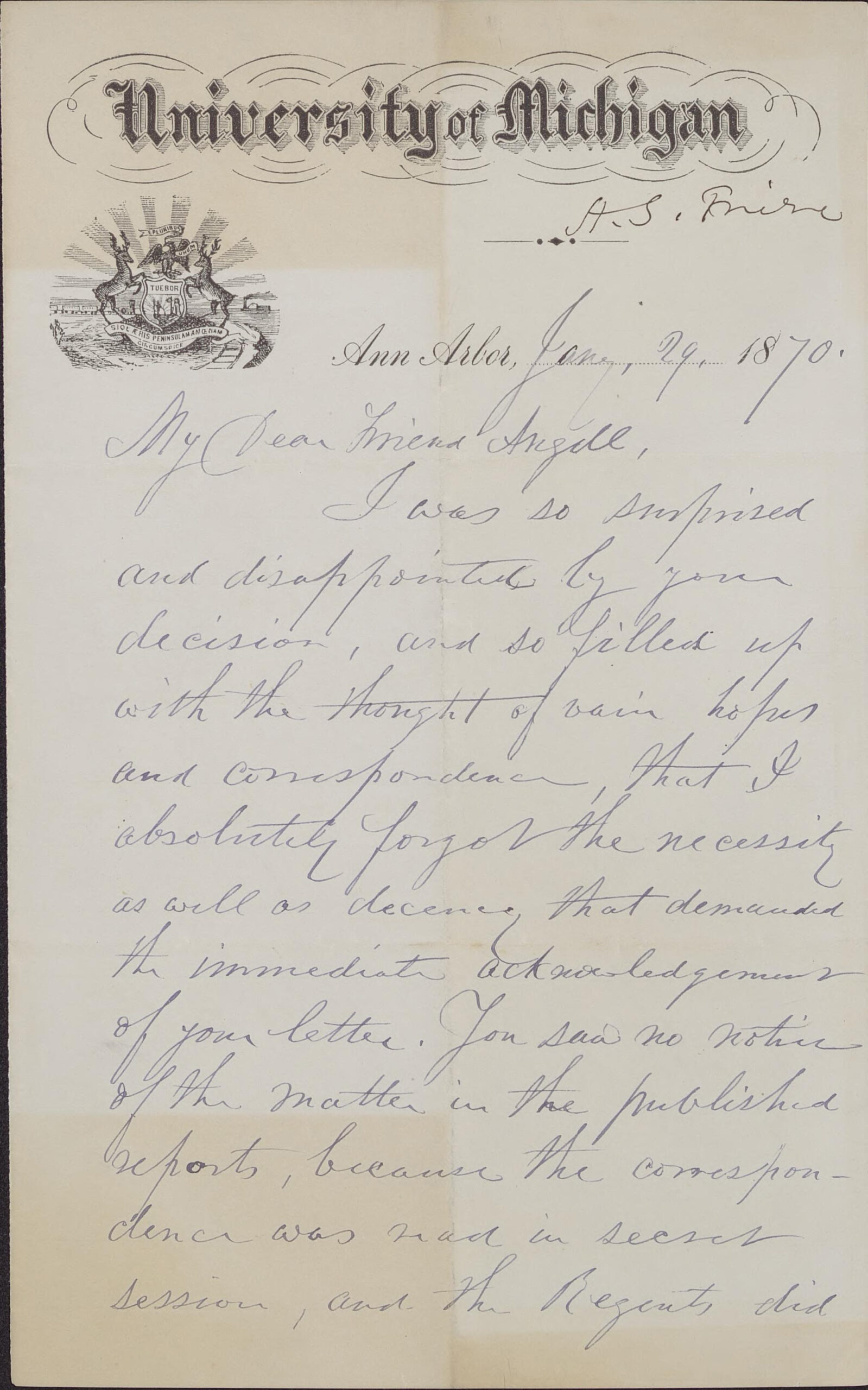
It was a negotiation that would take two years, three offers, a mindboggling number of letters, telegrams, queries, and concessions — not to mention the complete renovation of the president’s house. Papers archived at the Bentley Historical Library show how both sides successfully negotiated a complex employment deal at every turn.
Hot and cold
By the fall of 1869, Angell’s recruitment looked promising. Regent Edward Carey Walker already had written to Angell about a proposed annual salary ($3,500), and about the president’s house, which he described as “comfortable” and having a “large garden for fruit and vegetables.”
On Sept. 16, 1869, Angell wrote to Walker of his imminent arrival in Ann Arbor for a visit “in order to meet the Regents and gentlemen of the faculty. It is my present intention to leave here on Monday morning. I shall hope to reach Detroit Tuesday evening.”
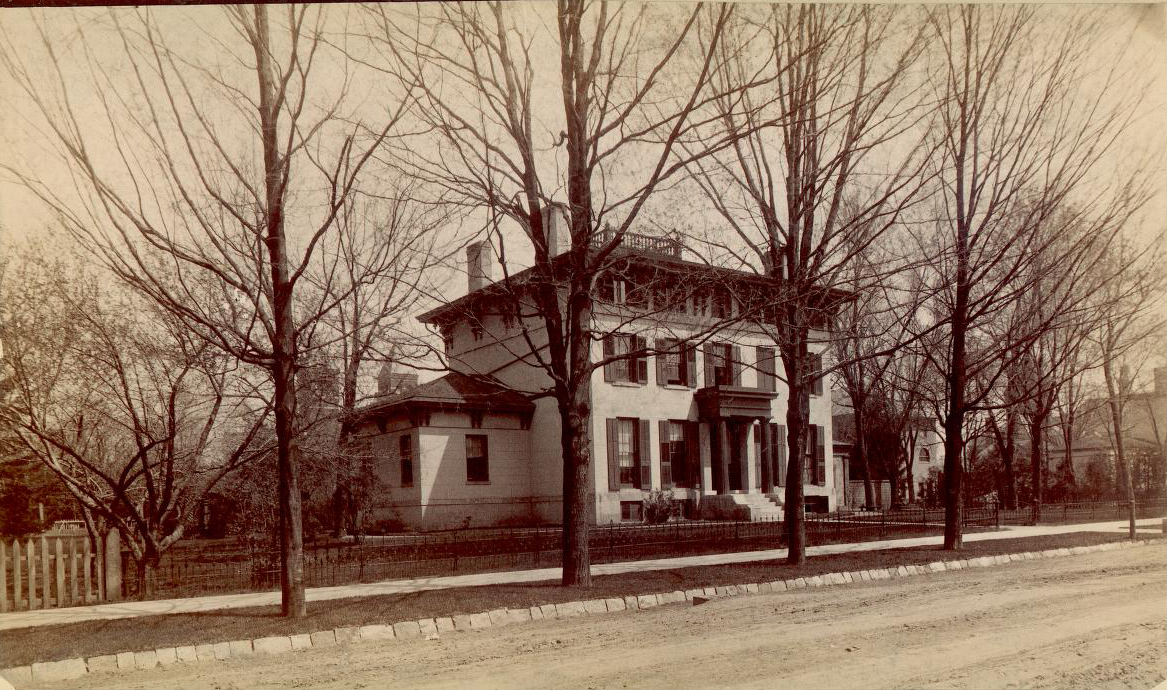
Angell arrived with Sarah Caswell Angell, his wife. The president’s house must have made an impression on them both because, after returning to Vermont, Angell inquired further about it. In spite of its large garden, he’d found the residence lacking:
“[The house] seems to me to need absolutely paper and paint, bathroom with hot and cold water, water closet, and some arrangement for a dining room closet, and a furnace,” Angell wrote. “My family has never lived in a house without the above-named conveniences, which the house lacks, and composed as it is of persons from very advanced age to infancy, I should not feel willing to ask them to dispense with them, unless there were an absolute necessity.”
Whatever the response was, it wasn’t enough. By Oct. 14, 1869, Angell had written to Walker to decline the presidency: “I am painfully aware that I am declining a post of greater responsibility and honor than in all possibility can ever be presented to me again. It is from no failure to appreciate the worth of the position at Ann Arbor. It is from no lack of competence in the future of the University that I do not take the chair that is offered to me. It is simply because I cannot at this time see my way clear to a resolution of my official connection here.”
In other words, Angell didn’t see how he could leave the University of Vermont in its present state. He worried that “some harm could come to the college from my departure,” and that one day he would “look back in ultimate deep sorrow and possibly self-reproach.”
Slim pickings
Angell’s decision was a blow to Michigan not just because the University lost a great candidate, but because there were so few candidates to choose from, writ large, at that time.
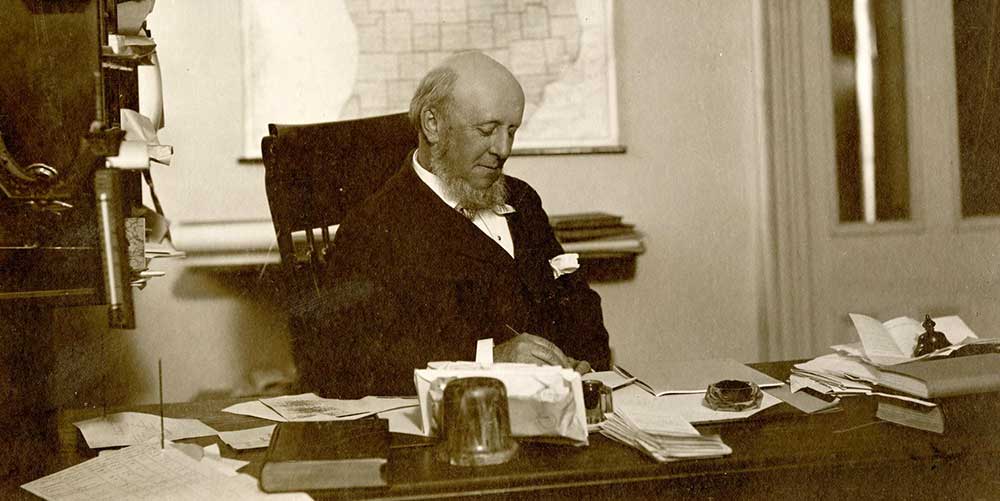
Erastmus Haven, who previously held the position of president (1863-69), had left Michigan to become president of Northwestern University in nearby Evanston, Ill. Henry Frieze, a Latin professor, had been happy to serve as U-M’s acting president, but had no wish to fulfill the position permanently.
The most esteemed colleges — and presidents — were located in and around New England, and it would be difficult to persuade any of them to come as far west as Michigan. Angell spells it out in a letter to Walker in 1869: “For $5,000 and a house, you may have almost your choice among [candidates]. For less than that, you will hardly draw a New England man of eminent academic position in truth.”
But the Regents didn’t want any New England man — they wanted Angell.
So weeks later, when Angell hinted that things might be turning around at Vermont and he could, in fact, give Michigan more consideration, the Regents were only too delighted. “Pray, do not think me fickle but circumstances have so changed . . . that I feel justified in writing in this, though I cannot say certainly what I may have to do,” Angell wrote to Walker. The negotiations were open once more.
But Angell still had concerns. He wrote to Walker personally to give him specific points about his hesitations:
- The house. “I am [currently] living in an elegant new house, made after my plans, and furnished with all modern conveniences,” he pointed out. He had members of his family who were sick, and he didn’t want to move them to the more rustic president’s house in Michigan.
- The University of Vermont. He still felt like he couldn’t leave without “grieving or offending some, who have been the best friends of me and the college.”
- The salary. $3,500 just wasn’t enough. For just a professorship, Angell wrote that Harvard was “offering $4,000 to my friends, and Yale and Brown must follow hard after to keep these choice men.” Michigan needed to up the ante.
By December 1869, the negotiations were a bust. Angell wrote formally to the Regents to decline the position yet again. “I find myself, honored, unable to accept your invitation on the terms you have named,” he wrote.
All in Due Time
The presidency remained vacant for months, to the increasing concern of some faculty. Benjamin Cocker, a Methodist minister and U-M professor of philosophy, wrote to Walker in September 1870 that “the election of a president cannot safely be delayed much longer,” and that hiring someone who is not a clergyman — i.e. someone like Angell — would be “a great calamity.” He continued: “I am convinced the sooner a president (evangelical and Christian) so declared, the better.”
But the Regents remained keen on their ideal candidate, and Frieze still thought Angell could be convinced to come to Michigan. By January 1871, the Regents had again “opened up a correspondence” with him, according to their documented minutes. The letters at this time indicate U-M had increased the salary to $4,000 and agreed to remodel the president’s house.
Angell continued to hedge. He wrote to Walker that “the salary must be satisfactory,” and, at $4,000, he said he wanted “a few days to reflect on the matter.”
The days passed, and on Feb. 1, he once again declined the position. “. . . I am reluctantly constrained to say that I really cannot afford to undertake the work in Ann Arbor at the salary named. I am sorry that my circumstances in life compel me to give more consideration the question of salary than I could wish. But so it is.”
The Regents moved quickly. They convened and unanimously agreed upon the $4,500 salary. Walker sent a telegram to Angell, which arrived on Feb. 8:
YOU WERE UNANIMOUSLY ELECTED PRESIDENT SALARY FORTY FIVE HUNDRED AND HOUSE EXPENSE OF REMOVAL
Angell finally accepted.
Renovations would begin in earnest to the president’s house in March of 1871, and Angell would deliver the commencement address that June to the graduating class.
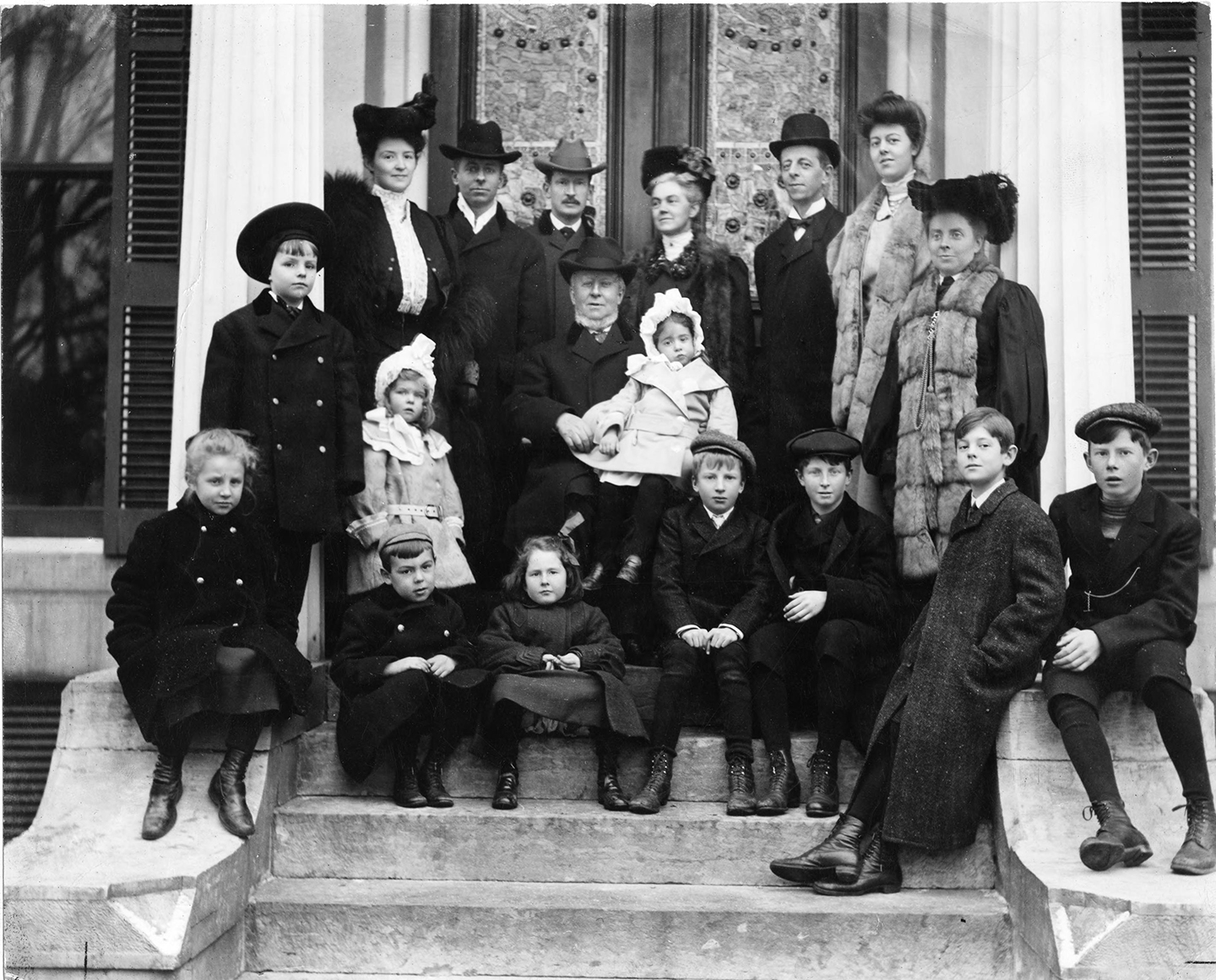
By September 1871, Angell would be fully installed in Ann Arbor as U-M’s president, and he would serve the University for 38 years until his retirement in 1909. He would live in the house he’d diligently negotiated to renovate until his death in 1916.
(Top image courtesy of U-M’s Bentley Historical Library.)