No one dies alone
This is personal
Bryana Bayly knew only a few facts about the patient, details picked up in conversation on the first day when he was still able to talk, at least a little.
He rooted for Michigan State and joked about being stuck in Ann Arbor. He liked the Beatles so she played a few songs for him on her phone. Pointing to pictures, he told her the names of his kids, grandchildren, and his dog.
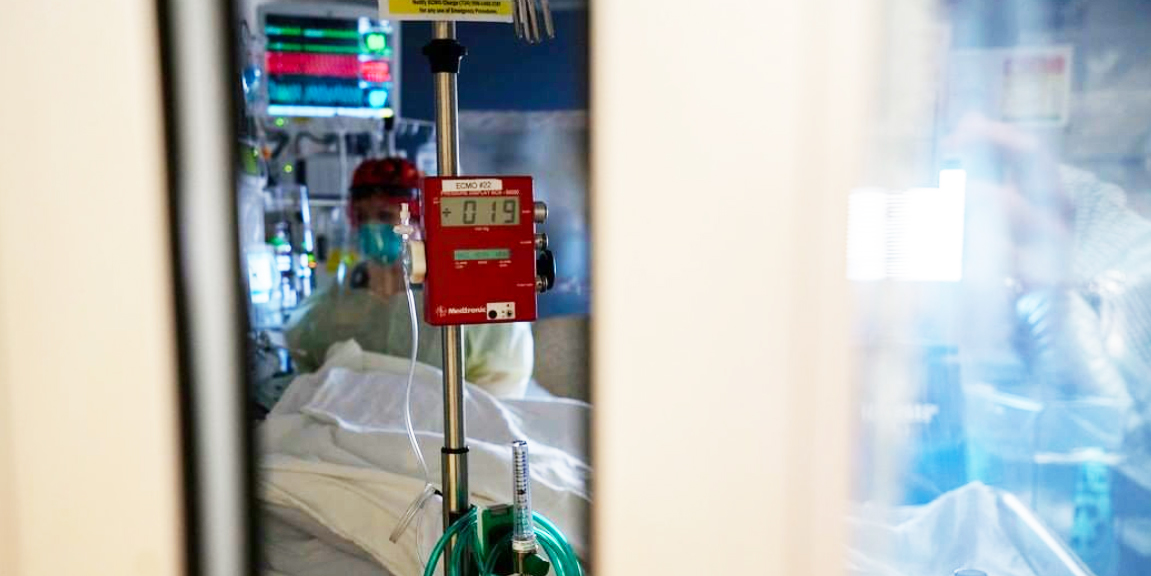
Bayly understood the profound significance of that connection: The man was dying of cancer and – if not for her and other student volunteers – he might be alone.
“In med school, we are taught how to run resuscitation codes, but we aren’t really taught how to manage our emotions,” she says. “Experiences like this allow you see to see the emotional side of end-of-life care, which sometimes gets lost in the medical management.”
A fourth-year U-M medical school student, Bayly is part of team of students who volunteered to maintain the No One Dies Alone (NODA) bedside program after it was nearly curtailed by the coronavirus pandemic. While stories of COVID patients forced into isolation during their final moments captivated the media, the problem extended to non-COVID patients too as the pandemic required hospitals to install new protocols and limit outside visitors.
U-M Social Work Program Manager Amanda Schoettinger launched NODA at Michigan Medicine in 2017 with trained community volunteers, but when the first coronavirus patients began arriving in March, the hospital closed its doors to visitors and volunteers alike. NODA’s future was in doubt, even as the need increased.
“It’s not just the institutional limitations that keep visitors from their loved ones,” says Schoettinger, LMSW. “Some people aren’t working and might not have the money to travel. Some are sick themselves. A lot of people are afraid to come to the hospital, which is understandable. This issue isn’t limited to the COVID wards.”
‘An essential part of humanity’
Schoettinger worked with third-year UMMS student Steven Davidson, one of the lead NODA program coordinators, to train a small group of medical students to hold vigil with dying patients. Davidson’s idea to sustain NODA using medical student volunteers followed a relative’s lengthy — and lonely — stay in the hospital this spring.
“In his three weeks as an inpatient there was almost no connection to his family. He was able to see my aunt a few times on video calls, and those sessions relied on nurses who took time they didn’t really have in order to make that happen,” Davidson says. “That experience was a big motivator.”
With clinical rotations canceled and classes moved online, medical students sought ways to get involved in COVID-19 response, both in the community and in the hospital. All student volunteer activities were coordinated through the student-driven M-Response Corps and had to be vetted for safety by administrative and clinical leaders.
“We are balancing safety with necessity,” says Nadine Ibrahim, an M-Response Corps co-director and a fourth-year UMMS student. “The unique thing about Steven’s proposal is that the program, while not a part of clinical care or management, is essential for humanity. This project in particular stood out as something that we needed to do.”
Preparing the volunteers
Davidson revamped the NODA program training, normally conducted in person, into an online course with a reflective writing component. More than a dozen student volunteers have been trained so far, and the first student-led vigils have already started. Volunteers sit in four-hour shifts with patients identified by health care staff, talking with patients whether or not they are responsive. Volunteers do web-based debriefing sessions with program leads after their first vigil and again in the event that a patient passes away in their presence. The NODA program also meets as a whole every other week for a group debriefing session to share new ideas amid a community of support and understanding.
“Having conducted vigils myself, I know how emotional it can be,” Davidson says. “Our top priority is to properly prepare our volunteers. We want to make sure they have a plan to cope and that we support them through their process.”
A resource for COVID patients
Because of the dangers associated with potential exposure to coronavirus, student volunteers are not able to sit vigil with COVID-positive patients. However, Davidson recently obtained tablets for NODA volunteers who plan to help coordinate webcast family visits for patients on the COVID wards.
“It is an inappropriate risk to have volunteers in COVID rooms, but with the video conference technology available we see an opportunity to facilitate some interaction,” Davidson says. “The front-line staff would still need to be in the room to set it up, but [NODA] could take the initiative behind-the-scenes to handle the logistics of coordinating with the family, scheduling, and determining which technology to use.
“It takes an emotional toll not just on the families, but also on the providers who care so much but aren’t able to take 15 minutes and make three phone calls to arrange a video chat — though many of them still do.”
Offering assistance supports the family and the busy front-line care teams, while also providing a life-changing learning opportunity for the student volunteers, Schoettinger says.“With the end-of-life care, they talk a little bit about it in medical school but it’s not necessarily something all students experience as part of their rotations,” she says. “This program gives them an opportunity to fully experience it — being connected to this patient at the end of their life as a person, not just a physician. That’s a powerful learning experience.”
‘You’ve seen the pictures and learned the names’
Six months into the COVID-19 pandemic, many of the visitor limitations have been eased but restrictions on community volunteers and other non-essential personnel at UMHS remain in place. NODA remains entirely reliant on a dozen or so medical student volunteers. In most cases, the students fill in at night or other odd hours when family members aren’t able to be there.
Such was the case with Bryana Bayly’s vigil with the Beatles fan who cheered for MSU. The man’s relatives had delivered family photographs to the room, pictures of football games, dance recitals, vacations. In the times when the man was awake, Bayly would take the pictures to the bedside and look through them with him. At the end of the shift, she would introduce the next volunteer and say goodbye until next time.
She sat with him five separate times. When the end came, she received an alert, as does every student who participates in a particular vigil.
“We get a notification right away to let us know that the service is no longer needed,” Bayly says. “On the one hand, it’s hard because you’ve seen the pictures and learned the names. The more time you spent with them, the more connected you feel. But on the other hand, you know for certain they weren’t alone. That makes it a really rewarding experience.”
(Lead image credit: Joe Hallisy)