Are we really talking about the weather?
I’ve seen fire, and I’ve seen rain
Those who work with me say they consider me steady and measured. But when I saw the heat forecasts for Seattle and Portland in late June, I was shocked. The temperature records were not just high. They were 10 degrees higher than standing records. In fact, the forecasted temperatures were so high that some seasoned scientists dismissed them as fundamentally flawed. But the forecasts verified; they proved to be correct.
The severity of this heat event is hard to exaggerate. We have had several heat events since late June, and it’s almost as if the hot weather isn’t newsworthy unless the mercury climbs to 120 degrees. We normalize, and that’s dangerous.
While heat is the story in many places in the northern hemisphere, chronic flooding has dominated the narrative in Southeast Michigan. Floods in summer 2021 are following a drought from the previous winter and spring, which reached severe status by mid-June. That drought came on the heels of several years of record precipitation, contributing to very high lake levels and persistent coastal flooding.
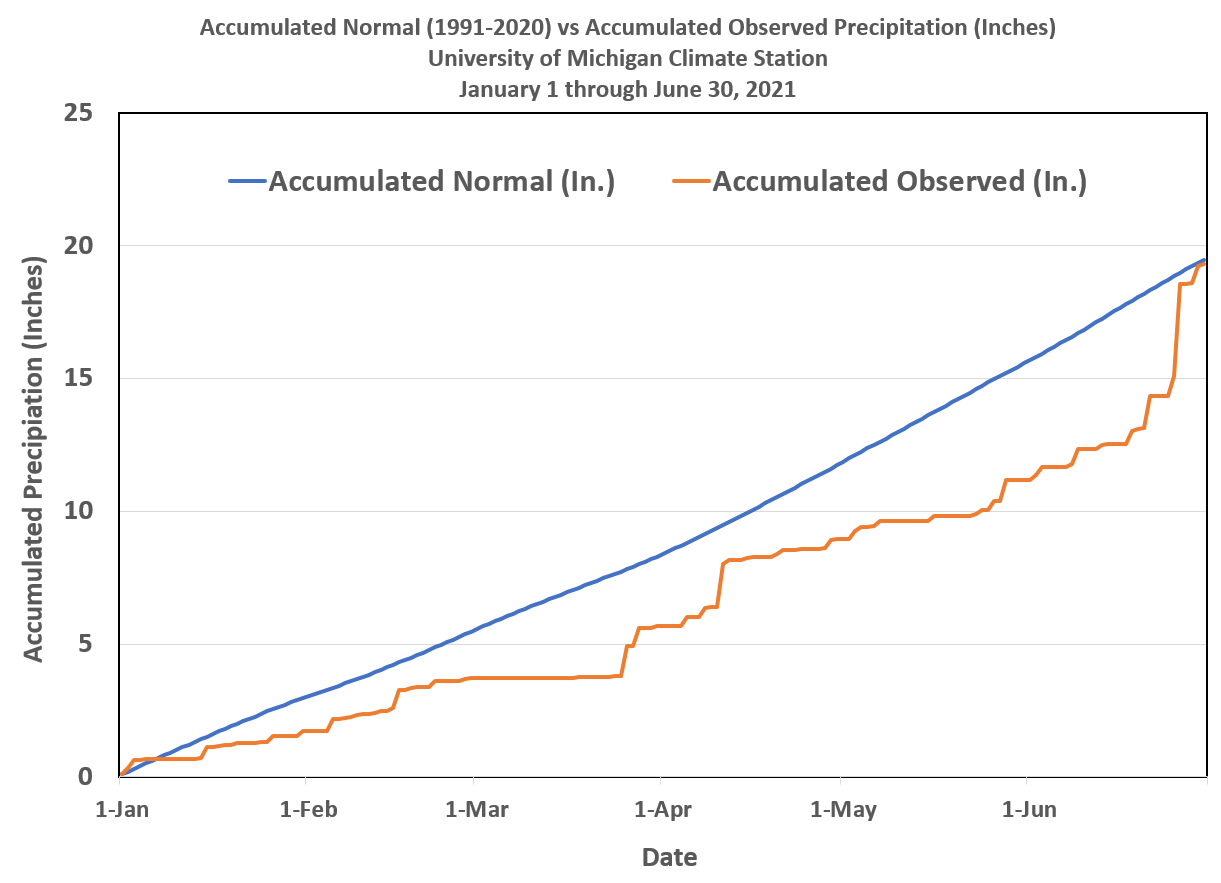
The graph here (from Frank Marsik) shows the accumulated precipitation recorded at U-M’s station at the Matthaei Botanical Gardens. The blue line represents the average accumulation for the previous 30 years. The orange line represents accumulation so far this year. Precipitation levels were well below average until late June. Then, largely in one event, we caught up with the average. As July unfolds, precipitation in Michigan is now well above the average.
These bursts of rain are coming in giant, intense steps. And this trend is not just happening in the U.S. We’ve seen extraordinary floods in Germany and China too.
This is global warming
I recently participated in a webinar that analyzed the quality of the National Weather Service’s heatwave forecast. Experts stated that the observed temperature was five-to-six standard deviations above an average derived from observations recorded between 1979-2010. Let’s place that in perspective: When you have an idealized bell-shaped distribution, if a value is three standard deviations from normal, it is outside of the range of 99.7 percent of the observations. If a value is six standard deviations above normal, then there are about two chances in a billion it will occur.
Look at the heat events surrounding the Earth, the floods encircling the Earth, and the physical processes that explain and connect these events. There is no rational chance that they are random. The same can be said for the rainfall increases in the Great Lakes.
Welcome to a land of regional fire and rain. All these events and their convergence with the fundamental physics-based behavior of heat, air, and water compels us to conclude global warming influences all weather every day.
Only the beginning
In my previous column, I wrote that living conditions in 2100 would depend on our behavior today. I stated, “ … we must develop a more systematic and anticipatory approach to extreme storms, fires, droughts, and floods. Today’s decisions regarding adaptation and mitigation will influence the quality of life for decades to come.”
It seems so obvious. People are dying in heat and floods occurring in unfamiliar places with unprecedented severity. Roads are buckling and washing away. I have heard from people on the shores of North Carolina and the shores of Lake Ontario that they cannot find contractors and engineers to do the work that would offset current and future damage.
Here in Southeast Michigan, chronic flooding of houses has persisted for about five years. Along the eroding shores of the Great Lakes, houses are disappearing and septic systems are overwhelmed. People are reacting by using pumps and more concrete. Some builders are using stilts. And in many ways, Michigan is a climate change “winner.”
Flames and floods
The heat and drought in the American West set the stage for massive forest fires that now affect air quality as far as the East Coast. (My sister in North Carolina calls to ask about when to go out during the day to avoid the worst of air pollution. I tell her she can re-purpose those COVID-19 PM 2.5 masks.)
These days, the majority of the National Forest Service budget is dedicated to firefighting. States most affected are adding billions to the coffers.
Is this where we are heading? A society that pumps excessive water in one place and fights devastating wildfires in others?
Though it is essential to reduce carbon dioxide emissions now, we must remember we are only approaching the onset of decades of continued warming. Those decades will deliver more drought, fire, rain, and flood. Where and when it is wet, it will be very wet. Where and when it is dry, it will be very dry.
The purpose of adaptation policy is to proactively develop practices and behaviors that will protect our lives and livelihoods. We need new building codes, land-use policy, and engineering standards. We need scenarios that identify when a population must abandon a location and scenarios to support the “climate refugees” forced to relocate.
We do not want an economy built on haphazard, one-off responses to disruptive emergencies. But if we continue down this reactive path, our descendants will be left wondering what was wrong with us stupid, stupid humans.
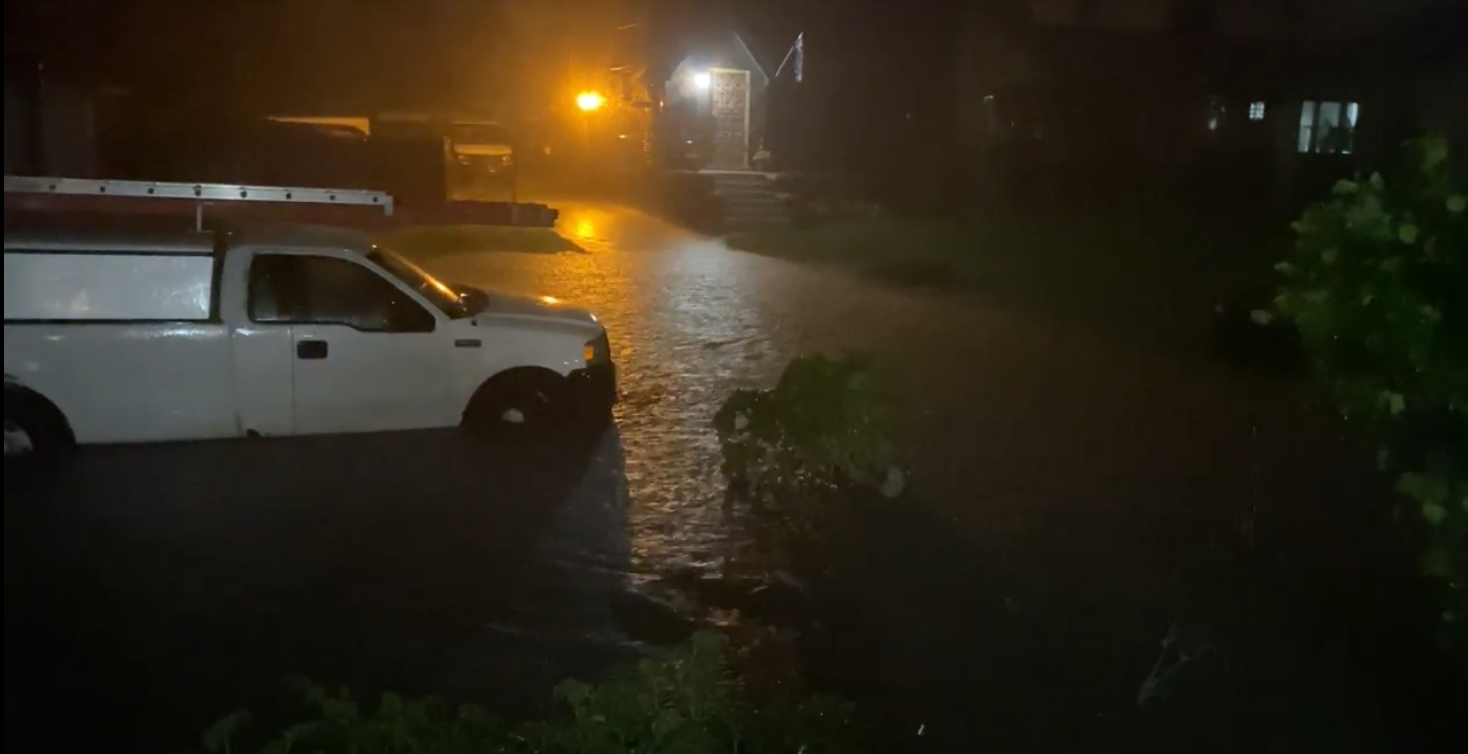
(Lead image: Flooding in Detroit is increasingly chronic.)