‘A place that respected one’s confusion’
Not just nostalgia
In 1965, the University was approaching its 150th anniversary. Somebody had the idea that to mark the occasion there ought to be a book, an anthology of essays by distinguished alumni recalling their days on the campus.
The result was Our Michigan, a slim volume printed locally and distributed in modest numbers. Sixty years later, consigned to the shelves of a few libraries, the book seems at first glance to be no more than a charming collection of nostalgia.
But a closer inspection reveals a theme with striking relevance today — a retort to the argument that a college education no longer needs to be delivered in person.When COVID-19 hit campus in 2020, confining professors and students to learning-by-laptop for months, some critics asked why higher education should ever revert to the status quo. Why pay the enormous costs associated with a physical campus when students could take their courses online? Digital college would be far cheaper and more flexible, and it would extend a university’s geographical reach.
All true. Yet those 37 little essays anthologized long ago in Our Michigan — the blended memories of scientists, corporate leaders, musicians, doctors, writers, athletes, engineers, teachers, economists, two astronauts, and a pharmacist — suggest that the claims for digitized education quite miss the point.
One writer after another said what mattered most in their time at Michigan was not the actual lessons delivered in lectures and labs. It was the experience of living and working side by side with teachers and peers in the sanctuary of a bricks-and-mortar campus.
The magic square
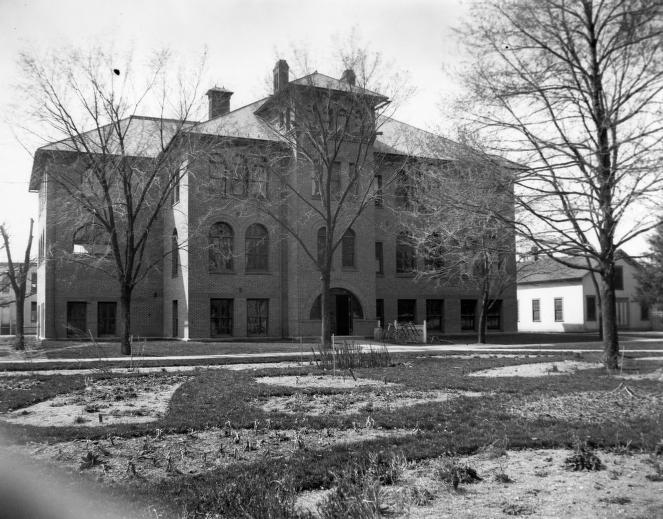
Detlev Bronk (1897-1975) was a medical scientist and president of Johns Hopkins University. He first encountered the Diag “on a soft September evening” in 1921. He described it as a “magic square” bounded by “Hill Auditorium, the Michigan Union, Martha Cook, and Betsy Barbour, the bookstores … a movie theater … I can see it now as clearly as I saw it then.”
Unsure of his calling, Bronk gravitated to a lab in the basement of the original Physics Building. Soon he was doing research with two other grad students. “Each of five nights a week through two happy years was a night of high adventure … A moving spot of light, reflected from a galvanometer that measured the properties of molecules in a gas, led me on as sailors are led by stars through unknown waters … No matter what we learned during those long nights; it is written in dusty journals. What matters much more to me is that I savored the endless joy of discovering something new. In a dingy basement within the magic square my path in life came clear.”
‘His chemistry I have long forgotten’
Admiral Arleigh Burke (1901-96) wrote his remembrance not long after retiring from three terms as chief of naval operations, the highest post in the U.S. Navy. Burke had commanded destroyer squadrons in the South Pacific during World War II and directed naval operations during the Korean War. In the early 1930s, the navy sent him to Michigan for a master’s degree in chemical engineering so he could do research in explosives and chemical processes.
Burke’s military superiors expected him to come back with advanced professional knowledge, and he did. But “it was not nearly so important as many other things I learned which proved to be more far-reaching than chemical engineering,” he wrote.These other things came to him during hours of dialogue with professors. One academic mentor was the noted scientist Moses Gomberg, the founder of the field of radical chemistry. But Burke remembered Gomberg the man — “how he used to talk to me in the evenings about his early life in Russia and Germany … From him I learned patience and tolerance as well as the necessity for hard work and persistence. He dwelt often on the philosophy of government, the free enterprise system, the advancement of individuals by merit in the United States … His chemistry I have long forgotten, his philosophy I will never forget.”
‘My whole soul and energy’
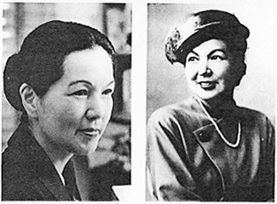
Regrettably few women were asked to submit essays for Our Michigan. One was Shio Sakanishi (1896-1976), who had a distinguished career as a translator of literature and advised the Occupation government of Japan after World War II.
Raised in a Christian family in Japan, Sakanashi came to the U.S. to pursue a bachelor of arts degree at Wheaton College. When her family died in the Japanese earthquake of 1923, she concluded she needed more education to make her way alone. “Overjoyed” to earn a Barbour Scholarship — Michigan’s financial award to Asian and Middle Eastern women of outstanding academic promise — Sakanashi completed a PhD in literature in 1929.
“The most exciting part of my days in Ann Arbor was to choose courses and then visit the professors,” she wrote. She was one of only four students in the course in Old English with Professor Samuel Moore who, “with a twinkle in his eye,” paired her for blackboard exercises with A.A. Hill, a giant who towered over her. She took DeWitt Parker’s course in aesthetics and became an assistant instructor. She made close friends.
“My professors and friends accepted me as a human being and never as a strange foreigner from the East,” Sakanashi wrote. “I put my whole soul and energy into learning the democratic way of life, and it certainly was a most rewarding experience.”
‘The freedom to search’
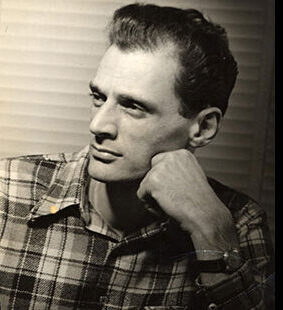
Arthur Miller (1915-2005), author of Death of a Salesman and The Crucible, arrived in Ann Arbor a year after Arleigh Burke. He was full of questions: “Could I hope to become a writer? Who was the best writer in America? Why?”
Miller wrote his first play as an English student, and when his professor, Erich Walter, praised the work and read it aloud in class, the young writer considered it a “high triumph.” Obviously, he thought, he was on the brink of getting his play produced on Broadway.
Then he took Professor Kenneth Rowe, who taught actual playwriting. Rowe was more exacting. “Not too slowly the truth began to dawn,” Miller recalled. “There might well be years of work ahead. A few better plays had been written in the world before mine.
“Rowe administered the kind of criticism that is hardest to take and most necessary of all — based on common sense…”
Miller remembered “Rowe’s calm, quiet refusal to encourage dreams of sudden glory and at the same time his sympathy with those dreams.”
When Miller won two Hopwood Awards, then lost a third, he could take the loss in stride. “Rowe did not lead, he accompanied. Maybe that is Michigan’s most endearing quality for me. It was a place that respected one’s confusion, which it countered not with doctrine but the freedom to search and the instruments for it.”
‘This magical address’
William Shawn (1907-92) was the longest-serving editor of The New Yorker magazine. He dropped out of Michigan to go to work in 1927. But he wrote with reverence about 408 Thompson St. — “this magical address” — where he lived his freshman year.“A short walk, and I was on the steps of the Library, or on the Diagonal, or in a little lunchroom called Van’s; I was reading the books that were to mean most to me; I was seeing the friends who were to be remembered; I was having the cup of coffee and the toasted sweet rolls that tasted so much finer than they were. The world was just a few blocks around, and yet within it was everything I wanted to learn…
“Melvin T. Solve was there, and Lawrence Conrad, to tell me all there was to know about literature, and waiting for me somewhere in this tiny but comprehensible realm were history and philosophy and science — intimations of bliss … There are other places, surely, for other people, but for me there is only one place, Ann Arbor, for there it was I discovered what life’s bright possibilities were.”
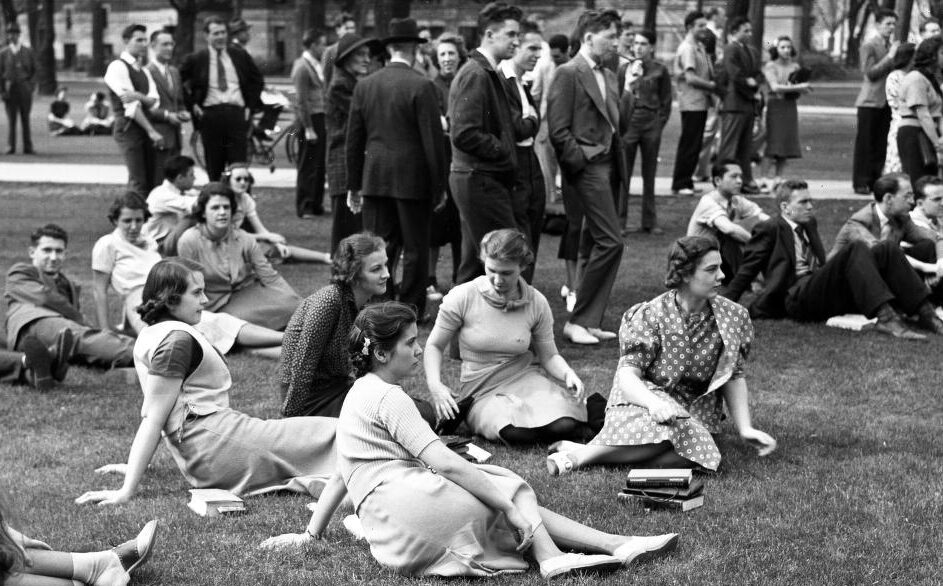
Our Michigan: An Anthology Celebrating The University of Michigan’s Sesquicentennial (1966) is available in its entirety online via Google Books. The lead image dates to the 1930s and is courtesy of U-M’s Bentley Historical Libary.