The problem, and the solution, is us

At Michigan
Soon after I arrived at Michigan in 2005, I attended a conference on climate change sponsored by the Erb Institute, a joint effort between the Ross School of Business and the School of Environment and Sustainability. After the conference, three students urged me to create a science-based class that explored climate change and its relationship with the real world. Together we drafted an outline and a list of guest speakers.
That meeting set me on a path of teaching, research, and public engagement that continues today. I presented the first session of that class in January 2006 and quickly realized that teaching the science of climate change would be simple, and teaching the relationship of climate change to the real world would be difficult.As I enter retirement and assume Emeritus status, I plan to continue on that path, with increased focus on writing and broader engagement in online education. Here is a recording of my talk at a recent convocation for my retirement, which stands as a unique and realistic perspective on how climate change will play into our lives.
Framed
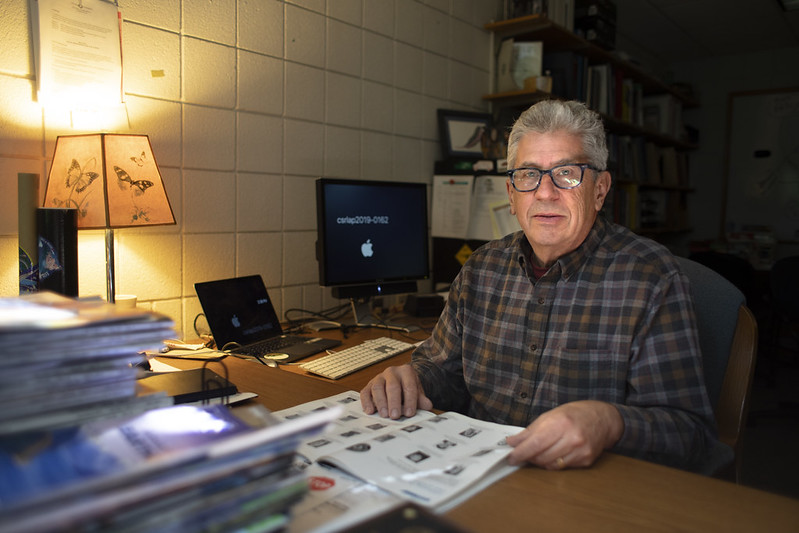
I’ve revised my approach to presenting climate change several times since my initial course. The first change came almost immediately. Students of climate science were very focused on one detail or another and had not made connections to other parts of the Earth’s systems. Nor were science students well-grounded in how science might be used in the real world. As a result, I reframed the class material to focus on the usability of knowledge.
I started a long term collaboration with Professor Maria Carmen Lemos, and in 2010, we joined with other colleagues to established GLISA, the Great Lakes Integrated Sciences and Assessments Center, as a collaboration with Michigan State University. Our unique approach integrated social science research and physical science research into applications and education.
By 2008, I concluded that we had vastly underestimated the melting of ice, that the effects of a warming climate were emerging more rapidly than expected, and that there was no evidence to suggest that we would limit warming to 2 degrees. I could not maintain the mantra that we needed to avoid dangerous climate change and that a 2-degrees Celsius change in the global average was the threshold of dangerous. I thought that focusing on 4 degrees might even be motivation to be serious about 2 degrees.
Emergency!
Around 2014, the public message evolved into framing climate change as an emergency, aka, “the climate crisis.” We needed to reduce emissions by 50 percent by 2030 to avoid catastrophe, a goal that was codified in Paris in 2015 with an ambitious target to limit warming to 1.5 degrees Celsius. The model storylines to achieve these goals were fantastic narratives of miraculous possibility. I felt disingenuous discussing them with my students, and this message of “10 years to catastrophe” did not provide any skills or usable knowledge.
I believe that this framing of 2030 as a critical point places climate change as an external problem. If we just decided to fix it, we would fix it. And then we would have a stable climate and, perhaps, even return to a previous climate.
People talk about “political will” as if political will could be achieved at some moment when the collective mind changes and everything becomes clear. Then, climate would be a moral imperative. This is an incorrect view of reality and conveys to me a naiveté on how the world works and how problems are solved.By framing climate change as an external problem, we take individuals out of the equation and direct our attention toward the failings of governments and corporations. It diminishes our power to affect the problem and absolves us of responsibility.
We need to recognize that living in and working with a changing climate is something we must do under any conceivable reality. We are now at a point in time in which the climate is statistically different from one decade to the next and we are not practically or behaviorally prepared to manage that.
People have the power
My goal as a teacher or coach is for people to feel they have some control over climate change, and to feel that they have the skills, the authority, and the mandate to address the issue. I want us to have confidence that what we are doing will, ultimately, make a difference.First, we have to learn how to:
- use knowledge to overcome the anxiety that leads to paralysis and inaction
- use knowledge to recognize and overcome barriers to applying climate knowledge
- identify and implement no-regrets, easy win, substantive mitigation and adaptation actions
The most difficult barriers we face are not technological, nor are they scientific. The problem is us. We are not very good at cooperation and culture change. And it’s even worse when the perceived benefits are decades away. For some, urgency inspires action. For others, urgency creates panic and despair. Guilt and shame play a role as well. There is no single right approach, no single communication strategy that will magically align us to “solve” the climate change problem.
Taking action
One predictor does stand out as a likely measure of someone taking action. That predictor is self-efficacy, “an individual’s belief in their capacity to act in the ways necessary to reach specific goals.” Education is another important attribute that delivers high impact. It’s important to know which actions have the most influence to produce the most benefit.I want all of my students to leave my classes feeling they have the capacity to act as individuals, influence their professions, change their institutions, and lead in their communities. And I’m pleased to report my students have found their ways into many diverse professions where they are exerting influence. Many find they are the sole “climate expert” in their organization.
There are many essential elements to solving climate change in all professions, but knowledge – and how to use that knowledge — is paramount.
We need to work toward goals over which we have direct influence.
We need to advocate for goals over which we do not have direct influence.
We need to have the confidence to lead.
We need to move on from the lamentations of loss due to climate change.
Those who choose to use the knowledge of climate change will be better off and contribute to a better world.
(Lead image: iStock.)