A man and his bog
Gentle obsession
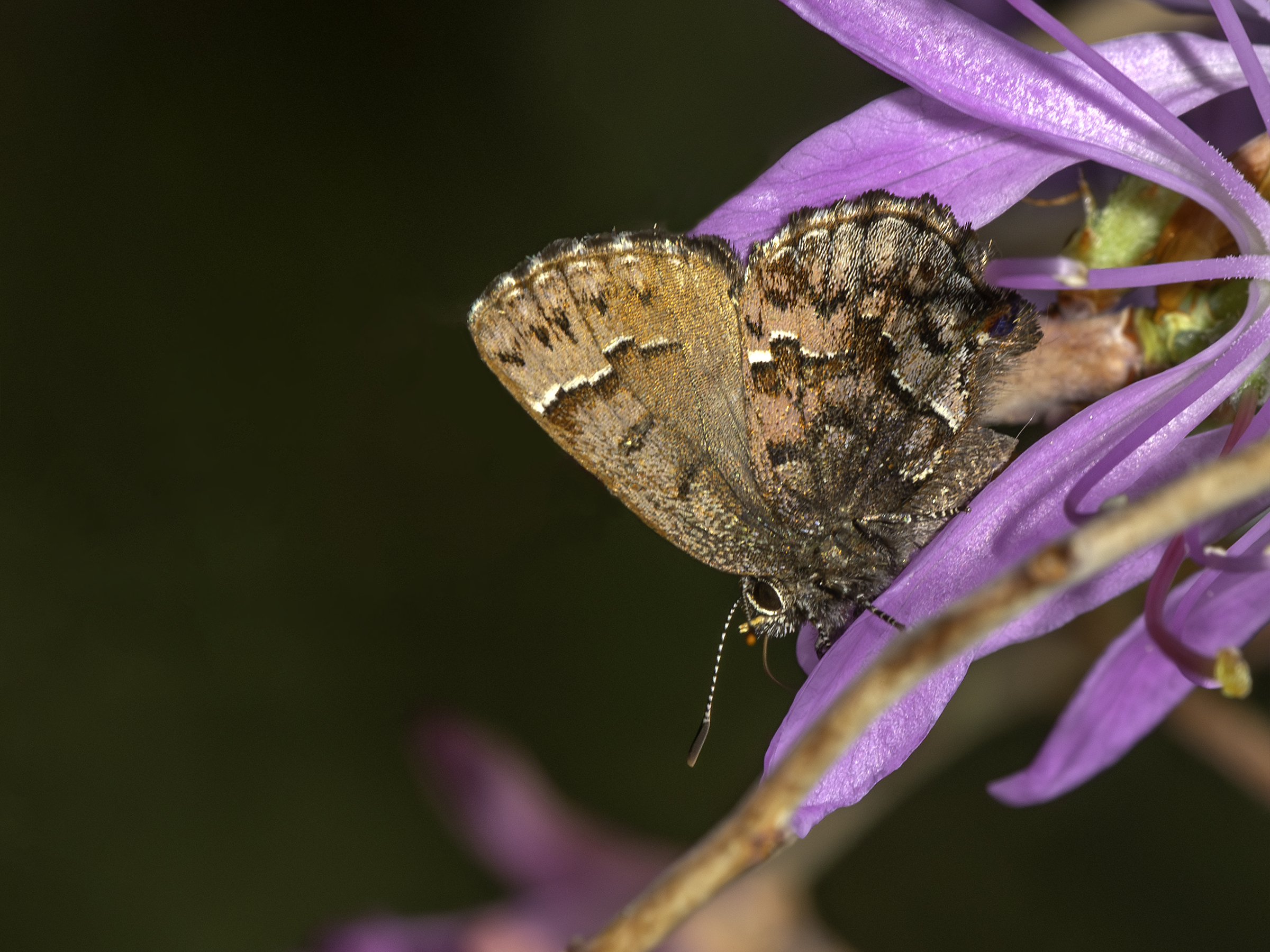
Twenty-one years. That’s how long it took field biologist Bryan Pfeiffer, BS ’80, to find the fantastically rare Bog Elfin butterfly (Callophrys Ianoraieensis) fluttering in a remote Vermont bog.
The penny-sized brown marvel lives high in black spruce trees, exclusively in — you guessed it — bogs. But it only takes wing in the brief span between mid-May and early June. And while fellow lepidopterists had sighted it elsewhere in New England, no one had seen it in the Green Mountain state.
Pfeiffer’s gentle obsession began in 2002 when he led the Vermont Butterfly Survey, a multi-year expedition and labor of love for which he was paid an hourly rate in the low two-figures. When not serving as an adjunct lecturer at the University of Vermont or consulting for governments, nonprofits, and private landowners, the Detroit native time and again found himself compelled to bushwhack with a compass through soggy forests to swampy sites.
Then, on May 19, 2023, Pfeiffer trekked to that bog in northern Vermont, binoculars in hand. The magic moment happened. The Vermont Center for Ecostudies, where he is a research associate, distributed a press release about the Bog Elfin’s appearance. A local paper picked up the story. Pfeiffer followed up with an essay in his online column, Chasing Nature. And then, the story got big: The Boston Globe, for whom he contributes essays, splashed the news around the region.
Overnight sensation
Pfeiffer was astonished at the media attention and has kept the bog’s whereabouts secret to save the fragile flier from harm.
“I was grateful it got attention, because when I write about nature, I live in abject fear of readers not caring,” Pfeiffer says. “That’s what keeps me up at night. Here we have a little brown butterfly virtually no one will see. It’s not charismatic. I wanted people to care. I think caring about a little brown butterfly is a moral challenge for us.”
Pfeiffer’s passions also include birding and dragonflies. He is a past president of the Dragonfly Society of the Americas. It exists, he confesses, mostly so its members can run around with nets in wetlands catching dragonflies.
“Choose any scene from the drama of life on Earth — birth, growth, warfare, death, sex — and you will find it acted out at your feet in the lives of dragonflies. They are audacious insects that have been around in one form or another for about 300 million years. They evolved early, got it right, and haven’t changed much. They figured things out. They are amazing expressions of life on Earth,” he says.
His happy place
Pfeiffer, who grew up in Oak Park, Mich., is happiest in bogs because of their remoteness, exotic flora, and fauna. “They are squishy, soggy mats of sphagnum moss where orchids bloom, unusual insects fly, and rare birds sing,” he says. “To many people, they are wet, inhospitable, inaccessible places with legions of biting insects and hazards, but I feel they are where I belong in the world. Bogs feel right to me.”
A former editor and staff writer at the Vermont newspapers The Times Argus and Rutland Herald, Pfeiffer spent decades learning how to share his soul with readers. When asked if he is an optimist about Earth’s fate at human hands, he admits he is a pessimist.
Nonetheless, he says he can go into the woods behind his Montpelier, Vt., home and see beauty. “This is the odd thing to me,” he says. “I still can find joy and wonder in the prosaic. Even as we destroy nature, nature is, in many respects, indifferent to our brutality. Nature will still give us joy, and that’s really easy to find, no matter where you live.”
A ‘beautiful gift’
Boston Globe deputy editor Kelly Horan recalls sitting up straighter and paying attention when Pfeiffer first submitted an essay. She rejects nine out of 10 pieces aspiring writers send for possible publication in her paper’s “Ideas” section.
“Bryan has a beautiful gift,” she says. “He has managed the neat trick of emerging into adulthood with his sense of wonder fully formed. He sees things I think many people don’t even know exist.”
Writing well comes as a struggle for Pfeiffer. Though he co-authored Birdwatching in Vermont and is mulling whether to finish a book on dragonflies, he holds dear a quip attributed to Hemingway: “There is nothing to writing. All you do is sit at a typewriter and bleed.”
His passion spills out in his columns. “I guess it comes from being in nature in all of its detail, in all of its force and grace, in its brutality and sensuality, and a burning desire in me to share it with the rest of the world,” he says.
Consider these passages:
“If you ask me, to be alone with Fen Grass-of-Parnassus is to be blissfully nowhere else. A single flower is refuge from the daily fusillade of distraction. Nature is good for that. Like sex or chocolate, like the Bach cello suites or love for another person, a flower can be a genuine manifestation of joy and wonder and mystery. Then again, sometimes a flower is just a flower — simply and objectively and forever beautiful.” (From a Boston Globe essay)
“A moth in flight in December is like civility in politics or going maskless in an indoor crowd — not impossible, certainly elusive, and mostly a fond memory to be sure. Fluttering in winter, a moth can embody joy in the moment and yet a kind of wistfulness — despite its unbecoming given name: Fall Cankerworm (Alsophila pometaria).” (From ‘Sex and Light’)
“My work is done at Bear Swamp. Even so, with unsettled acceptance, on my bum knee I’ll walk onward to keep the horizons — my own and nature’s — from fading. Along the way I’ll miss those high notes just as surely as I will stumble and fall. No matter.
“Although we are both damaged goods, nature now offers me slower rewards, quieter harmonies: the whispering butterflies of summer meadows, the furtive orchids of northern bogs, the silent ways of winter woods.” (From ‘A Fading Serenade’)
A ‘boy explorer’
Now 65 and having survived a near-fatal heart attack five years ago, Pfeiffer often ponders the trade-offs aging poses.“I think an important part of aging is wisdom and slowing down,” he says. “Most of us, no matter our age, would do well to slow down in almost every respect. I think being older in a bog, moving more slowly in a bog, being more aware in a bog, allowed me to find this rare butterfly.”
In a headline on his website, this naturalist dubs himself a “boy explorer.”
“I still get to run around Vermont with a butterfly net, and I do it with exuberance and passion. I hope that is reflected in my writing, along with genuine concerns about the human condition,” he says.
With the Bog Elfin under his belt, Pfeiffer is chasing two more elusive beasts — the Pygmy snaketail dragonfly (Ophiogomphus howei), which has never been seen in Vermont, and the Silvery checkerspot (Chlosyne nycteis) butterfly, last spotted there 20 years ago.
“There are other treasures to be discovered here,” he says.
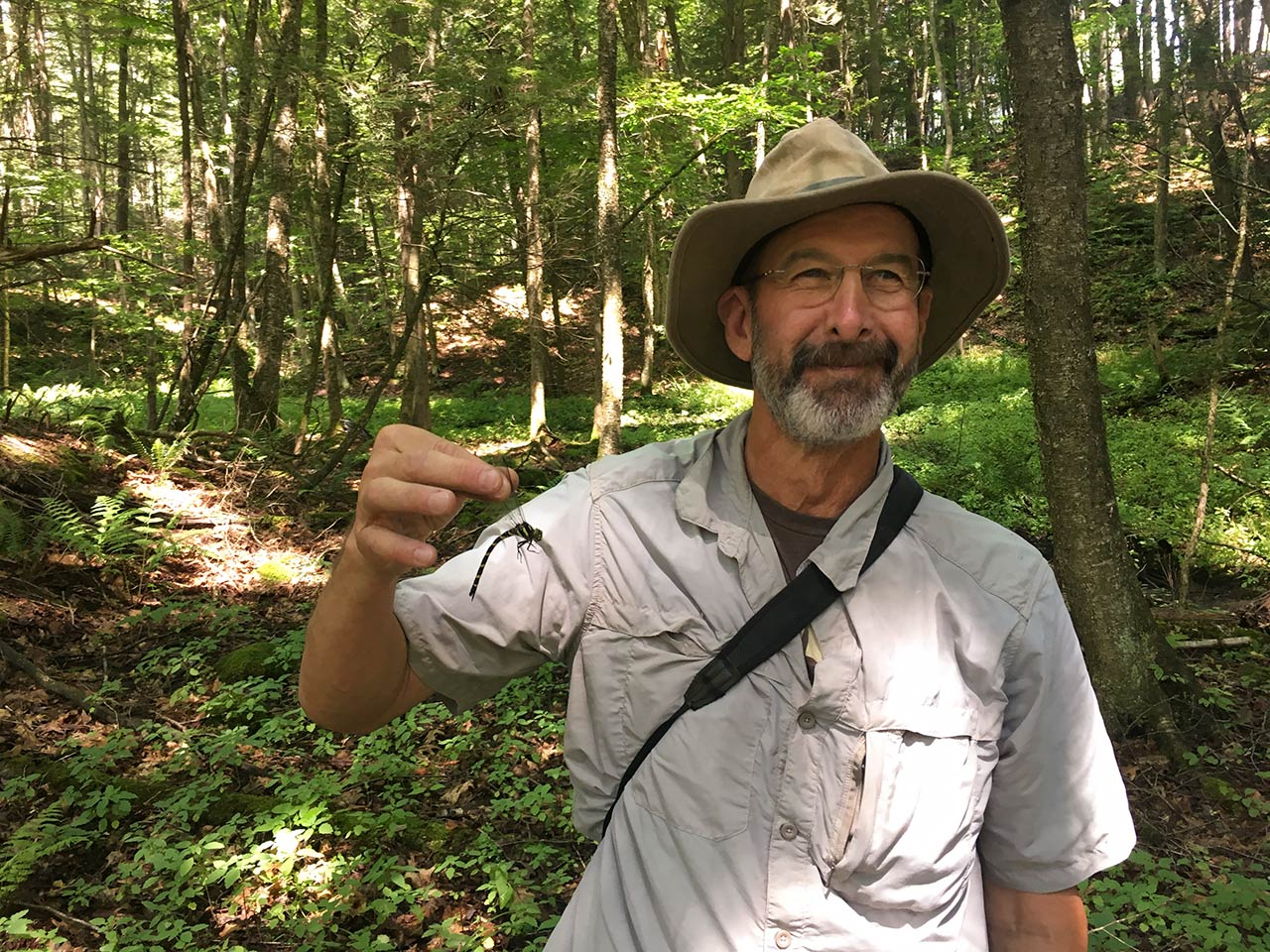
(Lead image: Pfeiffer poses in the Vermont forest with a beautiful dragonfly, the Cordulegaster erronea, or the tiger spiketail, a species of spiketail in the family Cordulegastridae. Image courtesy of Bryan Pfeiffer.)