Flooded with reality
Unwittingly prescient
Last month, I wrote about an emerging pattern of floods. The takeaway: In a warming world full of oceans, any rain-producing storm is likely to produce extreme rainfall rates and record-breaking amounts of water. You can think of this as buckets that fill up fast, and there are a lot of buckets.
As I wrote that article, I did not anticipate the stunning floods in North Carolina, South Carolina, Georgia, and Virginia after Hurricane Helene. And, we can’t ignore the extreme rainfall rates in Saint Petersburg, Florida, with Hurricane Milton.
Trending now
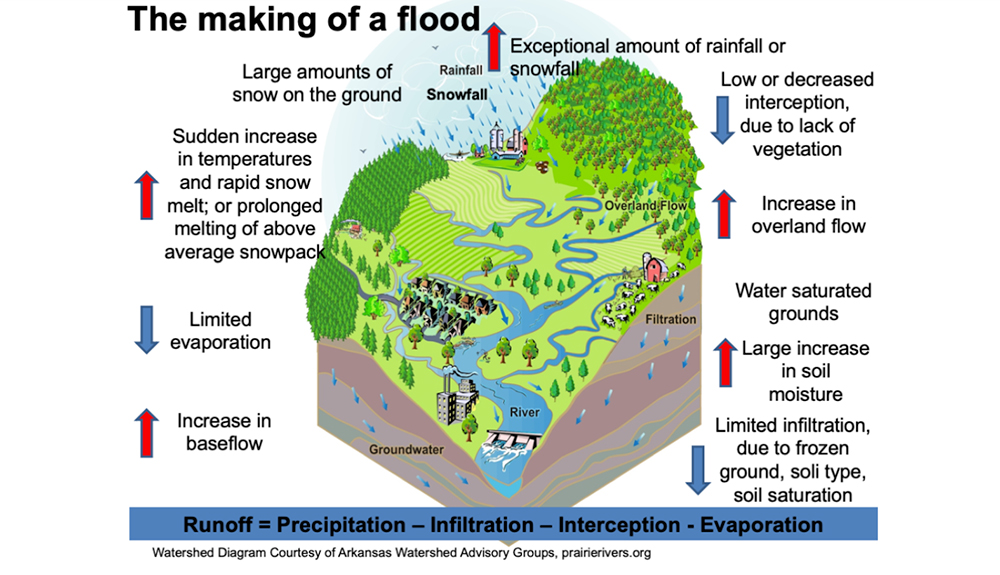
In the past year, I have written about flood scenarios several times. Floods are not just “a lot of rain,” and there are many ways to make a flood. If you’re attempting to understand floods, it’s critical you begin by evaluating the conditions on the surface. For example: Is there snow on the ground? Is the ground already saturated? Is there a lot of pavement? Are pipes funneling water to a particular place? The importance of surface conditions makes it difficult to make easy statements about whether or not climate change causes or contributes to increased flooding.One metric to analyze extreme rain events is the average recurrence interval. This measure is seen frequently in news stories, for example, the ‘1-in-100-year’ event. This term signifies that a certain magnitude in a specific area might be expected just once every hundred years. Another interpretation is that such an event has a 1% probability of occurring in any given year.
A 1-in-100-year event usually comes with severe consequences. Thus, an event that occurs once every 500 or 1,000 years wreaks even more havoc.
We do not have direct measurements of precipitation from 500 and 1,000 years ago. Therefore, when we talk about a 1-in-1,000-year event, we rely on statistical methods, backed up by our understanding of physical processes.
To the extreme
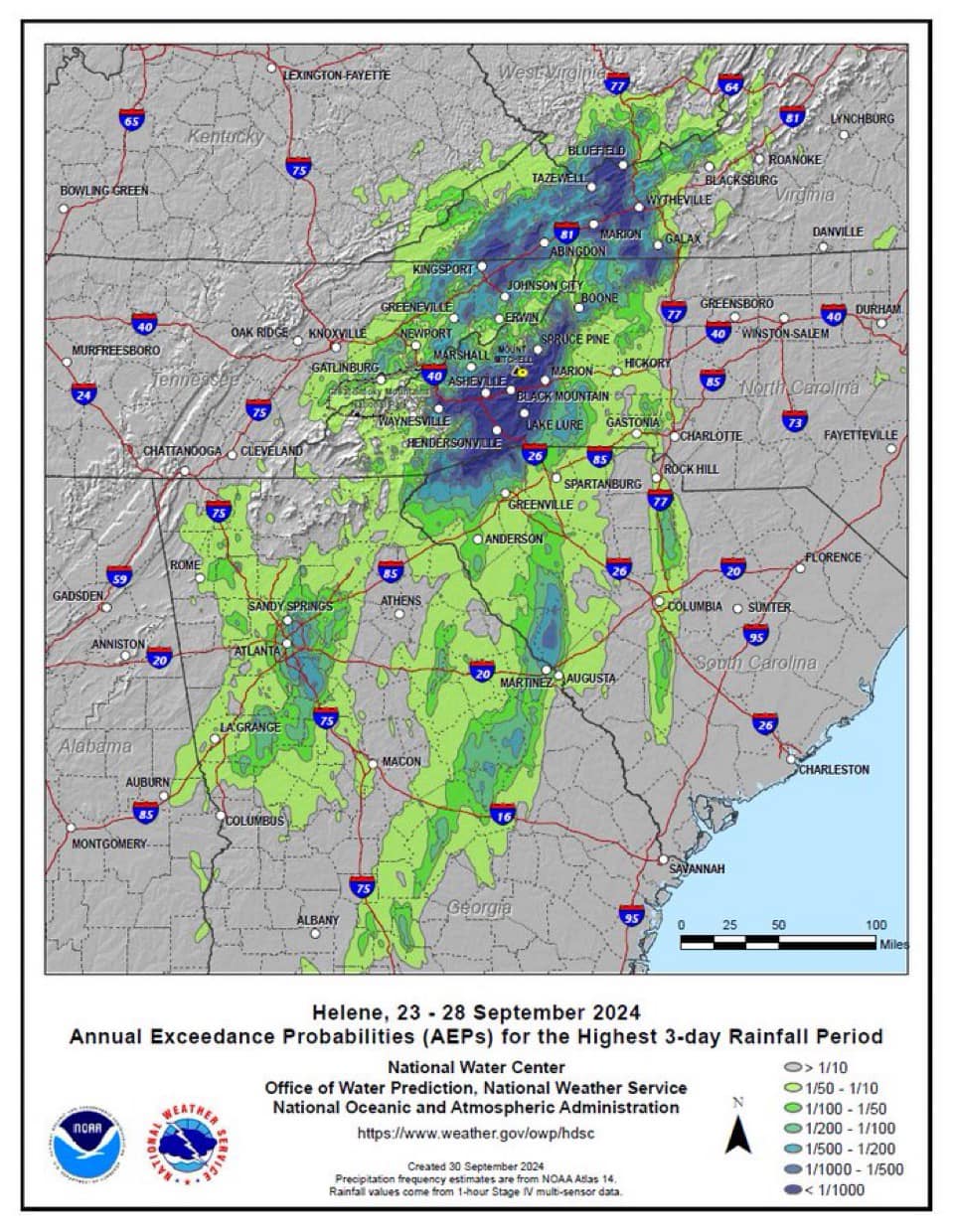 It is safe to conclude, that for most anyone, a 1-in-1,000-year event is unprecedented and unexperienced. It is also safe to conclude that few people, few regions, and few governments are prepared for such an event.
As context, for large portions of western North Carolina, the rain events in late September were more severe than a 1-in-1,000-year event. And earlier in the month, there was a much more localized 1-in-1,000-year event on the other end of the state. (Click on the image to enlarge.)
There is little doubt that when we experience a rain event that is as extreme as once in a hundred years, 500 years, or 1,000 years, we experience flooding. For a 1-in-1,000-year event, flooding will occur whether the landscape is urban, suburban, agricultural, forested, or wilderness.
For flooding associated with such extreme events, if we establish that these extreme events are occurring more frequently, then we can conclude there is a trend in flooding.
Observational evidence exists to support the increase in extreme events measured by average recurrence interval. For example, in the mid-Atlantic of the U.S., a 2022 paper concludes, “Collectively, the results indicate that, given recent trends in extreme rainfall, routine updates of extreme rainfall analyses are warranted on 20-year intervals.”
Take me home
Now, I return to North Carolina, my home state. I spent the first 20 years of my life traveling to nearly every part of North Carolina. The geographical extent of the September 2024 flood includes landscapes that are urban, suburban, agricultural, forested, or wilderness. All of it is in hilly and mountainous terrain that funnels water into ravines and canyons.
The amount of rain and the terrain’s subsequent focusing of that rain into torrents was landscape-changing. The ground liquifies and once we have a mud flow, rocks, roads, trucks, homes, and buildings are afloat. The pipes we designed to carry away water are, themselves, carried away.If this was really a 1-in-1,000-year flood, then maybe it’s wise to rebuild to incrementally higher codes and improved zoning.
But, with a warming climate can we count on our history that a flood like this will occur just once every thousand years?
In fact, we cannot.
We might expect a 1-in-1,000-year event to remain reasonably rare. But a person should expect to experience what had been a 1-in-100-year event several times in their life.
We need new language to describe these extreme events, which are no longer uncommon.
Repeating myself: The extreme weather we are experiencing today should no longer be considered extreme. We are only beginning to experience our warming climate. From a science-based perspective, it is safe to assume that today’s extremes are representative of what is emerging as routine.
Combating the conspiracies and chaos
The western North Carolina flood was immense and its consequences horrific. The story, however, does not end there.
It didn’t take long for the Pandora’s Box of conspiracy theories to break open. Disinformation ranged from accusations that meteorologists are controlling the weather under government direction to reports of the disaster being faked so that corrupt government officials could steal disaster relief money. These lies hinder response efforts and cause injury and damage to traumatized people. Though some misinformation may be rooted in legitimate fear and misunderstanding, many conspiracy theories are born of ill intent, and all are amplified with goals of discontent.
Aside from hindering rescue, relief, and reconstruction, the lies waste precious time. People, some whom I know well, spend valuable time — amid their devastated landscapes and disrupted lives — reporting and refuting conspiracy theories that are flat-out lies.I believe that our biggest threats from climate change are rooted in our own response to what is unfolding. What policies are in place to limit warming? How do our local and national leaders react to weather catastrophes? How do our governments anticipate and prepare for future weather catastrophes? How do we rebuild after the fact?
If we allow lies, the undermining of our institutions, and the dismissal of science-based evidence to rule the day, it only supports my belief that we are the greatest threat to ourselves. To be effective going forward, we need behavior and practice that is organized, connected, and broad-reaching.