Line 5 and its risks: ‘The consequences of failure would be catastrophic.’
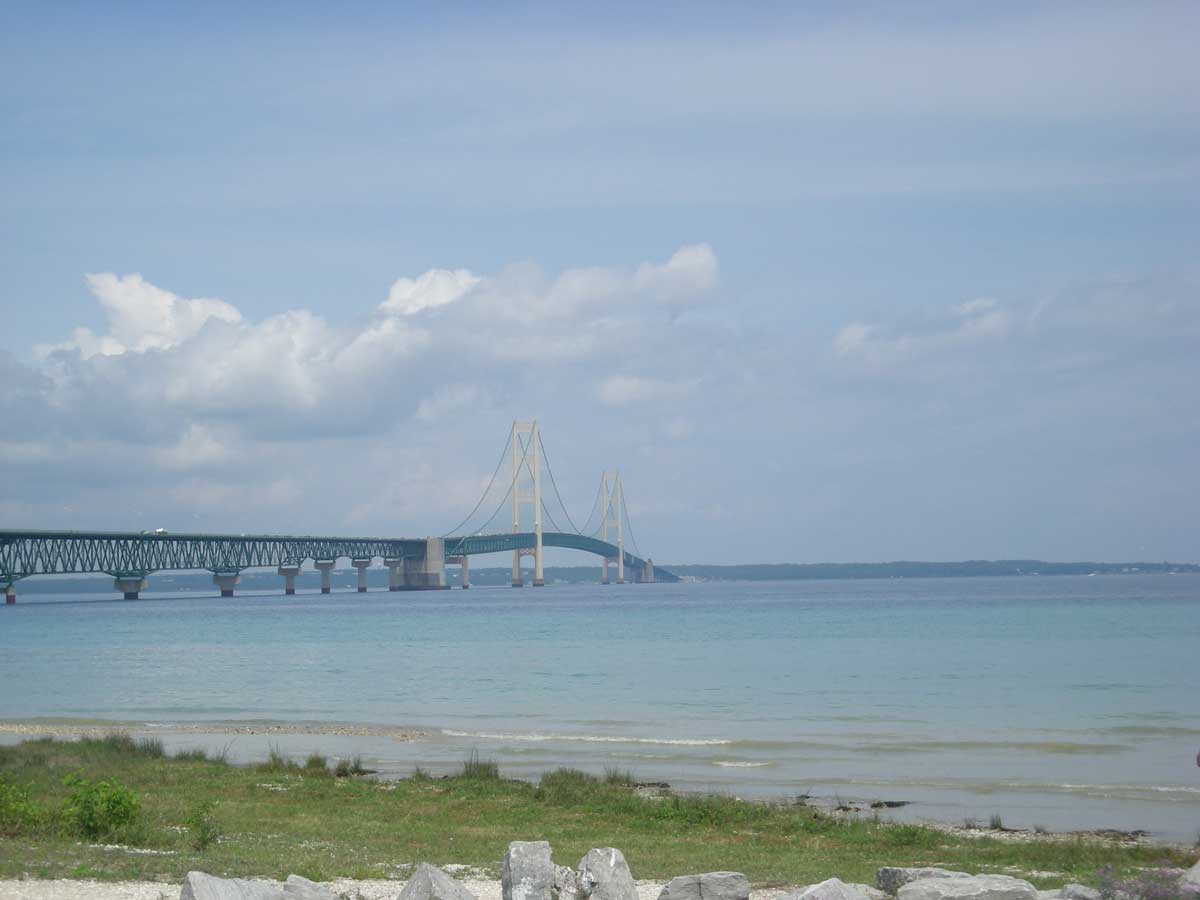
The fate of the Line 5 pipeline is at another critical juncture in its 70-plus year history. The pipeline carries more than 500,000 barrels of petroleum products daily across the Great Lakes region from Wisconsin into Canada, taking a path that runs along the bottom of the Straits of Mackinac.
Over its lifetime, the pipeline has leaked more than 30 times and released more than 1 million gallons of oil. A 2016 University of Michigan study showed that more than 700 miles of Great Lakes shoreline was at risk of being polluted should the pipeline fail in the straits.
Enbridge, the Canadian company that operates the pipeline, has proposed boring a tunnel under the straits to protect the pipeline and continue its operation. The Trump administration, after issuing an executive order that declared a national energy emergency, has instructed the U.S. Army Corps of Engineers to fast-track its environmental impact evaluation of this proposal.
The Corps of Engineers expects to release its draft Environmental Impact Statement on May 30, potentially clearing the way for Enbridge to move forward, following a 30-day public comment period, but not without opposition.
The accelerated timeline does not provide adequate time for a legitimate environmental assessment and burying the pipeline, while reducing the risk that it will be hit with an anchor again introduces new concerns, experts say.

Andrew Buchsbaum, a lecturer at the U-M Law School, is available to comment on various aspects of this contentious issue. He’s an expert in the Great Lakes and environmental law. Before joining U-M, he worked in leadership roles with the National Wildlife Federation, co-founded the Healing Our Waters coalition and was an attorney for the National Environmental Law Center.
What’s the current state of the Line 5 pipeline?
Line 5 is 72 years old, carries 23 million gallons a day—mostly Canadian oil—and it transits the bottom of the Straits of Mackinac, as well as going through incredibly sensitive pristine lands on a Native American reservation. It does so to carry this Canadian oil to primarily Canadian sources, which means that Michigan and the Great Lakes bear most of the risk and get few of the benefits.
This pipeline along the straits is huge and it’s never been replaced. It’s covered with zebra mussels, quagga mussels and other materials. Its protective coatings have peeled. It’s been struck by anchors two times in the last six years—one of them dented it and another yanked it ten feet out of kilter. This pipeline poses an immense risk to the Great Lakes. University of Michigan researchers have concluded that it is in the worst possible place in the Great Lakes for any pipeline to transit.
How would burying the pipeline in a tunnel dug through the straits change its risk profile?
Enbridge proposes to carry all of this 23 million gallons a day 50 to 200 feet below the bottom of the Straits of Mackinac—that is, below the lake bed to protect it from anchor strikes. The problem with that proposal is that the tunnel itself would be a significant hazard to the Great Lakes. They’re proposing a tunnel that would be 21 feet in diameter. It would have plenty of air in it, because people could get down to service the pipeline. But if you have any sort of a small pinhole leak which allows natural gas liquids or oil fumes to get out into an enclosed space, if you add a spark, you have a massive explosion hazard.
In combination with that is the fact that the rock that the pipeline is proposed to travel through is of poor quality. That means there are plenty of possibilities of a connection to the Great Lakes. In fact, if there were a significant influx of groundwater from the surrounding area or an explosion, you can actually see subsidence of the Great Lakes bottomlands, of the lakebed. You actually could see a sinkhole open up in the bottom of the Great Lakes, so you get a proverbial “from the frying pan into the fire” for this solution.
What’s the impact of fast-tracking the U.S. Army Corps of Engineers’ evaluation?
The fast-tracking notices that came out indicate potential changes in the timeframe that would make for less public review, less scientific study. The draft environmental impact statement will be published May 30 and there will be only 30 days for public comment. We’ve been told that the corps expects to finalize the EIS in the fall. That timeline is too short for public comment on what’s likely to be a voluminous and technical document, and it implies that the corps isn’t going to consider the public’s comments anyway—that the process is a sham and the corps has already made its decision.
Generally, the assessment of the viability, feasibility and hazards of building the tunnel, so far, has been insufficient. It’s been inadequate. We are still trying to learn how a tunnel can safely be built through rock that is porous. There are actual voids in the rock, meaning empty spaces, that would have to be filled with grout concrete. That’s very hard to do when you’re 50 to 250 feet below the lake bed. Then how the explosion risk plays out—none of those questions have been answered yet.
There has been some data and some research. The state has actually hired consultants to look at Enbridge’s submissions, and the state consultants blankly said there’s insufficient research as to the quality of the rock. Enbridge hasn’t done the borings even to determine where the tunnel is passing through rock which is solid or rock which is porous. There’s a great deal of uncertainty as to whether the tunnel can even be built, and, once it’s built, whether it would be safe.
The shortcut with the Army Corps of Engineers process means that the federal government is not going to look at that. It’s not going to look at those questions, or if it looks at those questions, it won’t have the data or the research to be able to determine how to answer them. That means the federal government is willing to leave to the state of Michigan all the heavy lifting as to whether this thing’s going to work. It also means that the federal government is willing to use the Great Lakes as an experiment. If you don’t have the data and you go ahead and do it, you’re basically saying, “We don’t know if it’s going to work. Let’s see.”
The consequences of failure would be catastrophic for the Great Lakes, for Michigan, for the region and all 40 million people who depend on the Great Lakes for drinking water and their quality of life.
What are the arguments for continuing Line 5’s operation?
Central to this issue is the question of, if there isn’t a tunnel, what is the alternative? If you stop the flow of 23 million gallons a day of oil and natural gas liquids through Line 5 because of its hazard to the Great Lakes, then what happens? Are there shortages? Are there price rises? Is there joblessness? The answer is no. There are alternatives that aren’t Line 5, but the narrative being pushed by Enbridge and by Canada and others makes it sound like there would be an apocalypse if Line 5 were shut down. It’s simply not true.
The Bad River Band case in Wisconsin had a trial where this was front and center and then an independent consulting agency, PLG Consulting, did a study. The conclusions from both are that virtually every barrel of oil that’s now supplied by Line 5 could be replaced by the market through other sources within three months. Then every barrel, not just almost every barrel, would be replaced within 18 months, from other pipelines, rail and especially waterborne transport from the Gulf of Mexico around to Montreal. We know that’s possible because, prior to 2015, that’s what was happening. This is incredibly important because what that shows is that prices won’t rise.
In fact, Enbridge’s own experts in the trial admitted that gasoline prices in the U.S., if Line 5 were to shut down tomorrow, would rise between half a penny and a penny a gallon. Refineries would continue to get the same oil they did before and so they wouldn’t lose jobs and the energy supply would remain the same. So, unlike the narrative Enbridge and Canada painted, shutting down Line 5 is essentially shutting down a surplus pipeline. We don’t need that oil and we don’t need those natural gas liquids.