Domenico Grasso champions innovation, student success
Domenico Grasso’s arrival on the University of Michigan’s Ann Arbor campus May 8 signified the latest “first” in a storied educational career.
He’s a first-generation college student. He was the first UM-Dearborn chancellor to have earned a University of Michigan degree. And now, he’s the first Dearborn chancellor to lead U-M as interim president.
The Board of Regents has named Grasso interim president and is expected to officially appoint him at its May 15 meeting.
Grasso brings a deep engineering and liberal arts background blended with extensive university leadership. The son of immigrant parents, he’s built a lifetime of service focused on clearing hurdles for students to achieve lofty goals.
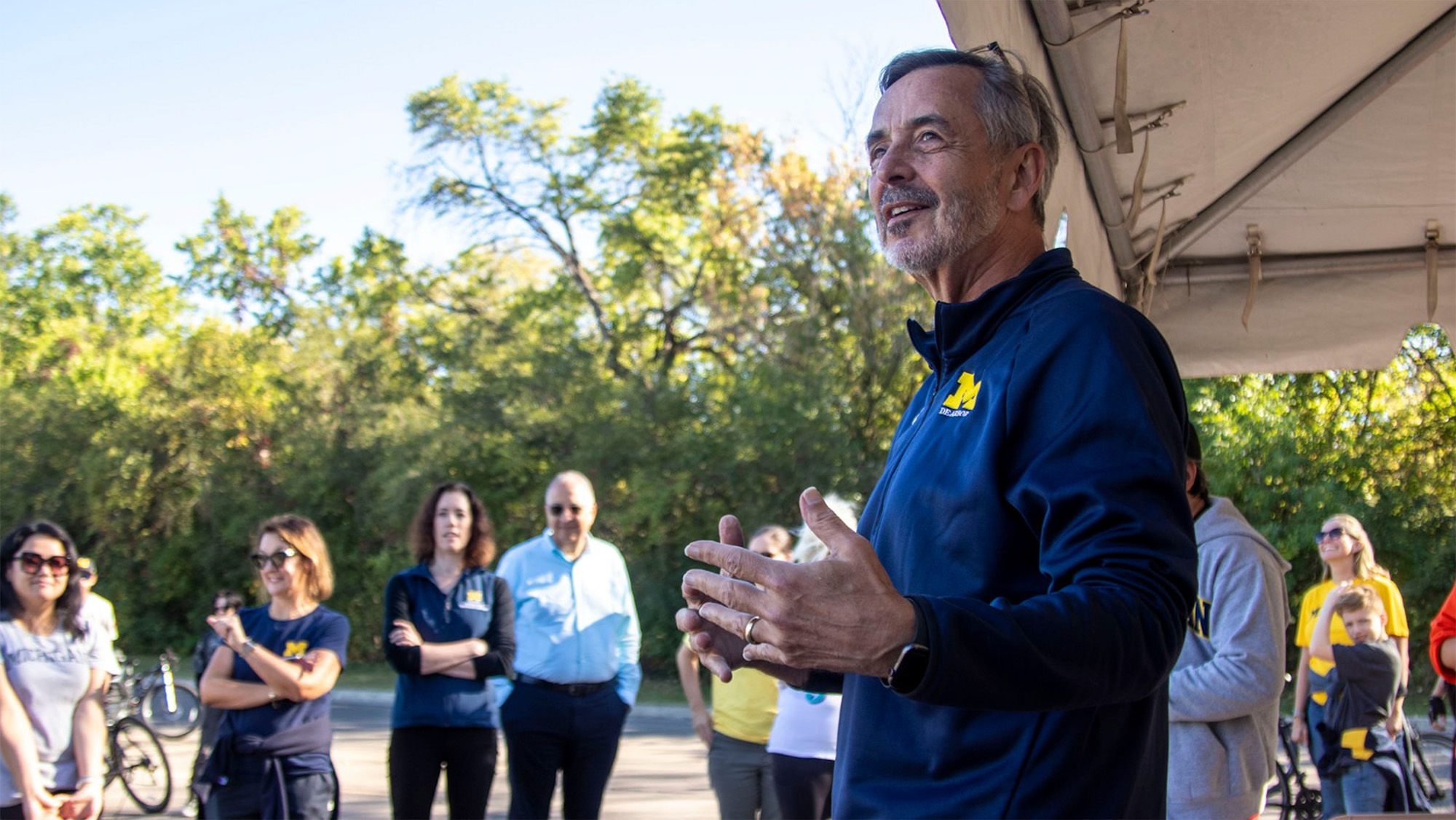
As he steps to the helm during the search for the next president, Grasso is focused on three main objectives: support the well-being of the three campuses, advance and protect U-M’s academic mission and foster a vibrant environment where the best minds continue to thrive, unblinkered and unfettered. He has said he will serve in this interim role only and will not apply for the permanent position.
“Domenico is a visionary leader who understands the needs and potential of students, faculty and staff and the power of institutions like University of Michigan to serve as launchpads for individuals in ways that transform lives, drive critical innovations and fuel economies,” said Board of Regents Chair Katherine E. White. “He has the full support and confidence of the Board of Regents, as he now guides the university through a crucial presidential transition and helps us all live up to the promise of leaders and best.”
Engineering a better future
Grasso was born in Worcester, Massachusetts, and grew up in Shrewsbury, west of Boston. His Boston-born mother was raised in the Italian village of Vieste, and his father immigrated to the U.S. from Italy’s Ariano Irpino region and became production supervisor in a textile mill.
MEET DOMENICO GRASSO
- Some favorite books: “Arrowsmith” by Sinclair Lewis, “Fountainhead” by Ayn Rand, “Meditations” Marcus Aurelius
- Some favorite authors: Sinclair Lewis, Italo Calvino, Jose Saramago, Phillip Pullman
- Farthest ever ridden a bike: 127 miles, from Valley Forge to Gettysburg
- Favorite fashion accessory: Bow tie (owns 20) and anything with a block M
- First concert: Bruce Springsteen
- Favorite summer getaway: An isolated family cottage without electricity or running water on the coast of Manitoulin Island, Ontario
- Favorite subject in school: Physics
Grasso’s mother, a seamstress, was an especially important influence. “My mother’s early and persistent admonitions have guided many of my decisions in life. Be friendly with everyone, be uniquely me and don’t define success in life by materialism,” he said in a 2018 interview.
The first in his family to attend college, Grasso enrolled in Worcester Polytechnic Institute on an Army Reserve Officers’ Training Corps scholarship and earned his bachelor of science degree in civil engineering in 1977. Commissioned as a U.S. Army officer, he obtained his master of science in civil engineering from Purdue University and, after graduation, served over 10 years on both active and reserve status. He deployed twice for annual NATO military exercises, received citations and awards including the Army Commendation Medal and Army Parachutist Badge, before he resigned his commission at the rank of major.
“My time in the military shaped my character and leadership skills,” Grasso said. “It deepened my empathy and taught me the true meaning of courage.”
He came to Michigan in the 1980s for his Ph.D. work at U-M in Ann Arbor, where he met his wife, Susan Hull Grasso, and studied under the guidance of Walt Weber, an international leader in the development of advanced technologies for environmental restoration, and founder of the Environmental and Water Resources Engineering Program in the College of Engineering.
Leading across the country
His first opportunity to influence students began as a professor in the Department of Civil and Environmental Engineering at the University of Connecticut, where he also served as department head.
He then moved to Smith College, where he became an advocate for diversity of thought as the Rosemary Bradford Hewlett Professor and the founding director of the Picker Engineering Program, the first engineering program at a women’s college and one of the few in a liberal arts college in the United States.
“In contrast with medicine and law, the engineering profession remains ‘pale and male,’ with white men making up 90% of practicing engineers,” he wrote in 2004 in American Scientist. “The engineering program at Smith is designed to diversify the ranks of America’s engineering professionals (and of those who sit at the highest levels of government and corporate America) in intellect as well as gender.”
At Smith and elsewhere he stressed the importance of integrating engineering with aspects of liberal arts and social sciences. “A common misperception is that engineering is another one of the sciences. It is not,” he wrote in the American Scientist essay.

Engineering decisions, he continued “must be tempered by an element that is often lacking in the education of engineers — the human spirit.” He quoted the writer and philosopher Robert Pirsig, noting technology should not be “an exploitation of nature, but a fusion of nature and the human spirit into a new kind of creation that transcends both.”
“In engineering, a discipline that purports to design for humanity and improve the quality of life, the unity of knowledge should be a sine qua non that asks engineers to look outward, beyond the fields of math and science, in search of solutions to entire problems. To better serve humanity, engineers must at least attempt to understand the human condition in all its complexity — which requires the study of literature, history, philosophy, psychology, religion, and economics, among other fields,” he and David Martinelli, a professor of civil and environmental engineering at West Virginia University, wrote in the Chronicle of Higher Education in 2007.
At the University of Vermont, Grasso served as vice president for research, dean of the Graduate College and dean of the College of Engineering and Mathematical Science. He worked with the faculty to build university-wide Transdisciplinary Research Initiatives or “Spires of Excellence” for future resource investments. The most successful of those initiatives was the Center for Complex Systems, which are defined as “systems of systems” that exhibit difficult to predict emergent behavior. The center established teams of faculty and students to tackle real-world, data-rich, problems.
In 2013, he became provost, chief academic officer and an engineering professor at the University of Delaware, where he led the campus through a variety of initiatives, including the creation of the Division of Enrollment Management, the Financial Services Analytics Institute and initiatives on cybersecurity and community engagement.
“At University of Delaware, I worked closely with Domenico and saw his deep commitment to student success and to the role of universities in driving innovation and social progress,” said Patrick T. Harker, president of the Federal Reserve Bank of Philadelphia, who was the president of University of Delaware when Grasso was provost. “He is a person of the highest integrity.”
A passionate advocate for the environment and sustainability, he focused his research on how contaminants change and move over time, as well as processes to reduce their impacts on nature and human health. He authored the book “Hazardous Waste Site Remediation” (Routledge 1993) and served as the editor-in-chief of the journal Environmental Engineering Science and the co-editor and chief contributor to the book “Holistic Engineering Education: Beyond Technology” (Springer 2010).
Grasso has held a variety of posts in the environmental engineering and science fields, including fellow on the NATO Committee on the Challenges of Modern Society, technical expert to the United Nations Industrial Development Organization, vice chair of the Science Advisory Board for the United States Environmental Protection Agency and president of the Association of Environmental Engineering Professors.
He was also a member of a World Bank-funded international team of scholars that established the first environmental engineering program in Argentina and addressed the Congress of the Republic of Peru on the topic of sustainable development.
Most recently, he chaired the National Academies of Sciences, Engineering, and Medicine committee that authored “Environmental Engineering for the 21st Century: Addressing Grand Challenges.”
Innovation and growth at Dearborn
The Board of Regents unanimously approved Grasso in 2018 to lead UM-Dearborn. The only fully commuter campus out of the 15 public universities in Michigan, the campus operates independently from Ann Arbor and Flint and has its own priorities, accreditation and undergraduate and graduate programs. It also attracts a unique study body, with 50% Pell eligible, 41% first generation and more than 75% working at least part-time.
Grasso tapped into his upbringing and beliefs to shape the campus and connect with Dearborn students.
“Every president says that — and believes it — but the difference we make in our students’ lives is truly remarkable,” Grasso said at his five-year mark in Dearborn. “Because of the demographic groups we serve, when students come in, many seem timid about exploring the potential they have, or maybe even feel like they’re not worthy. By the time they leave, they’re self-confident, they have bright futures ahead of them, they’re changing their lives.”
He instituted practice-based learning, which brought a collaborative and holistic problem-solving environment that blends class time with real-world contextual situations and industry professionals.
Grasso oversaw the tripling of external research funding that allowed the campus to achieve R2 status.
He transitioned the university to a need-based financial aid model and increased its four-year graduation rate by 16%. He oversaw two years of record first-year student enrollment and obtained Rackham Graduate School sanctioning for all Ph.D. programs.
Grasso’s GO BLUEprint for Success is Dearborn’s first strategic plan, measuring four institutional priorities: Student Experience and Success, Holistic Excellence, Faculty and Staff Excellence and Economic Sustainability.
In February 2024, he shared a new vision for the fundamental concepts of inclusion, diversity, equity, and launched the Office of Holistic Excellence as a hub for fostering multidimensional approaches to understanding the world and envisioning a future that is defined by interconnected perspectives and shared growth. In the fall, the campus will embark upon the Year of Intellectual Empathy, which will focus on the importance of considering alternative perspectives.
“We put a lot of new programs in place, and our four-year graduation rate grew by 16%. I think we should be extremely proud of that, especially given the challenges universities and students faced over the past few years,” he said.
He also strengthened relationships and inspired confidence among the community.
“As a member of two of his committees, I have watched him lead with great empathy while inspiring the team to elevate and transform the UM-Dearborn student learning experience,” said Patricia Mooradian, president and CEO of The Henry Ford. “He strives for and expects excellence and is fully committed to helping people reach their full potential.”
“Domenico is a top-notch professional and an extraordinary individual. I am proud to call him my friend because he is smart, caring and values personal relationships,” said Russ Kavalhuna, president of Henry Ford College and incoming president of Western Michigan University. “We share a passion for the transformational power of higher education because we both come from families of immigrants who achieved the American Dream through public higher education.”
Those who have worked closely with him agree.
“I’ve known Domenico for three decades — as a faculty colleague, fellow administrator, leader and friend. He is thoughtful, deeply caring, collaborative and creative, someone who brings his own ideas to any opportunity and at the same time brings out the best and most creative thoughts of others,” said Joseph Helble, president of Lehigh University. “I know how special it is to have the opportunity to lead one’s alma mater. Michigan is an extraordinary university and one that means so much to him as an alumnus, and I cannot imagine anyone better suited to lead the university through this important transition.”
“I have long admired Domenico for his exceptional vision and leadership skills. But what impresses me most are his values and character,” said Richard K. Miller, president emeritus of Olin College of Engineering. “He is a strong advocate for best practices in student-centered undergraduate education that drive upward mobility and lifelong flourishing for all students. I believe he will make decisions that build trust from all stakeholders and strengthen the university community.”
Staying active
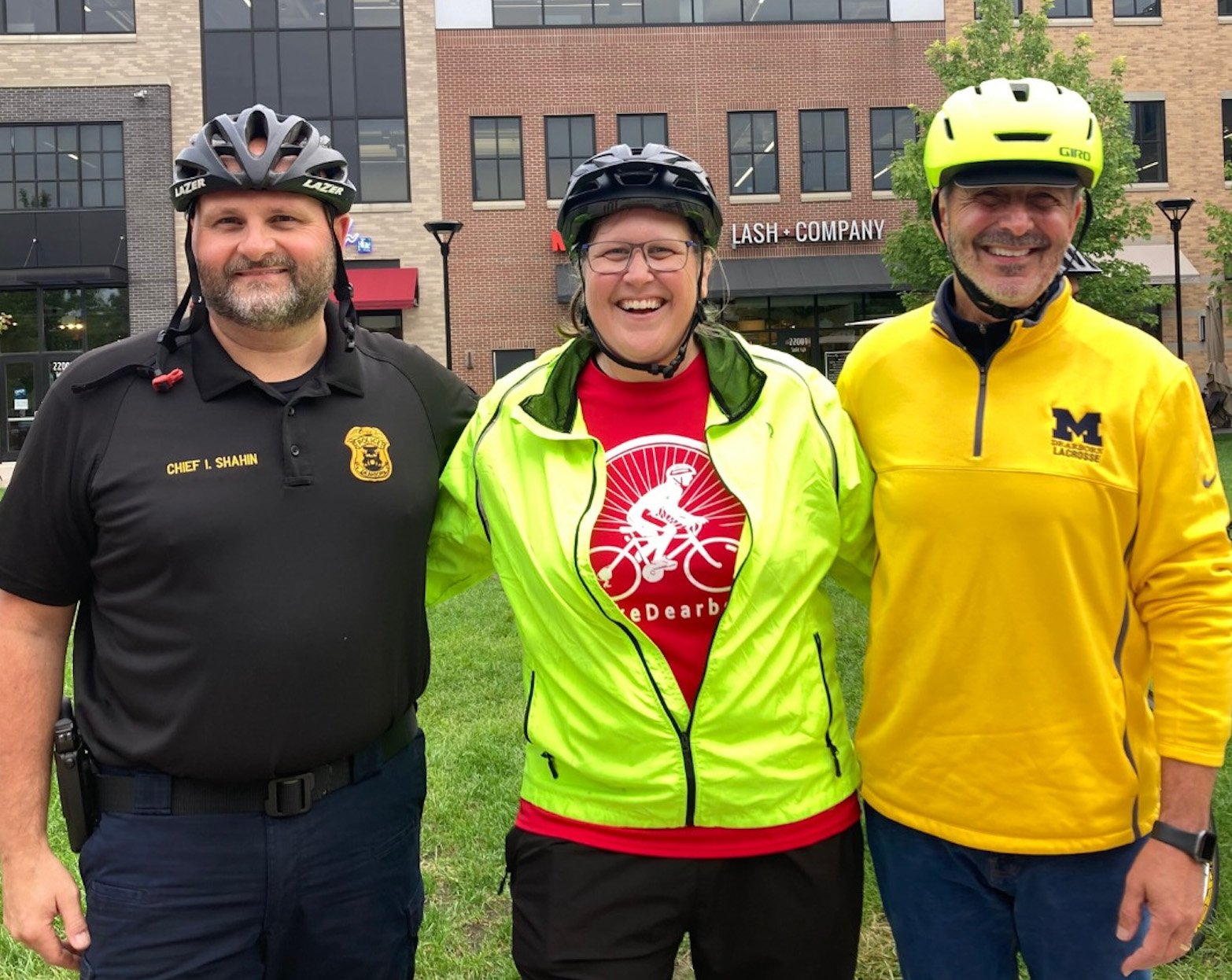
An avid cyclist, he shared his love of biking by creating a bike-friendly campus environment at UM-Dearborn and launching an annual town-to-gown bike ride co-led with the mayor of Dearborn. No surprise, he commuted daily to the Dearborn campus on his bike, a Fuji that — in the winter — he equips with studded snow tires. He typically rides to work until the temperature drops below zero degrees Fahrenheit.
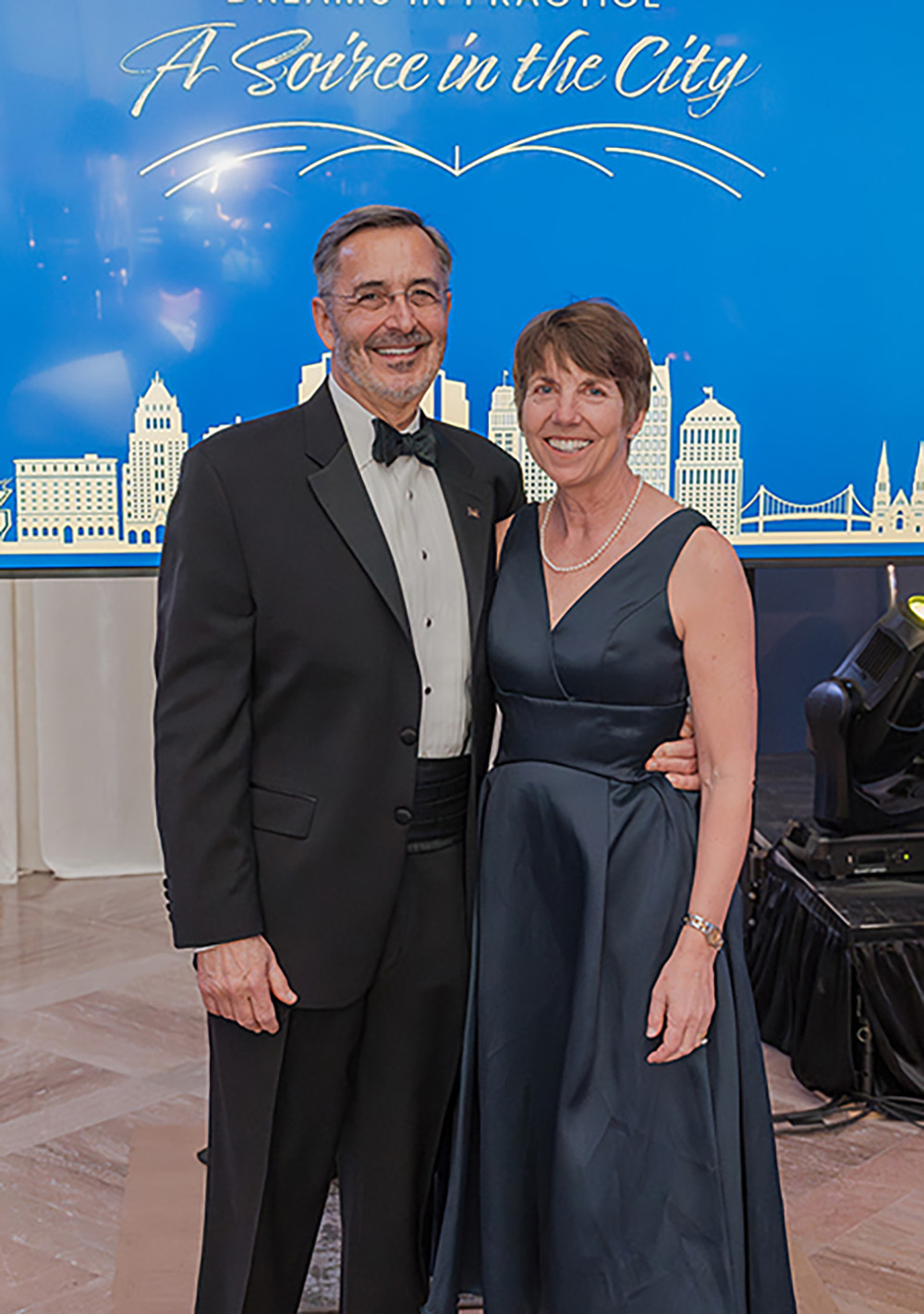
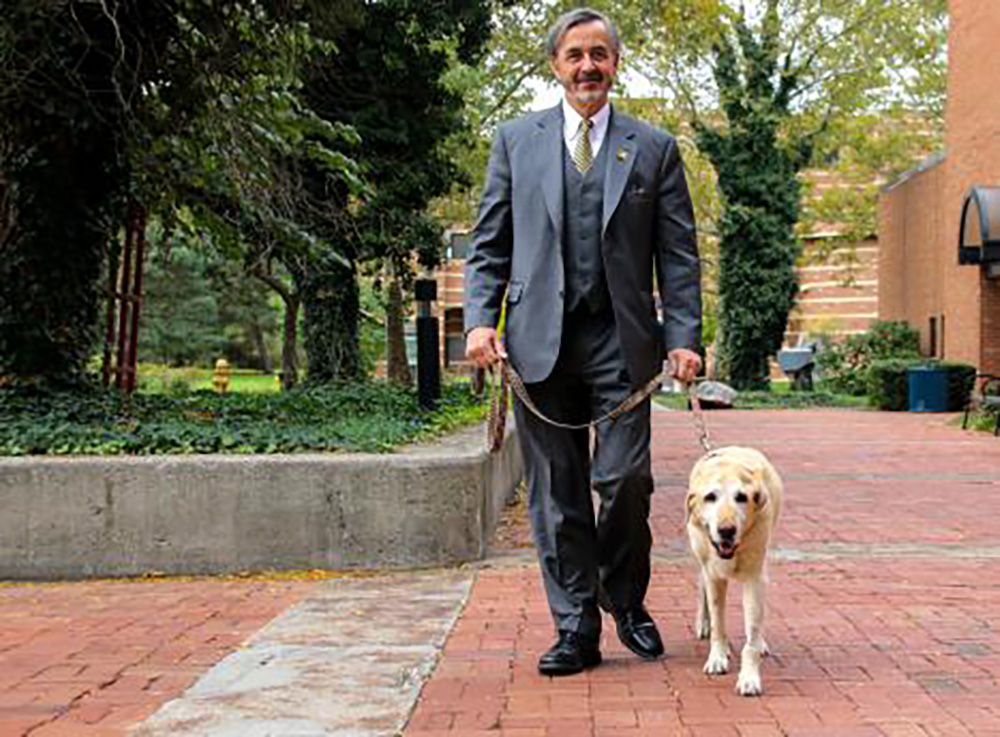
Grasso’s wife, Susan Hull Grasso, is also an accomplished engineer and U-M alumna who has a Ph.D. in public policy from Delaware. Susan has worked both in private practice for large national firms as well as in government labs and for NGO advocacy groups promoting active transportation. Together, they have four adult children. He and Susan enjoy reading, hiking, skiing, and spending time outdoors with their dogs.
Grasso also promoted a healthy and fun lifestyle for the campus community. He had pickleball courts installed behind the UM-Dearborn Fieldhouse last year. Students can be seen daily taking advantage of this popular recreational activity. Grasso is always up for a match or a friendly game of kickball.
“The University of Michigan is a respected leader in higher education because of its people — in Ann Arbor, Dearborn and Flint,” Grasso said May 8 in a welcome message to the U-M community. “I look forward to working with each of you and serving this remarkable university in the months ahead.”