Provost’s Seminar challenges traditional grading practices, offers alternatives
Examining alternative ways to assess student learning, particularly at scale in “larger” classes, was the topic of the spring Provost’s Seminar on Teaching.
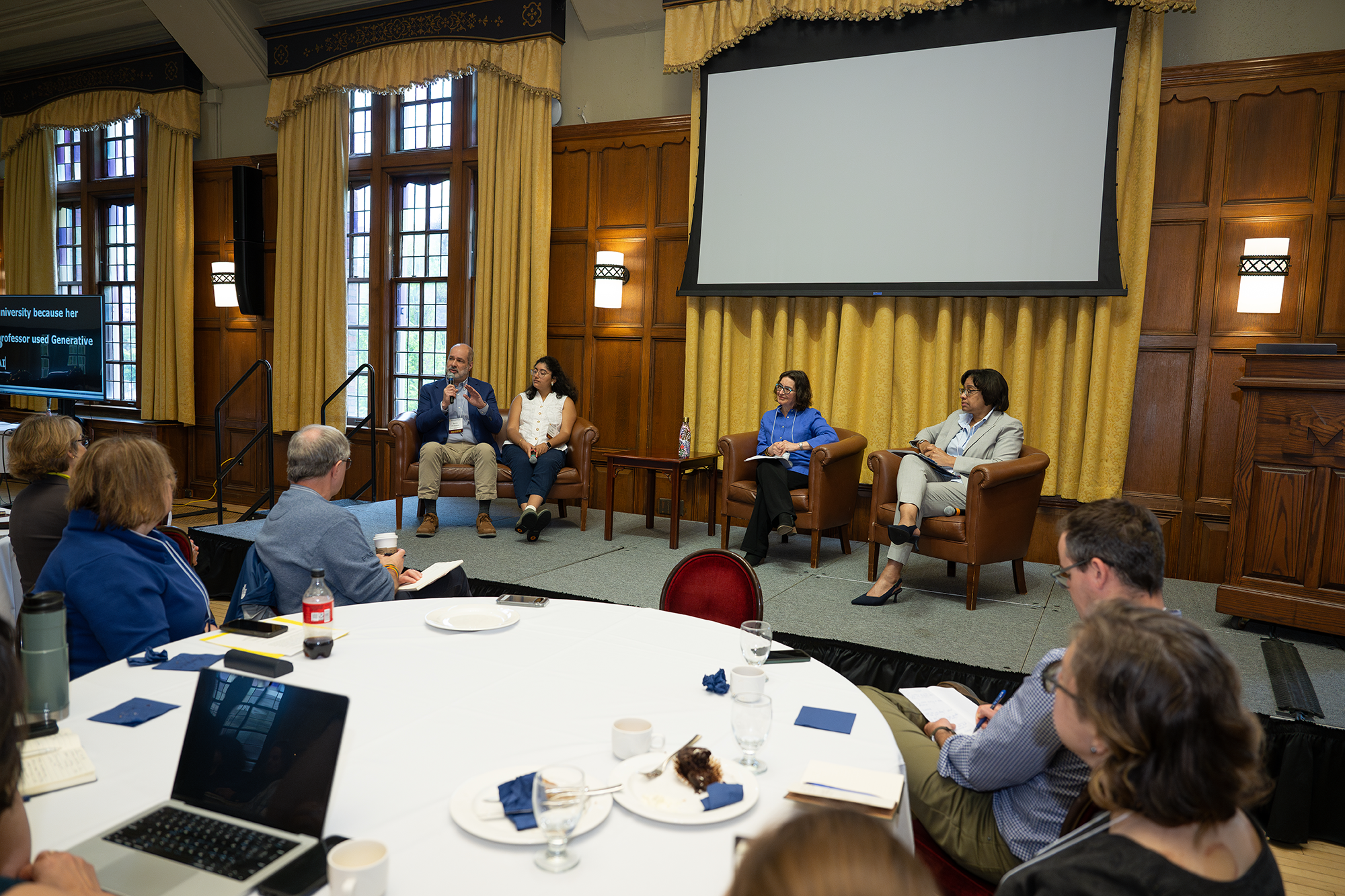
More than 110 faculty, staff and academic leaders attended the seminar, which was May 22 at the Michigan League and was co-sponsored by the Provost’s Office and the Center for Research on Learning and Teaching, or CRLT.
The growing conversation around traditional assessments and the potentially negative impacts on a student’s mental health and academic success served as inspiration for the day’s agenda, said Matt Kaplan, executive director of CRLT.
The goals of the seminar included challenging the nature of traditional grading, providing concrete examples of alternative assessments, and addressing questions and assumptions about accommodations, particularly in larger class settings.
“For many of us, rethinking assessment in larger courses requires courage and means stepping away from familiar practices,” said Laurie McCauley, provost and executive vice president for academic affairs. “But the potential rewards for both our students and ourselves as educators are substantial.”
“Think about students who struggle with high-stakes testing environments, but who can demonstrate deep understanding in other ways,” she said. “Think about students who need accommodations and how alternative assessments might create more inherently accessible learning environments.”
To contextualize the pros and cons of traditional assessments, as well as explore alternatives, Angela Dillard, vice provost for undergraduate education, moderated a panel featuring:
- Susan D. Blum, professor of anthropology at the University of Notre Dame and author of “Schoolishness” and editor of “Ungrading.”
- Barry Fishman, Arthur F. Thurnau Professor; chair of Learning, Equity, and Problem Solving for the Public Good Program and professor of education in the Marsal Family School of Education; professor of information in the School of Information; and professor in the Digital Studies Institute in LSA.
- Nita Tarchinski, research specialist in LSA and project manager of the SEISMIC Collaboration, an organization working to address inequity in STEM education.
Blum kicked off the panel discussion by providing historical context for the current debate around assessments. She pointed to the early 20th-century educator John Dewey, who advocated for a more progressive, “learning-by-doing approach to education.” She also cited the emergence in the 1960s of schools that emphasized human-centered education, such as The Evergreen State College, Hampshire College and University of California, Santa Cruz.
There have always been alternative approaches, Blum said. They just haven’t become as prevalent as high-stakes exams and other traditional ranking assessments.
The pervasiveness of those traditional assessments, however, Fishman said, makes it harder to innovate, especially in highly selective schools like U-M, where grades help determine who gets admitted.
“The infrastructures we have at the university level are very powerful and put a lot of pressure on how we think about grading,” he said, also referring to how students anticipate using their grades for their next career steps, such as graduate school admissions or job searches.
Nonetheless, mounting evidence suggests there are significant benefits to alternative approaches, and Tarchinski, who graduated from U-M with a bachelor’s in 2018 and a master’s in 2021, said she experienced some alternative strategies as a student and found value in them.
“I had two gameful learning classes during undergrad and really liked them,” she said. “Everything I did was a choice. I chose to read this article versus that article, or to do this kind of assignment. That autonomy was freeing.”
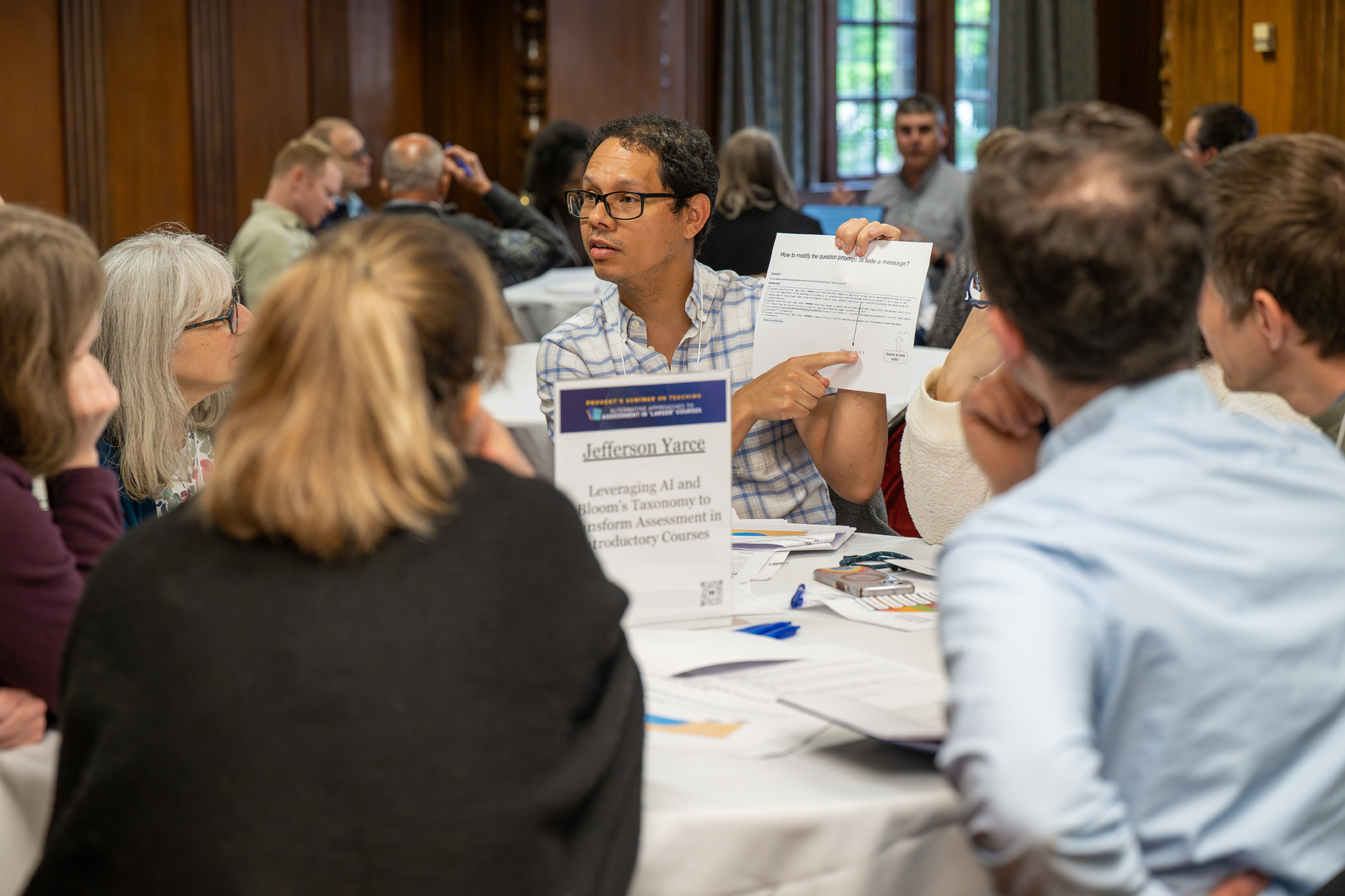
Tarchinski also shared active learning examples from her work with SEISMIC, including instances where students came up with their own exam questions and solutions, and tests that were done both individually and as a group. The latter, she said, better reflects a real-life work environment where scientists, especially, often work on teams.
Blum also acknowledged that the freedom to experiment with alternative approaches may not be equal among all instructors.
“Someone like me — a white woman and full professor at a private university with moderately sized classes — I’ve been willing to take a lot of risks,” she said.
“But I’ve talked to a lot of other people in other positions with other identities … LGBTQ people, people with disabilities, people of color, untenured faculty, people who are not native speakers, people without citizenship … and they are more vulnerable in the academy.”
MORE INFORMATION
Her suggestion: “Find a buddy … somebody who is trustworthy and also a champion. And I think you have many champions here at Michigan. There are people in positions of authority who are on your side, who are willing to go out on a limb for you and encourage alternative approaches when they’re based in research and principle.”
Blum also recommended taking advantage of current resources, such as the book “Grading for Growth” by Robert Talbert and David W. Clarke, which has an accompanying website filled with suggestions.
Fishman said approaches to grade reporting are evolving as well, and he pointed to the Mastery Transcripts Consortium, which creates high school and college transcripts that include a portfolio of student work and a list of skills, in addition to traditional letter grades.
“Mastery Transcripts is currently working in high schools to collect useful information about what students can do, and college admissions departments are willing to read these more complicated transcripts,” he said. “This may force us to go away from oversimplified metrics into something richer.”
U-M, he said, is the first college to use Mastery Transcript tools in its own transcript reporting, as it’s now part of the Learning, Equity and Problem-Solving, or LEAPS, program in the Marsal Family School of Education.
“When a student graduates from LEAPS, they receive both their traditional U-M transcript and a Mastery Transcript with the attendant portfolio,” he said.
During the Q&A portion of the panel, there was a discussion of alternative approaches in large lecture classes, as well as the need for additional financial resources for instructors who want to experiment with new assessment strategies.
Following the panel, a series of 20-minute roundtable discussions were led by faculty who are currently using evidence-based alternative approaches to student assessments. Some topics covered:
- “Gameful” active learning strategies.
- Practical alternatives to high-stakes exams.
- Leveraging AI to build new assessment approaches.
- Using teamwork to foster students learning from students.
During the roundtable discussions, stations were also set up by CRLT, Information and Technology Services, LSA Student Academic Affairs, and the Sweetland Center for Writing to answer faculty and staff questions and provide customized support.
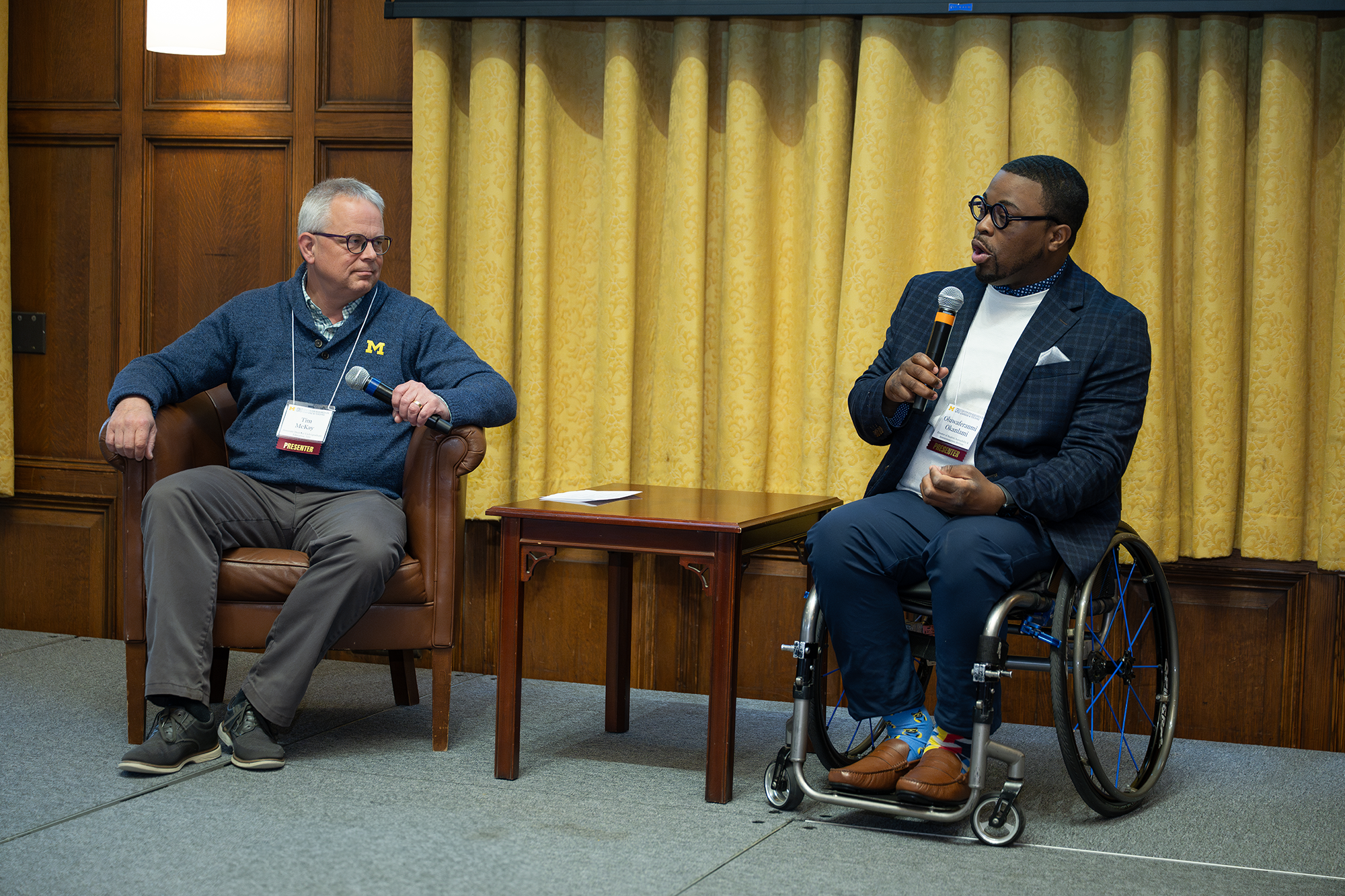
To conclude the day’s programming, Timothy McKay, Arthur F. Thurnau Professor; associate dean for undergraduate education, professor of physics and of astronomy in LSA; and professor of education in the Marsal School; and Oluwaferanmi Okanlami, director of Student Accessibility & Accommodations Services, assistant professor of family medicine, of physical medicine and rehabilitation, of urology and of orthopaedic surgery in the Medical School, addressed faculty and staff questions around accommodations and assessments, particularly at scale.
Among the issues discussed: providing accommodations in a clinical setting; how alternative approaches to assessments may lessen the need for accommodations; improving communication between faculty and the Student Accessibility & Accommodations Services; and the need for more resources at U-M, as the demand for accommodations has grown.