More than ever, U-M degree pays off for students
A bachelor’s degree from the University of Michigan is affordable, rewarding, valuable and in-demand.
During a special presentation June 12 to the university’s Board of Regents, UM-Ann Arbor Senior Vice Provost for Academic and Budgetary Affairs Tom Finholt broke down data that reinforces a UM-Ann Arbor degree as a strong return on investment for students, the state and the country.
“Public skepticism about higher education has never been higher, and many are now asking: Is a college degree still worthwhile,” Finholt said. “Not only is it worthwhile, but U-M shows the critical role that higher education plays in preparing students for careers that increasingly require a four-year degree.”
Affordability, value
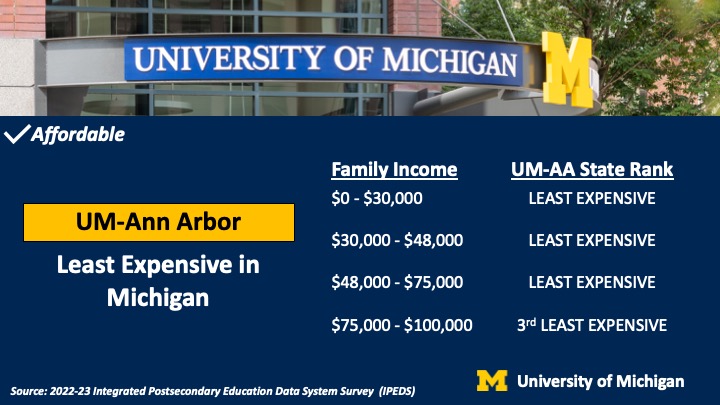
A UM-Ann Arbor degree is the least expensive among the state’s 15 public four-year institutions for resident undergraduates who rely on financial aid to afford college, Finholt said.
According to the Integrated Postsecondary Education Data System survey, UM-Ann Arbor’s net price is the least expensive for resident undergraduate students from families with incomes up to $75,000 and the third least expensive for students from families with incomes of between $75,000 and $100,000, trailing only UM-Flint and UM-Dearborn.
UM-Ann Arbor is also the only public institution in Michigan that guarantees to meet full demonstrated financial need for resident undergraduate students.
“This is the result of our commitment to financial aid programs like the Go Blue Guarantee … that was recently expanded to provide free tuition for resident undergraduate students from families with incomes of up to $125,000,” he said.
And that affordability directly results in a significant return on investment.
According to the Georgetown University Center on Education and the Workforce, Finholt said that on average, UM-Ann Arbor graduates achieve a $2.8 million return on their educational investment during their careers, $1 million more than those who receive bachelor’s degrees from other institutions.
In demand, rewarding
“U-M’s degree value is also demonstrated by the leading Michigan and global companies hiring our graduates and by the critical industries they serve,” Finholt said.
More than 116,000 UM-Ann Arbor alumni are working in Michigan, well represented in Fortune 500 companies and major Michigan-based employers. In addition, UM-Flint and UM-Dearborn both report that the overwhelming majority of their graduates join the Michigan workforce.
Demand for these graduates continues to grow. Finholt pointed to a Georgetown Center on Education and the Workforce survey, which indicated the number of jobs that require a four-year degree is projected to increase by 15.6 million over 10 years. Over the same period, the study anticipates a decline in jobs requiring less than a four-year degree.
And UM-Ann Arbor graduates overwhelmingly describe their educational experience as rewarding.
A 2023 survey of UM-Ann Arbor alumni who graduated in 2013 and 2018 showed that 87% were satisfied with their educational experience, 90% were satisfied with their career so far and 90% believed they work in a position that is meaningful.
“Now as ever, U-M remains a wise investment for students and their families,” Finholt said.