The view from 70,000 feet
Elevation
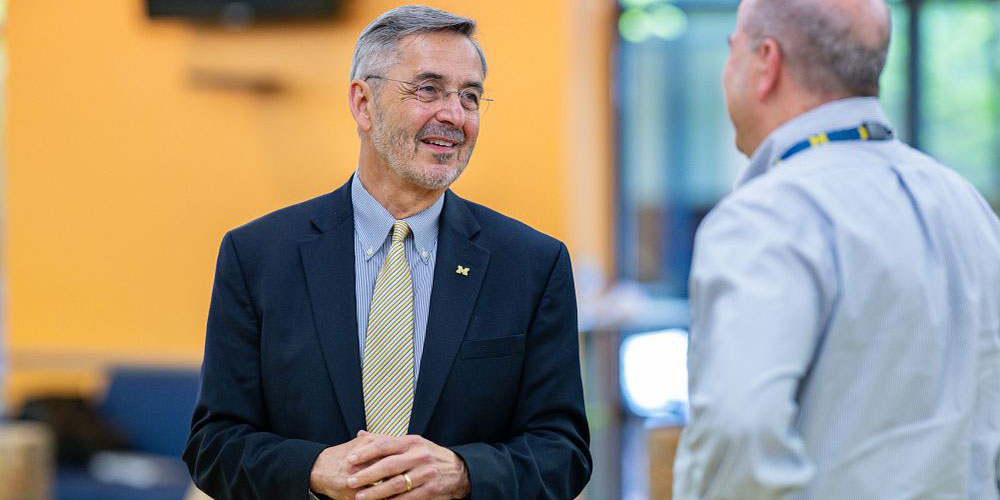
As Domenico Grasso, PhD ’87, settles into his role as University of Michigan president, he has U2 on the brain.
But it’s not Bono lurking in the gray matter. Nor is it the Edge, Adam, or Larry.
“I’m talking about the spy plane that flies at 70,000 feet,” says Grasso, an environmental engineering graduate and U.S. Army veteran who resigned his commission at the rank of major. Most recently, he served as UM-Dearborn’s sixth chancellor and professor of public policy and sustainable engineering.
Much like the metaphorical pilot of a U2 aircraft, any high performing institutional leader needs to assess the landscape from horizon to horizon — in the past and going forward.“At the same time, a good leader has to know when to ‘land on Earth,’ make decisions and get involved in the details,” he says.
Grasso assumed the presidency on May 8 following Santa Ono’s resignation. He has expressed his desire to serve in the interim role only. He plans to retire from the University once a permanent president is hired.
He took the helm during a tumultuous period in higher education marked by national student unrest over the war in Gaza, a rise in anti-Semitism on campuses, the dismantling of DEI, and a transition to revenue-sharing in college athletics. The federal government has contributed to the on-campus chaos as well: calling presidents to testify before Congress, cutting funding for critical research, and investigating the legal status of international students.
When asked which issues keep him up at night, Grasso replies: “All of them.”
Sweetest thing
The University’s top job may have come at an “odd time” for him, but Grasso says his Wolverine pride motivated him to give back to the institution he reveres. His alumni status offers a keen advantage; he often refers to the book “View from the Helm” authored by the late James Duderstadt, U-M president from 1988-96.“Jim wrote that a president of any university should understand the saga of that university to be successful,” says Grasso. “You have to protect the legacy that the institution is known for. You also have to protect the institution, in terms of both physical protection and intellectual protection.”
And what better protector than a passionate graduate who, as a student, often walked past the president’s residence that he now calls home?
“It is remarkable that I live there,” he says of the palpable history permeating the oldest building on campus. “I mean, if you go to Michigan, what more magnificent dream would you have other than to be president of the University of Michigan?”
Rattle and hum
Grasso says he seeks to distinguish his term by nurturing a close-knit community that encourages diversity of thought and intellectual freedom. It’s a delicate balance, he says, as U-M and other universities contend with ideological and cultural disunity, on and off their campuses. Social media “doxxing,” a malicious act in which a poster’s personally identifiable information is published, is increasingly used by online agitators to silence productive discourse, even around seemingly apolitical research and faculty expertise.
“Even though we may have differences of opinion, I hope we can engage civilly and with empathy and try to talk through things,” Grasso says. “We want people to engage in difficult conversations because it’s those conversations that move society forward.”
Now, more than ever, it takes integrity and conviction to listen to opposing viewpoints and seek compromise, Grasso says.
“It comes down to intellectual empathy. A good leader has to be able to get in a room, or out on campus where people are disagreeing, and understand the varying perspectives and where folks are coming from. Then you can start looking for solutions,” he says.
It’s a beautiful day
Get to know President Grasso in this video interview with U-M student Sydney Cyprian.
Songs of experience
Grasso is intent on rebuilding America’s trust in higher education, with U-M leading the way. The University reported a record $2.04 billion in research volume during fiscal year 2024, including $1.17 billion in federally sponsored research expenditures that led to groundbreaking medical treatments, energy solutions, advanced space exploration, and cutting-edge defense technologies. The University’s research partnerships in Detroit and throughout the state impact education, health care, economic development, and the Great Lakes, to name a few.
“We need to explain to everybody from the Congressperson in Washington, D.C., to the farmer in the UP why the University of Michigan is so important to their personal well-being, their future, their children’s future, and the well-being of the country,” Grasso says. “We do this through quality health care, life-changing education, and a stimulating environment that fosters new knowledge, creativity, and service to society.”
He cites the 1955 announcement at Rackham Auditorium by epidemiologists Tommy Francis Jr. and Jonas Salk regarding the efficacy of the polio vaccine, as just one example: “It’s mind-torturing what people now take for granted as a result of all the work that’s been done on university campuses,” he says.
Wide awake in America
Touting the value of a college degree is challenging when economic uncertainty dominates the national narrative, so Grasso is focused on informing constituents about “how we’re using resources, and how we’re educating our students.”A degree from the Ann Arbor campus pays off: It is the least expensive among the state’s 15 public four-year institutions for resident undergraduates with family incomes under $75,000 who rely on financial aid for college. For families with incomes between $75,000-$100,000, UM-Dearborn and UM-Flint are the least expensive for resident undergraduates.
Evidence shows that a U-M graduate holding a bachelor’s degree on average earns $1 million more in salary over a lifetime than alumni of other American universities. “People will pay a premium for a Michigan graduate,” Grasso says.
He lauds the menu of U-M’s tuition-assistance programs, including the Go Blue Guarantee, which provides free tuition to students from families with a net income of $125,000 or less, and assets below $125,000. Focusing on need-based financial aid, as he did at UM-Dearborn, strips away the “concept of privilege” and opens the University’s door to students with viewpoints and talents across the economic spectrum.
International students also contribute to diversity of thought, but they are under intense scrutiny today from a federal government focused on immigration reform. Recently, U-M made international headlines when two Chinese researchers based in Ann Arbor were charged with smuggling a biological pathogen into the U.S.
Grasso warns against the tendency to criminalize all international students based on the perceived behavior of a small group. Security concerns are paramount, he says. In an email to the University community he wrote: “We are cooperating with federal authorities and reviewing our internal practices to protect the community, national security, and all aspects of our research enterprise.”
All that you can’t leave behind
U-M’s Board of Regents cited several significant successes at the Dearborn campus as examples of Grasso’s effective leadership, including that transition to a need-based financial aid model, the increase of its four-year graduation rate by 16%, and more than doubling external research funding that allowed the campus to achieve R2 status, a designation from the Carnegie Foundation for the Advancement of Teaching and the American Council on Education. As UM-Dearborn chancellor, Grasso also served as an executive officer of the University.
Prior to returning to U-M, Grasso served as provost and chief academic officer at the University of Delaware. Earlier, he held posts as Smith College’s Rosemary Bradford Hewlett Professor and founding director of the Picker Engineering Program — the first engineering program at a women’s college and one of the few at a liberal arts college in the U.S. He also served as dean of the College of Engineering and Mathematical Sciences and vice president for research at the University of Vermont.
Grasso has published extensively in the areas of environmental science and engineering and has been cited extensively. In addition, he has held several high-profile advisory posts, including fellow on NATO’s Committee on the Challenges of Modern Society, technical expert to the United Nations Industrial Development Organization, vice chair of the Science Advisory Board for the U.S. Environmental Protection Agency, and president of the Association of Environmental Engineering and Science Professors.