Black Friday, 1908
Rush or riot?
Ritual warfare between freshman and sophomore men had erupted every autumn at Michigan since at least the Civil War. But Black Friday, Oct. 9, 1908 — the appointed day for that year’s battle — looked like it was going to be especially nasty.
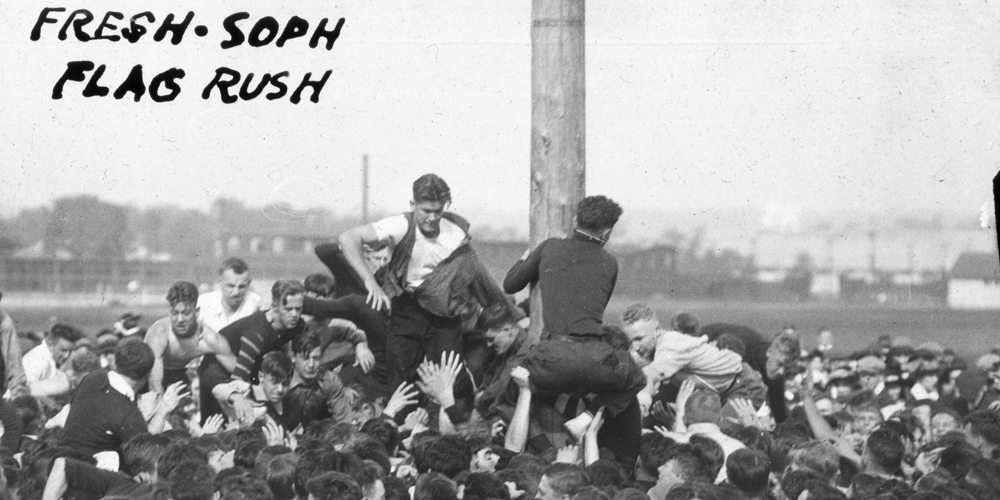
The annual event universally known simply as “the rush” was barely tolerated by faculty and administrators. They had tried to channel freshman-sophomore mayhem into a single event — a pole rush, where each side tried to get one of their number up a pole to capture a flag — with hostilities in the weeks beforehand strictly forbidden.
But in 1908, skirmishes flared early in flat defiance of the rules.
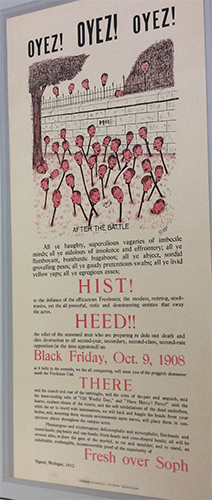
As usual, both sides paid for the printing of gruesome posters — called “procs,” short for proclamations — to advertise the affair and offend the other side. On Saturday afternoon before Black Friday, sophomores got a tip that stacks of frosh posters were due to arrive late that night from a print shop in Ypsilanti. So lookouts were posted at the “Ypsi-Ann” streetcar station and the Michigan Central depot. They spotted the arriving packages and passed the word: Freshman “procs” would likely be posted overnight.
Ambushed
Meanwhile, some 500 freshmen had gathered that evening on Medic Green, the open field at the northeast corner of the Diag. They marched around the campus 12 abreast, shouting and singing, then paraded downtown in a long single file — and laid plans to plaster the town with copies of their “proc.”
The poster was especially provocative that year, with an image of sophomore heads on pikes and a snarly warning to “all ye abject, sordid, grovelling pests…ye egregious asses…,” the “second-year, secondary, second-class, second-rate opposition.”
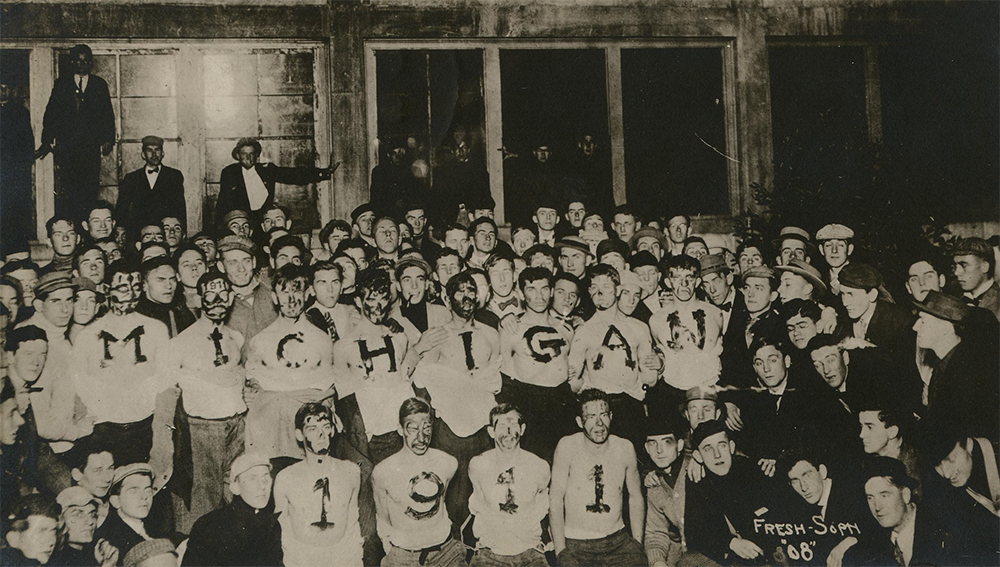
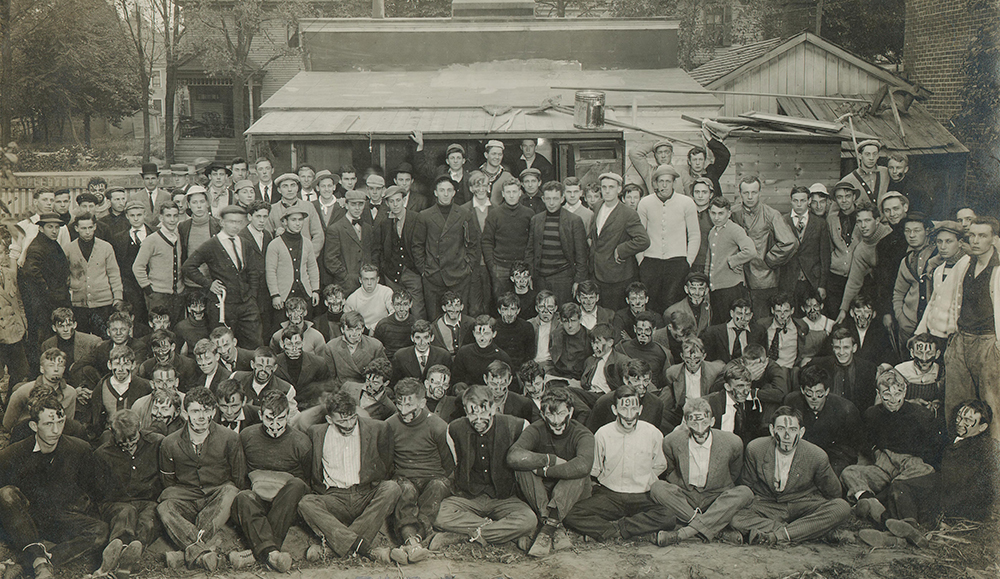
Sophomores had made a plan of their own. They split up into squads and deployed in the streets at 1 a.m. Frosh bearing posters were caught by surprise, roped together, shoved around, face-painted, and corralled to be photographed en masse. Others were dragged out of fraternities and rooming houses.
Rotten-egg shampoos
President James Burrill Angell had issued warnings against any pre-rush outbreaks that might turn violent. So did the upperclassmen of the Student Council and the editors of The Michigan Daily, who smelled something ugly in the wind. The officially sanctioned events of Black Friday itself were one thing, the editors said. But a spontaneous rush could become a riot, “and a disgraceful one at that.”
And so things went on Wednesday and Thursday. “Premature hostilities” did turn a little ugly. Sophomores grabbed freshmen and administered sour-milk-and-rotten-egg shampoos. Passing women were propositioned. A freshman was dragged from his bed in his pale blue pajamas and thrust into the popular Granger’s Dance Academy on Maynard Street. “I think it’s a shame to have them act like this after we do our best to please them,” Mrs. Granger said. “There are some awful cads.”
Meanwhile, the Student Council set new rules for Black Friday’s main event. A flag would be nailed to the top of a 30-foot pole — 10 feet taller than in past years, and covered with grease this time — then raised on Medic Green. The freshmen would defend the pole for 30 minutes. If a sophomore could grab the flag in that time, the sophs would win. If not, the victory would go to the frosh.
No ladders or ‘sharp instruments’
No ladders would be permitted, nor “sharp instruments of any kind.” With just one referee looking on, hand-to-hand combat between 2,000 young men would decide the result. Upperclassmen would attempt to hold back freelance brawlers among the spectators.
No wonder onlookers worried.
The Daily remarked on Michigan’s fine reputation for “the clean, true, sportsmanlike attitude of her athletes” — yet the rush in recent years had seen students treat each other in ways “that can only be characterized as foul.”
Harry Burns Hutchins, dean of the Law School and soon to succeed Angell as president, declared the rush “an abomination, a disgrace to an American university!
“I am sick of this whole rushing business. The peace is broken and property is destroyed. After an affair of this kind, how can we go to Lansing and ask the legislature to make us appropriations? The first thing they do is to throw the rush up into our faces. They say this rush business is unworthy of a state institution, and they are right.”
The pole rush
Black Friday arrived. Five thousand spectators milled on Medic Green. At 7:35 p.m., the referee, A.G. Schulz, fired his pistol to start the pole rush.
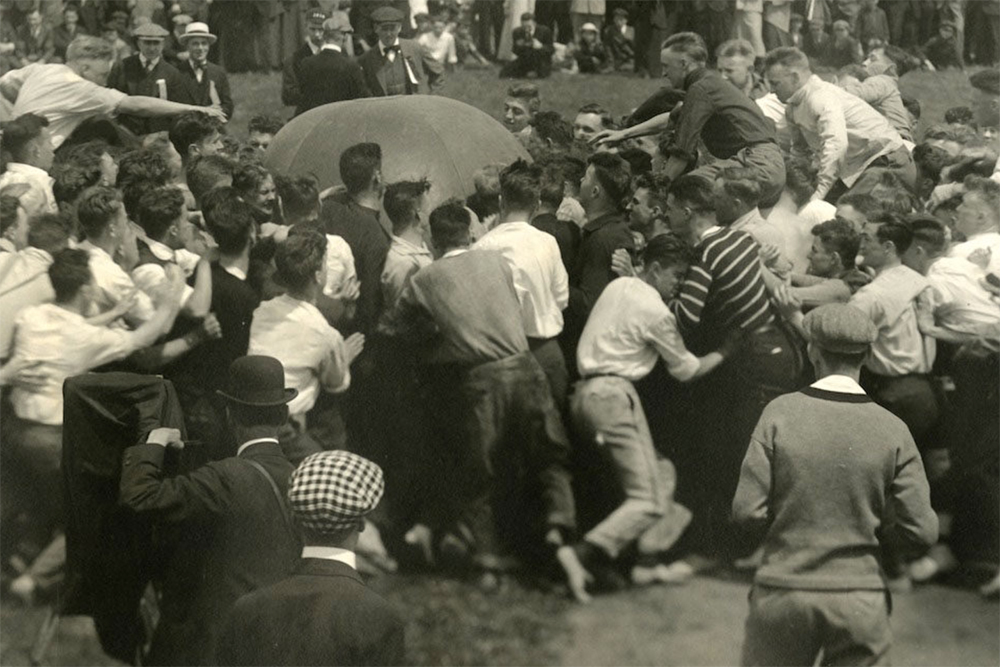
One phalanx of sophomores smacked into the freshmen defenders from the north. A second came bruising in from the south. They heaved one man above the frosh defenders’ heads, then another and another. The referee stepped in more than once to let an injured man leave the fray. Then the battle resumed.But at 30 feet, the new pole was just too tall. No sophomore could get more than halfway up. The sophs produced a ladder and sent a man up for the flag. But the ladder violated the rules, so Schulz declared the freshmen winners by a technicality.
By that point, clots of sophomores had begun to turn on individual freshmen, muscling them over to nearby elms and chasing them into the branches with flailing belts and switches.
Then, according to witnesses, 30 or 40 sophomores seized two freshmen, stripped them of all their clothes except shoes and socks, and chased them through the crowd — in full view of women and children. Upperclassmen stepped in, got the naked first-year men into clothes and bundled them away. But more freshmen were chased and half-stripped. Several were taken to University Hospital.
Or so it was reported at length in the next day’s editions of The Detroit News — precisely the sort of awful attention that Dean Hutchins had warned about.
Some cried foul, saying the out-of-town journalists had exaggerated. But The Daily backed up the News’ reporting, even expanded on it, and said that faculty, upperclassmen, and townspeople had all been “disgusted by the hideous performances of the past week.”
A case for prohibition?
In the following days, outrage ensued. Some said even this year’s rush was no more than “dangerous fun.” But others were quick to cite the incident as prima facie evidence for the rising cause of Prohibition.
A professor in the Medical Department went public with a fact that had been obvious to onlookers — many Black Friday brawlers had been drunk. “Alcohol is the cause of most of the disgraceful acts committed by collegians,” Dr. James F. Breakey remarked. “Not only is this true of Michigan but of every university in the country.”
Victor Vaughan, dean of medicine, agreed. He had never been a prohibitionist, he said. But Black Friday — an “obscenity” — had changed his mind. If given the chance, he would vote to make Washtenaw County “dry.”
President Angell had been trying to curb the rush since his arrival on campus nearly 40 years earlier. Now he said: “If anyone can inform us how to do away with it, we will listen to their advice very gratefully.”
Nobody could. The rush went on, year after year, until the 1930s, when the Great Depression shocked a new generation of students out of the long tradition of “dangerous fun.”
Sources included the Michigan Daily and the Detroit News. Lead image, courtesy of U-M’s Bentley Historical Library, features freshmen and sophomores in a pole rush on Black Friday 1915.