Campus briefs
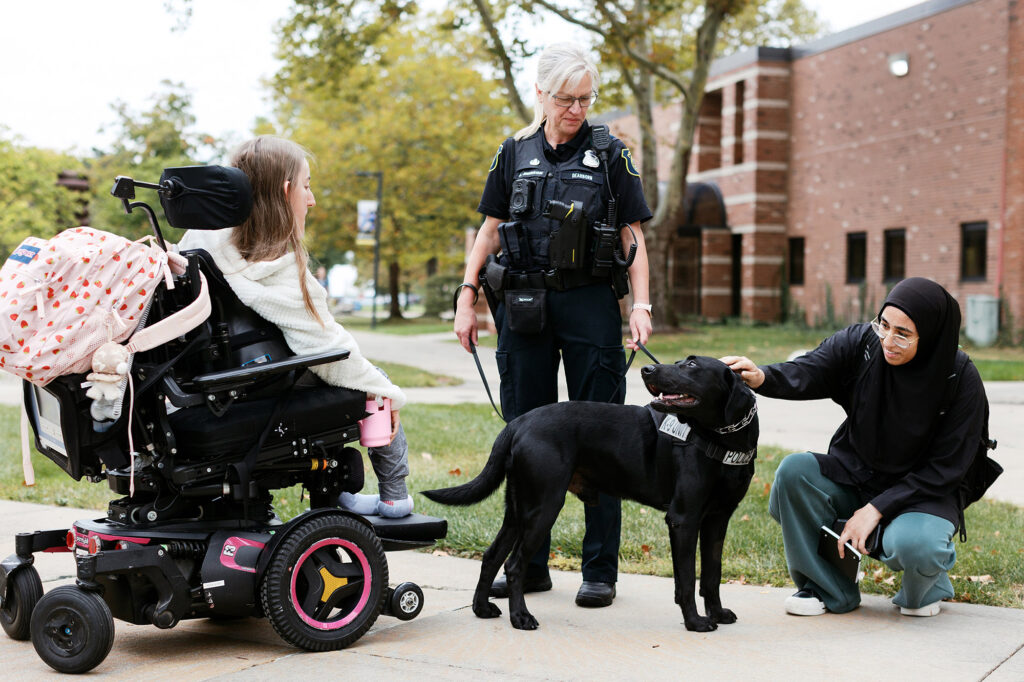
Bruce makes his debut as the first police dog at UM-Dearborn
UM-Dearborn Police Chief Paul Tennies said having an explosives detection dog permanently on the UM-Dearborn campus was a major priority for former UM-Dearborn Police Chief Dave Hawkins, who’s now serving as director of UM-Ann Arbor’s University Security and Safety Services. In July, the team got their wish when Bruce, a 2-year-old black lab, started at UM-Dearborn. Bruce’s handler, Officer Jennifer Jackson, said Bruce completed some initial training with UM-Ann Arbor’s master trainer, where the pup was introduced to scents of common materials used in explosive devices. While being exposed to these scents, Bruce was given a reward — Jackson said the food-motivated lab preferred treats to toys — which teaches the dog to associate scent detection with positive reinforcement. Dogs are also taught a specific alert behavior to indicate when they’ve found something suspicious. Jackson and Bruce then completed an additional six-weeking training in Ann Arbor, where the two learned to work as a team. Tennies stresses that Bruce was not “hired” due to any specific threats but because having regular explosive-sniffing capabilities is a public safety best practice. For more about Bruce.
UM-Flint library receives $600K gift from estate of retired librarian
The legacy of Dorothy Gae Davis, associate librarian emerita, is one of decades of service and selfless giving. Davis served as a librarian at the University of Michigan-Flint for 31 years, retiring from her role as government documents associate librarian in 2008. After her passing earlier this year, the university learned that Davis’ trust bequeathed $600,000 to the Frances Willson Thompson Library — a lasting capstone to her lifelong support of UM-Flint. “The generous estate gift from Dorothy Davis stands as a powerful testament to the enduring impact of faculty and staff who dedicate their careers to the university,” said Shari Schrader, vice chancellor for university advancement. “It is deeply inspiring to witness colleagues who, even after retirement, remain committed to our mission and feel compelled to invest in the success of future generations. Their legacy not only enriches the lives of our students but also sets a profound example of lifelong dedication and support for our academic community.” According to Jennifer Dean, Thompson Library director, a twofold strategy will maximize the impact of Davis’ gift. A portion of the money will be used now to update and renovate select library spaces, while the remainder will create a quasi-endowment. For more on the gift.
CEW awards over $1M in scholarship and fellowship funds
CEW is pleased is welcoming the 2025-26 cohort of the CEW Scholar Community. The center has identified 102 new scholarship recipients, 13 continuing scholars, and 17 graduate fellows. CEW awarded over $1 million in scholarship and fellowship funds to these resilient and determined agents of change thanks to the generous support of individuals, organizations, clubs and foundations. Among the current class of scholarship recipients are student parents and primary caregivers, students returning to the classroom after a prolonged interruption, underrepresented students in STEM fields, first-generation students, international students and those who have overcome significant obstacles to achieve their dream of earning a degree in higher education. CEW fellows are engaged in research of importance to women, researching or traveling abroad while completing a health degree, or working to remove barriers impacting advocates and allies striving for social change. These individuals were selected through a highly competitive process as leaders with great potential to make a significant impact in their field. The 2025-26 CEW Scholar Community inductees include 32 doctoral students, 55 master’s students, and 32 undergraduate students, 98 of whom are studying on the Ann Arbor campus, 16 at UM-Dearborn and five at UM-Flint. Scholarships range from $1,000 to $11,000 with a few larger awards, which can cover tuition, fees, and living expenses, and fellowships ranging from $1,500 to $5,000 support research and travel. The average award amount for a 2025-26 CEW Scholar is over $8,800. For more on the scholars and the scholarships.
Common hospice drugs linked to higher death risk in people with dementia
Hospice care aims to bring comfort, peace, and dignity to patients at the end of life. Yet for the growing number of Americans with dementia who enter hospice, their course is often long and unpredictable — making it especially important to ensure treatments align with each person’s goals and stage of illness. A U-M study published in JAMA Network Open finds that medications commonly prescribed to ease symptoms such as agitation, anxiety, and delirium — benzodiazepines and antipsychotics — may carry major unintended risks for people with dementia receiving hospice care. Among more than 139,000 nursing home residents with Alzheimer’s disease and related dementias enrolled in hospice between 2014 and 2018, those who began taking a benzodiazepine or an antipsychotic after enrollment were 41% and 16% more likely to die within six months, respectively, than very similar hospice patients with dementia who did not receive these medications. “Dementia is now the most common qualifying condition among hospice enrollees, yet many of these patients are not imminently dying,” said Lauren B. Gerlach, lead author and assistant professor of psychiatry in the Medical School. “Because prognosis in dementia is so difficult to determine, nearly 1 in 5 patients will outlive the six-month eligibility window for hospice. This makes it critical that medications used during this period enhance, rather than diminish, quality of life.” For more on the study.
— Compiled by Jeff Bleiler, The University Record