Professor bringing Count Basie Orchestra to Ann Arbor
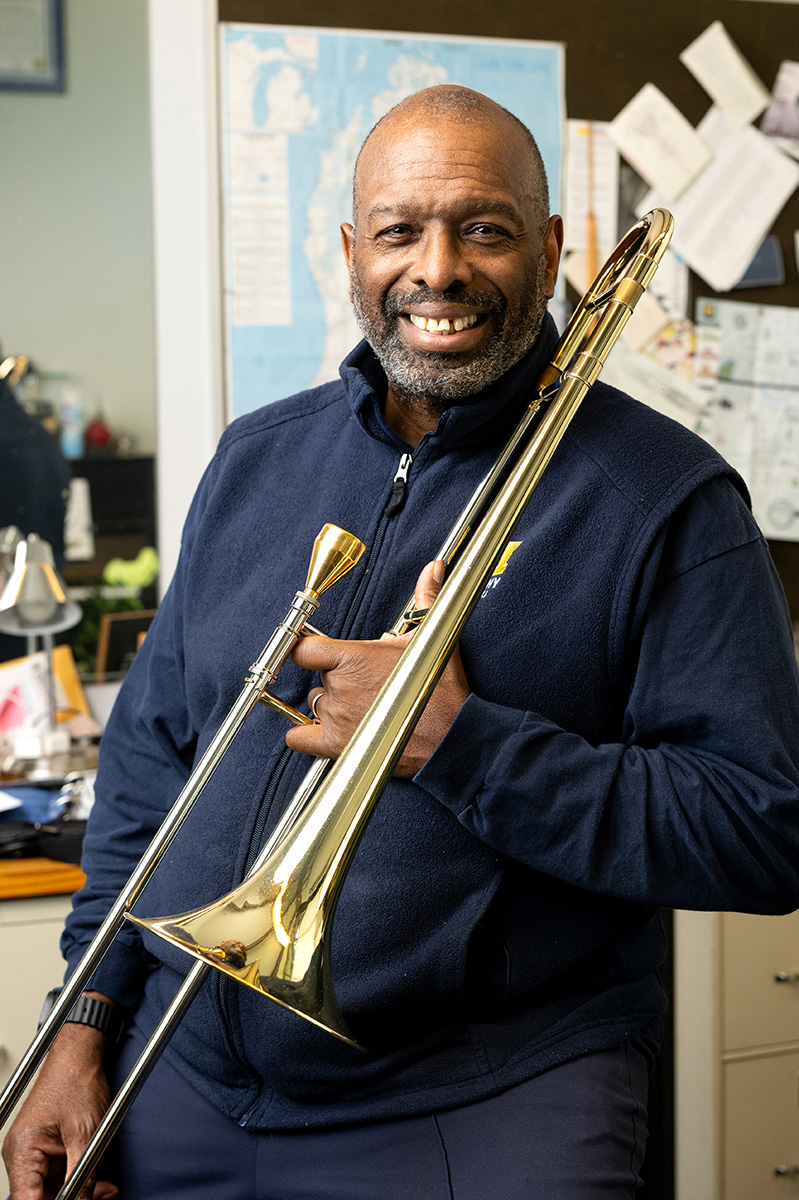
On Oct. 24, the Power Center in Ann Arbor will reverberate with the swing of the legendary Count Basie Orchestra. For Dennis Wilson, associate professor of jazz at the School of Music, Theatre & Dance, the evening will be a culmination of decades of devotion to music education.
A trombonist, composer, arranger and one-time member of the Count Basie Orchestra, Wilson sees the concert as an opportunity to unite generations of musicians on stage in celebration of the Count Basie Orchestra’s 90-year legacy and the enduring power of jazz.
Founded in 1935 by pianist and bandleader William “Count” Basie, the Count Basie Orchestra became a defining ensemble of the swing era. The band toured internationally and collaborated with well-known performers, including Ella Fitzgerald, Frank Sinatra and Tony Bennett. Today, it remains one of the longest-running jazz orchestras.
Musical beginnings
Raised in West Babylon, New York, Wilson’s path to music began in high school, where his band director regularly brought in jazz luminaries, including Lionel Hampton, a jazz vibraphonist, percussionist and band leader.
By his junior year at Berklee College of Music, Wilson was playing trombone in Hampton’s band. That gig launched him into a career that would span collaborations with some of jazz’s best-known artists.
After graduating from Berklee, Wilson joined Count Basie and his orchestra in 1977. He remained with Basie for a decade. Along the way, he performed and recorded with Fitzgerald, as well as Diane Schuur, the Dizzy Gillespie Big Band, and the Carnegie Hall Jazz Band.
Wilson describes his years with Basie as transformative: “You had to say something when you played — not just show your technique, but tell a story. That’s how you connected with an audience,” he said.
Following his years on the road, Wilson turned toward education, first serving as an assistant dean at Kansas State University before joining U-M as a professor in 2000. At Michigan, he has combined his professional expertise with his passion for teaching, mentoring generations of student musicians while continuing to perform, arrange and produce music.
Remembering Basie
One of the centerpiece works of the upcoming concert is Wilson’s composition “Dark Morning,” written after Basie’s death in April 1984.
“I was living on Long Island, and it was late at night when I got the call from Sonny Cohn, the band manager, that Basie had passed,” Wilson said.
Wilson sat at his piano and composed until dawn. “The sun was coming up, but it was still dark. The clouds were heavy, the light muted. It was the perfect metaphor for how I felt,” he said.
The piece became Wilson’s tribute to Basie. For years, it existed primarily on paper, occasionally performed live but never recorded.
At the urging of fellow musician Johnny Williams, Wilson finally recorded “Dark Morning” with the Count Basie Orchestra about a decade ago. On Oct. 24, the work will be performed jointly by the Michigan Youth Jazz Orchestra and the Count Basie Orchestra.
The power of collaboration
Wilson has been planning this concert for years, aligning it with the Basie Orchestra’s 90th anniversary. His goal is as much about education as performance.
Event details
- SMTD | Count Basie Orchestra: Mélange Concert
- Friday, Oct. 24 at 8 p.m.
- Power Center for the Performing Arts
- Get tickets
“This concert had to happen now,” he said. “Part of celebrating the 90th year is celebrating music education. Basie’s music has probably been played by more young musicians around the world than any other jazz repertoire, even Duke Ellington. The style of Basie endures.”
The run of show reads like a jazz festival compressed into one evening, with most works arranged or composed by Wilson. Titles like “Sittin’ with the Kids” and “T.T.T.” (“the two tenors”) showcase his creative voice, alongside classics like “One O’Clock Jump.”
Wilson also collaborated with songwriter Roberta Fabiano on “I Didn’t Sing with Basie, But I Sho’ Will Swing His Band.” That work will be performed by Carla Cook, a Detroit-born, Grammy-nominated jazz vocalist.
The second half of the program will feature U-M alumna and former Michigan Poet Laureate Nandi Comer presenting a poem she wrote using the “golden shovel” technique, in which each line ends with a word from a source text — in this case, a line from the Declaration of Independence.
Wilson is pairing Comer’s poem with musical work involving the Telegraph String Quartet, Basie saxophonist David Glasser, trumpeter Ed Sarath, pianist Andy Milne, and bassist Robert Hurst. The ensemble will improvise around Comer’s recitation.
“It will never sound the same way twice,” Wilson said. “That’s the beauty of jazz. It’s spontaneous, responsive, alive.”
Pulling together such a multifaceted production is no small feat. Wilson spent his recent sabbatical composing and arranging the program, much of it while working in Osaka, Japan, where he could write in peace.
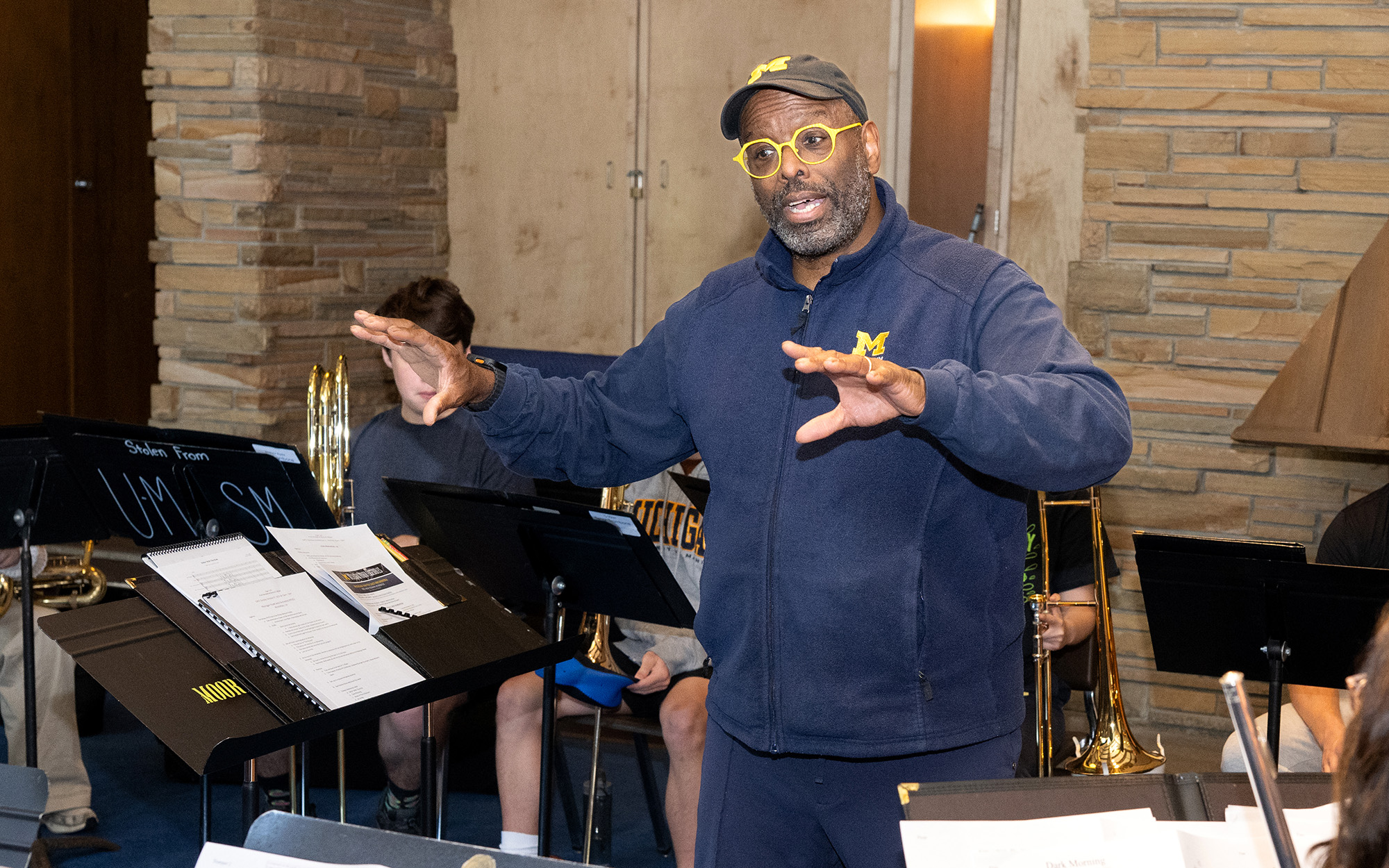
Now back on campus, he is leading twice-weekly rehearsals, preparing student and faculty ensembles for the moment they’ll share the stage with one of jazz’s most storied bands.
“When the Basie Orchestra arrives, there’s only one day of rehearsal together,” Wilson said. “That means every student and faculty member has to be fully ready.”
Teaching the next generation
For Wilson, the concert is more than a performance; it is a teaching moment. He sees it as an opportunity for young musicians to absorb lessons that can’t be taught in the classroom.
NOMINATE A SPOTLIGHT
- The weekly Spotlight features faculty and staff members at the university. To nominate a candidate, email the Record staff at urecord@umich.edu.
“I want students to learn how to improvise by telling a story,” he said. “It’s not about showing off your chops. It’s about making people feel something.”
Wilson admits that the concert is among the most ambitious projects he has undertaken at U-M. Coordinating international musicians, guest artists and multiple ensembles — all on a budget — has been a logistical challenge.
At one point, he had hoped the performance would be broadcast live on SiriusXM’s jazz network, reaching hundreds of stations nationwide. But financial constraints prevented that, though it will be recorded for archival use and possible distribution later on.
For Wilson, the concert also holds personal significance. In 1978, he stood on the stage of Hill Auditorium with Basie and his orchestra, along with Ella Fitzgerald.
“This is a chance to honor the past, but also to look forward,” he said. “Basie said his music was about making people tap their feet. That’s what I hope happens on October 24.”