The anti-influencer’s influencer
Counter-intuitive and compelling
He operates in a vast, fast, and noisy universe where clicks are king, speed outpaces accuracy, and attention is the coveted prize. But in the digital realm we call social media — a place that thrives on gimmicks — he has no gimmick. In a forum that demands a hook, he has no hook. In a world powered by controversy, he cultivates curiosity.
- Return of the creature-feature … on Tik Tok
- U-M Museum of Zoology
- TikTok: oddanimalspecimens
- Instagram: theoddanimalspecimens
- Instagram: worldbycharlie
Recently named one of Time 100’s Creators of 2025, he could be considered an odd specimen himself, in social media, that is. Rather than generating content for passive consumption, he tickles the brain with questions and delivers bizarre factoids designed to motivate additional discovery.
Educational and entertaining
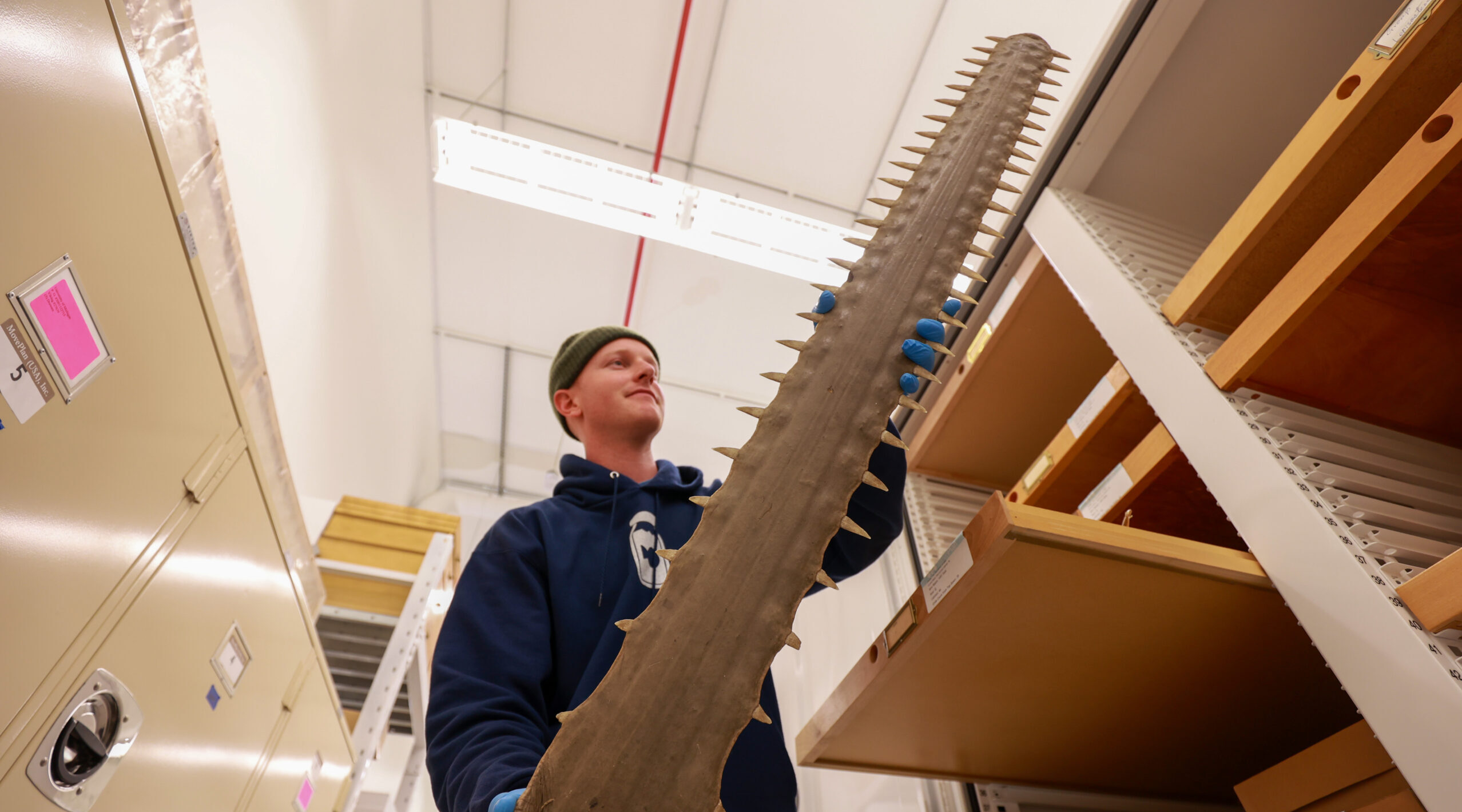
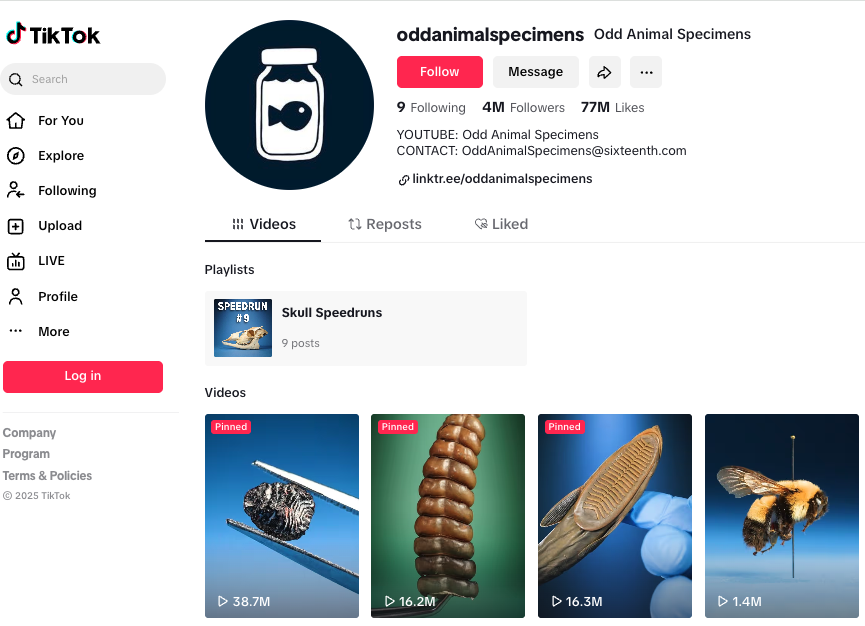
As a science educator and journalist of sorts, he began by creating thoughtful — almost gentle — videos to showcase the U-M Museum of Zoology and its trove of 15 million specimens: mammals, birds, amphibians, reptiles, mollusks, insects, and mites. Engelman’s feed won’t hit you with the newest dance craze or idiotic viral challenge, but it will provide a steady flow of facts about pufferfish, snakes, bears, houseflies, sea lampreys, and more. Hundreds of millions of people worldwide have viewed his content. Some 17 million people have clicked on a single post about a squirrel’s “private bone.”
 “As someone who cares about science, biology, ecology – all the plants and animals – I feel beholden to the natural world and to other people who also care about this stuff,” Engelman says.
The other people who care about this stuff have found in “Odd Animal Specimens” an educational oasis in which critical thinking is encouraged, questions are prioritized, and credibility is the main ingredient. Representing the Museum of Zoology’s specimen collection is a rare privilege, Engelman says, since most museums are reluctant to share their collections with the public.
“When you come down to it, it’s a preserved animal, you know, not the most appealing thing,” Engelman says. But he enjoys piquing the public’s curiosity about such natural wonders. He sees himself as an ambassador for university museums, natural history collections, and the knowledge they generate regarding climate change, biodiversity loss, habitat loss, and more.
“I am responsible not only for how these collections are viewed, but for how people feel about the natural world,” he says. “And because of that, I feel an immense amount of responsibility to make sure I do a good job and make sure that I’m accurate.”
Social media metrics represent only one aspect of his influence, Engelman says. “I get comments all the time from people who say they are studying entomology in college, or are becoming mammalogists, because of my videos.”
Quiet and slow
Influencing and intelligence
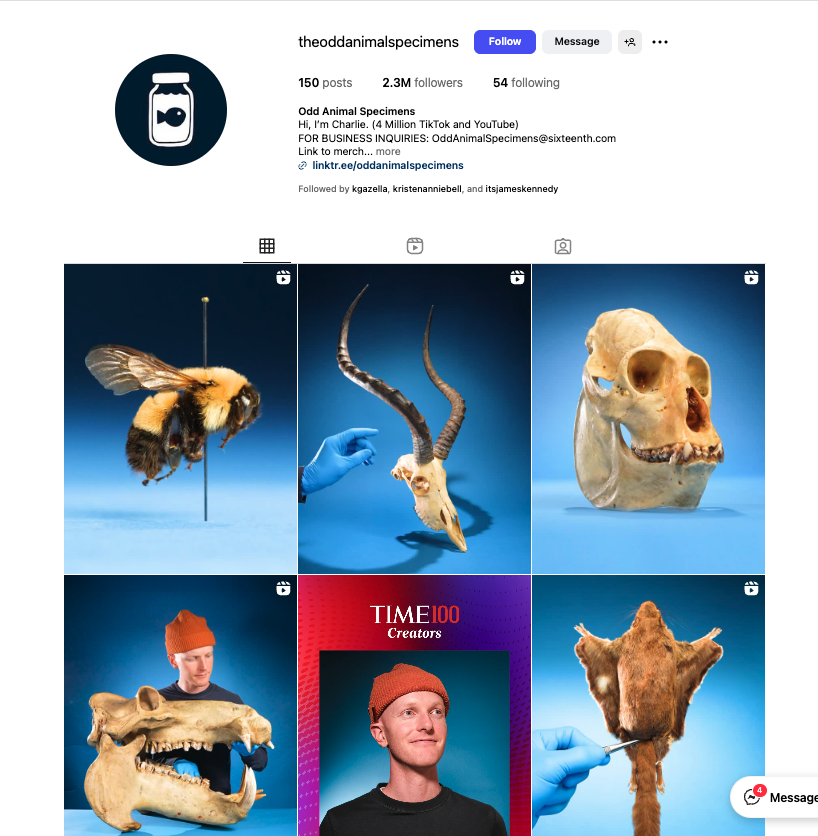 Engelman’s on-air persona began to emerge during his senior year at U-M when he won a National Geographic Channel contest that funded his first online nature series. That motivated him to pitch leaders at the zoology museum on a series to complete his U-M honors thesis in ecology and evolutionary biology. He continued to create programming for National Geographic and the NatGeo channel before returning to his mentors at UMMZ to develop the wildly successful accounts he currently manages. Today he is one of the few content creators in the world with access to such a diverse inventory of museum specimens.
As a producer, he follows a meticulous process, shooting most clips against a blue screen using a table covered in the same blue paper. A stationary video camera and a spotlight complete the set-up. He shoots in extreme close-up, showing only his gloved hands. He tweaks timing, use of humor, shooting style, etc., and then takes a deep dive into his analytics and tweaks again.
Science and sincerity
 In a world of media-savvy personalities like Bill Nye and Neil DeGrasse Tyson, Engelman has found a niche among science lovers who reject the trappings of traditional, legacy journalism. As an independent creator, he pursues a topic because he likes it, which resonates with his audience. He approaches content with a reporter’s ethic, rare in social media, and cites a science journalism course he took at Michigan for preparing him to communicate about complicated topics to a general audience.
“When I studied science at U-M, I learned how to dissect information, to really analyze whether something is true or untrue, and put a lot of emphasis on proof. I’m able to present things with a very influential and strong voice while maintaining accuracy and scientific integrity,” he says. “Sincerity and authenticity are very powerful.”
Those qualities are more important today than ever as federal support for academic research is declining, stifling the scientific enterprise, he says. There’s no better time for people to learn about and appreciate natural history museums and the knowledge they hold.
And now that he has conquered the digital world, Engleman’s greatest desire is for his online followers to put down their devices and go outside to experience the natural one. As social media influencers go, that makes him an odd specimen indeed.