U-M mathematician Charlotte Chan named 2025 Packard Fellow
Charlotte Chan, an assistant professor in the Department of Mathematics, is one of 20 early-career scientists and engineers who have been named 2025 Packard Fellows.
The David and Lucile Packard Foundation has awarded this cohort $875,000 each over five years to pursue their research.
“I’m overwhelmed and very honored,” said Chan, who works in an area of math known as representation theory. “I still can’t believe it.”
Representation theory provides a mathematical framework for understanding symmetry in the world around us, in both qualitative and quantitative terms, Chan said. This understanding can lead to powerful problem-solving tools, not just in math, but in many areas of science and engineering where symmetries appear.
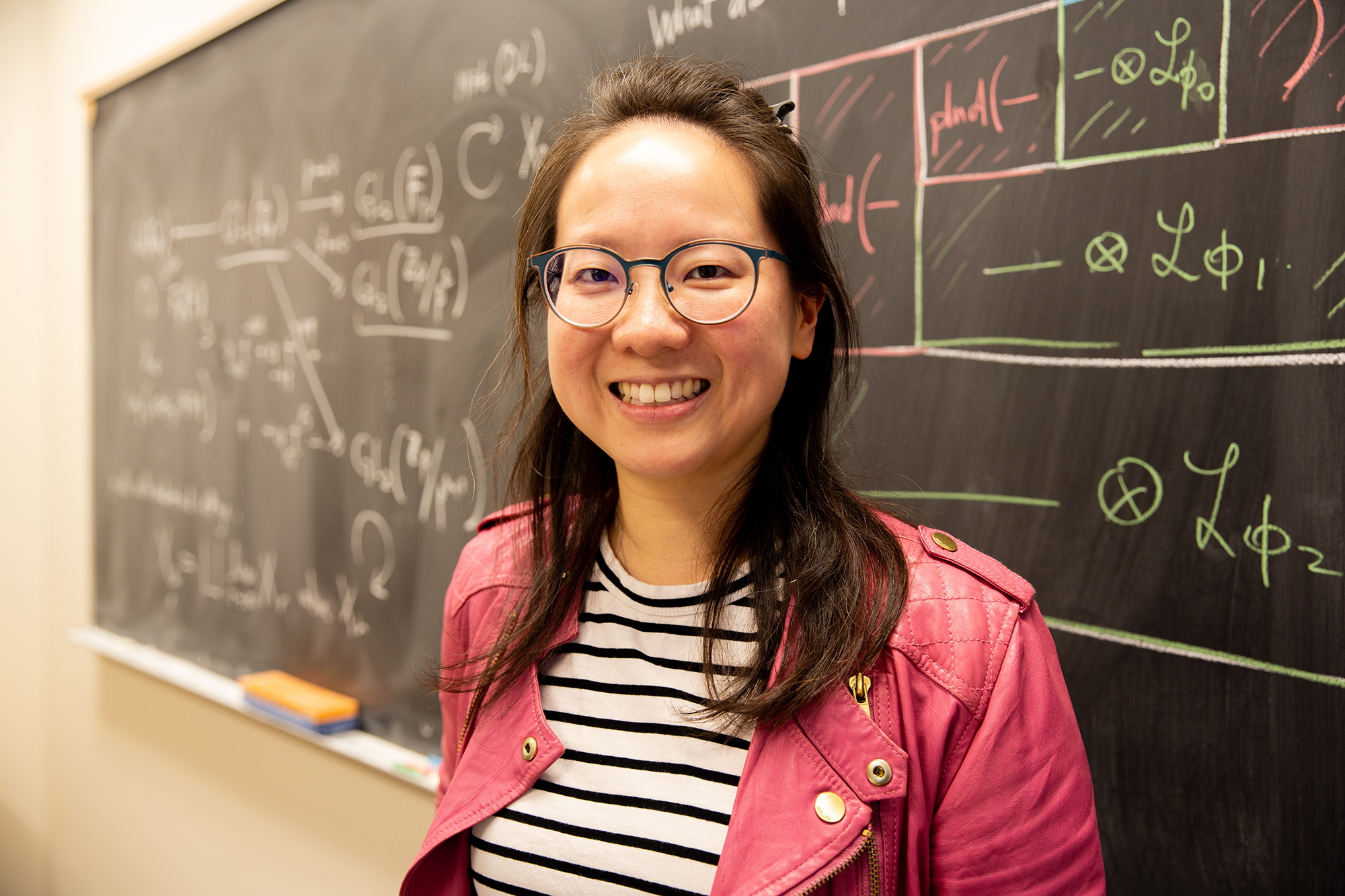
“I’ve known Charlotte since she was a beginning graduate student and have always been impressed by her incredible bravery, ambition and optimism about even the most difficult mathematical endeavors. Her courage has driven her to take on some of the hardest questions in representation theory, and her perseverance has led her to solve many of them,” said Karen Smith, the William Fulton Distinguished University Professor of Mathematics and chair of the Department of Mathematics in LSA.
“The Packard Foundation has made an excellent choice in selecting Charlotte as a 2026 Fellow. She will take on big risks to pursue the biggest questions, which is exactly what they are trying to support. I am incredibly proud to be a member of a department with researchers like Charlotte Chan for colleagues.”
Chan is particularly interested in how she can connect ideas from representation theory to other branches of mathematics.
“My favorite kind of thing in math is when subjects talk to each other,” Chan said. “If you have a way to bridge between two subjects, you can bounce back and forth. In these different subjects, different things are easy and different things are hard. So you can try to leverage the easy things on one side and to get at the hard stuff on the other.”
These connections can also reveal surprising phenomena that may not have been otherwise discovered, she added.
“These visionary Packard Fellows are pushing the boundaries of knowledge, and their bold ideas will become tomorrow’s real-world solution,” said Nancy Lindborg, president and CEO of the Packard Foundation.
The Packard Fellowships were inspired by David Packard’s passion for science and engineering and his commitment to strengthening university-based science and engineering programs in the United States.
Recognizing that the success of the Hewlett-Packard Co., which he co-founded, grew from breakthroughs in university labs, the foundation launched the Packard Fellowships for Science and Engineering program 37 years ago. Since then, the Packard Foundation has awarded more than $500 million to support 735 scientists and engineers from 55 universities.
“David Packard believed that science was the cornerstone of America’s progress,” Lindborg said. “He invested in science not only because it drives innovation, but because it is a public good that strengthens our society and our shared future. Today, that vision matters more than ever.”
Chan said she plans to use the fellowship to enable her and her team to devote more of their time to research. But she also added that one of the most exciting things about the award is that she has a lot of latitude to use the funds as she sees fit.
“The generosity and flexibility of the fellowship afford me freedom,” Chan said. “And I think that’s one of the most precious resources a researcher can have.”