Provost’s Seminar explores GenAI, undergraduate education
The latest Provost’s Seminar on Teaching invited discussion on the challenges and opportunities generative artificial intelligence poses for undergraduate education.
The event, co-sponsored by the Provost’s Office and the Center for Research on Learning and Teaching, or CRLT, brought nearly 200 faculty, staff and academic leaders to the Michigan Union on Nov. 10.
Matt Kaplan, executive director of CRLT, kicked off the programming by noting that the last time the seminar had focused on generative AI and education was in December 2023, a year after the introduction of ChatGPT.
“Nearly two years have passed in chronological time, but it feels a lot more like two decades in GenAI time,” Kaplan said. “This technology is impacting teaching practices and student learning across higher education and at all levels.”
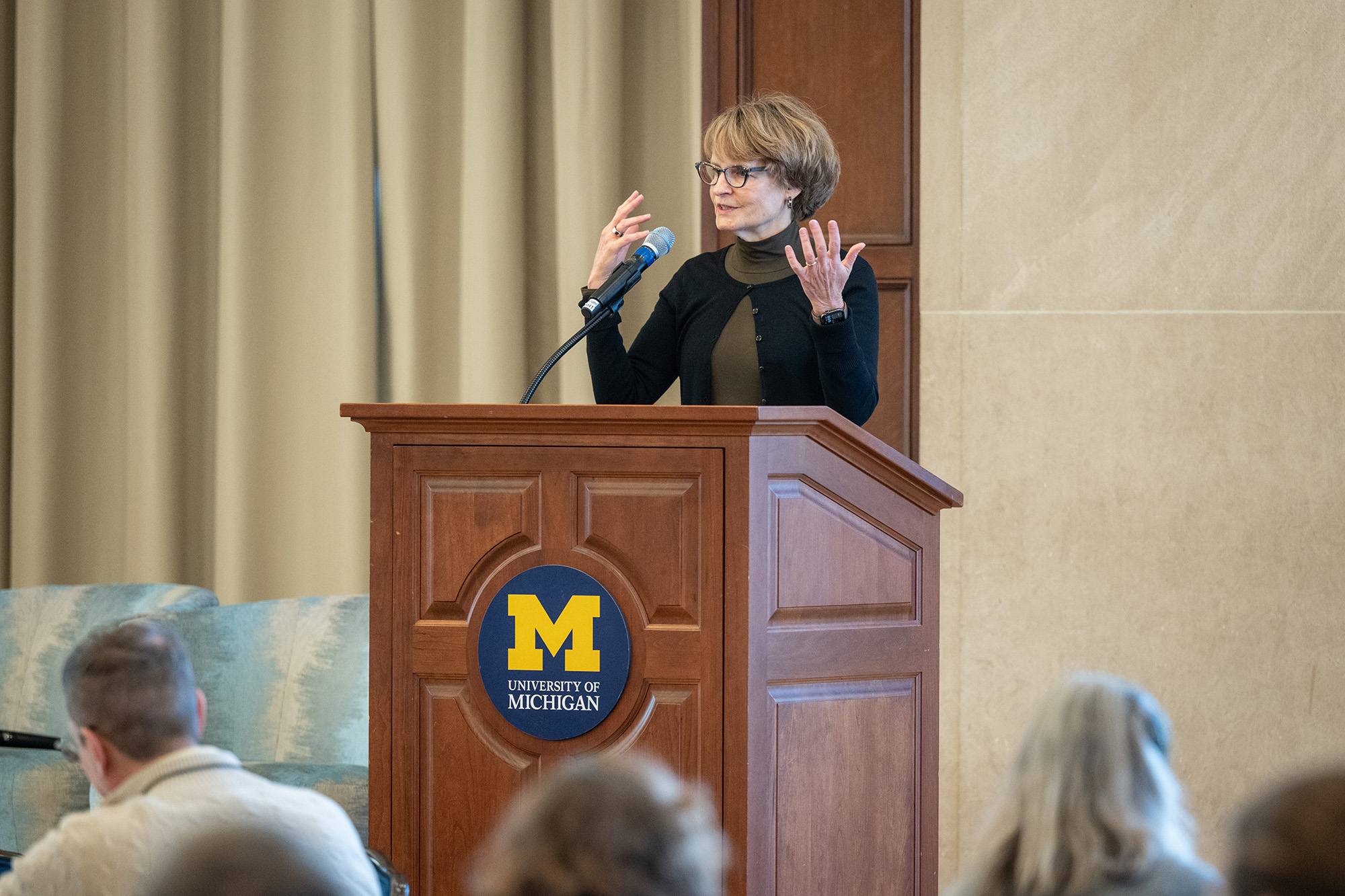
Laurie McCauley, provost and executive vice president for academic affairs, outlined both the positive and negative aspects of generative AI, posing the question: “Is AI an existential threat or is it an incredibly impactful breakthrough?”
She then shared several examples that illustrated the complexity of AI’s impact.
“AI has the ability to amplify human intelligence and solve problems, but at the same time, it also has the potential of diminishing cognitive engagement and perhaps eroding the very skills we’re trying to develop here.
“We want our students to become thinking, creative and reflective human beings, and we know that requires a balance between innovation and reflection.”
An expert panel, moderated by Josh Pasek, professor of communications and political science in LSA, discussed issues raised by the intersections of generative AI and undergraduate education. The panelists included:
- Sol Bermann, executive director of privacy and faculty affairs, adjunct clinical assistant professor of information and research investigator, School of Information.
- Taz Daniels, associate director, CRLT.
- Tim McKay, Arthur F. Thurnau Professor; associate dean for undergraduate education, professor of physics, professor of astronomy, LSA; and professor of education, Marsal Family School of Education.
- Louise Jackson, director, University Career Center.
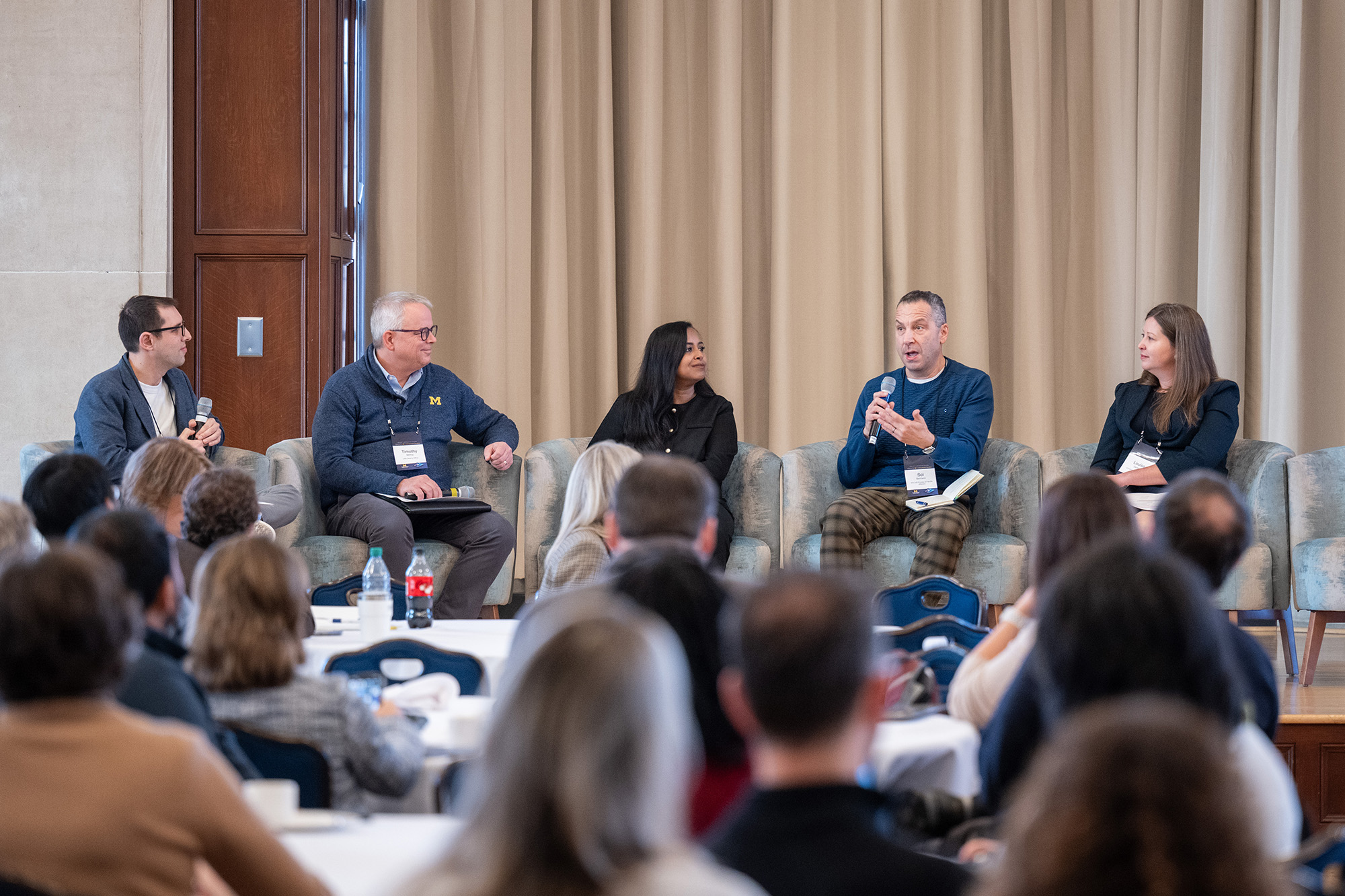
In a wide-ranging discussion that touched on implications of GenAI for student cognitive development and workforce readiness, course and institutional policies, and privacy issues, panelists were mostly in agreement that artificial intelligence is now an unavoidable part of higher education and that the university’s role is to guide students toward thoughtful, ethical use.
“We can’t put the genie back in the bottle,” Bermann said. “It’s incumbent on us to have the conversations we’re having today — how to acknowledge this reality, help students learn to use these tools appropriately, and do so with the right guardrails.”
McKay acknowledged that the university’s decentralized structure makes consensus difficult but said departments are beginning to have productive, discipline-specific conversations.
“With 19 schools and colleges, 8,000 faculty, and 53,000 students, there’s never one view about anything,” he said. “But what we share is a commitment to education. We need to empower faculty to decide whether and how generative AI should play a role in the learning environments they create and then support them when they do.”
Looking beyond U-M, Jackson noted that many employers expect students to have familiarity with AI tools.
“We’re preparing students for the world as it exists, not the world as we hope it would be,” she said. “Employers are incorporating AI into their hiring processes and expect students to arrive with some understanding of how to use it.”
Daniels urged faculty and departments to make informed decisions. “We need ongoing, transparent engagement,” she said.
Panelists also raised concerns about privacy, data use and equity. Bermann cautioned that many students “are already paying money to commercial AI platforms that consume and share their data.” He added that part of the university’s responsibility is to help students “understand the surveillance environment they’re entering and make informed choices about their digital footprints.”
The conversation closed with a look toward community-building and support. Jackson encouraged faculty to partner with career offices “to develop experiential learning opportunities that help students connect classroom learning with the realities of an AI-integrated workplace.”
Daniels announced that CRLT, in collaboration with the Teaching and Technology Collaborative and the UM-Flint Office of Online and Digital Education, will soon launch Critical Conversations on Generative AI in Higher Education, a monthly, cross-disciplinary learning community. Information on the initiative will be sent to faculty later this term.
“Too much of this [conversation] is happening in silos,” she said. “The best support faculty have is each other — and we’re here to help make those connections.”
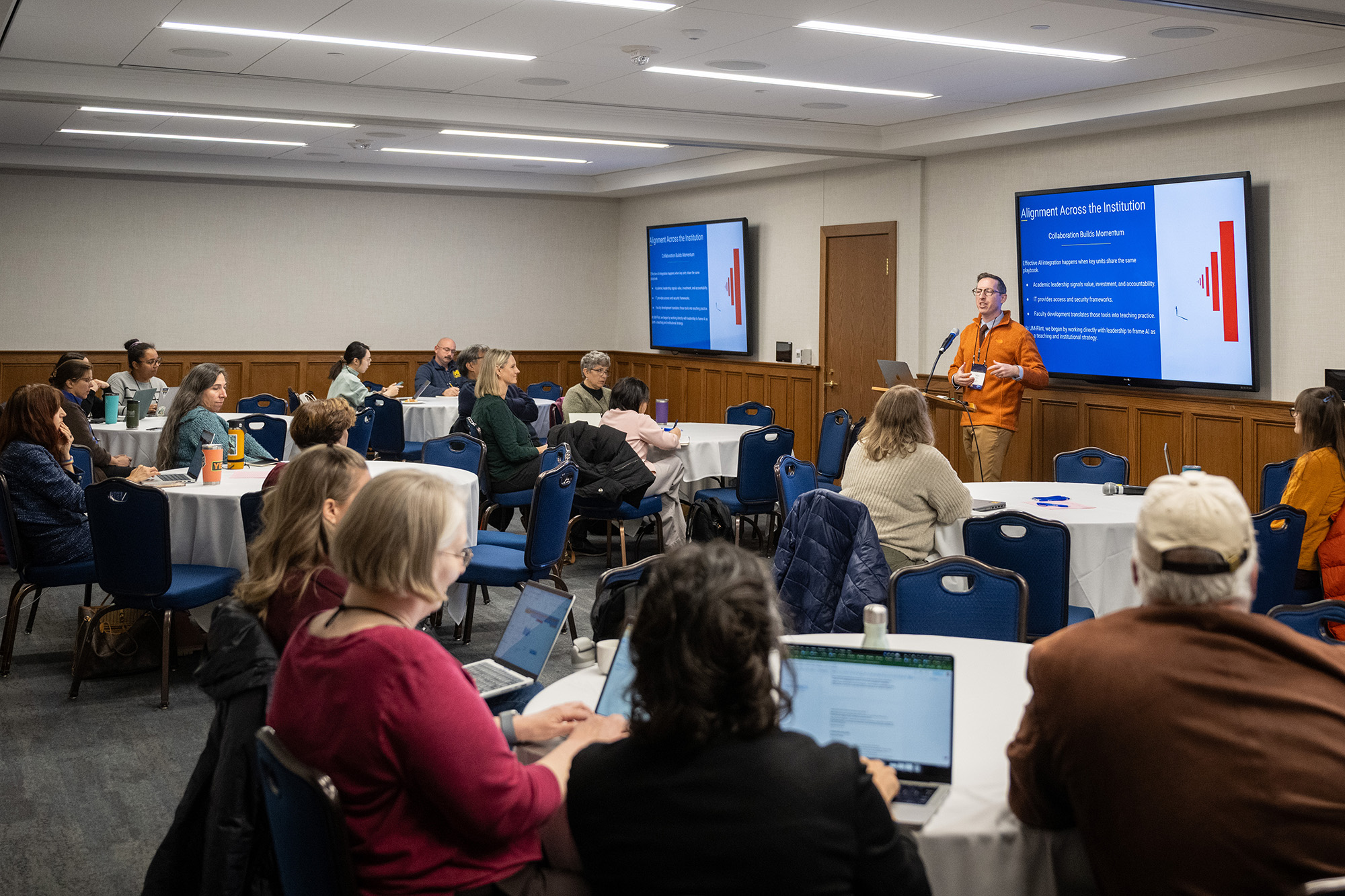
Following the panel, two blocks of 50-minute concurrent sessions tackled a variety of Generative-AI and education topics, including:
- Creating GenAI policies that are practical and effective.
- How faculty are adopting AI tools to support teaching.
- What students should know about how GenAI works.
- Redesigning assessments in the wake of GenAI.
- GenAI and writing instruction.
A resource room was also staffed during the sessions by representatives from CRLT, Information and Technology Services, the Center for Academic Innovation, the Sweetland Center for Writing, and LSA Technology Services to answer faculty and staff questions and provide customized support.
After the morning sessions, while attendees ate lunch, Pasek and U-M undergraduate senior Hailey Gabron presented preliminary results from a student survey that asked U-M students how they use and feel about generative AI. The preliminary results suggest students are regularly engaging with generative AI but feel conflicted about its use. Survey responses are still being gathered, but once they’ve all been received and tabulated, the full results will be made available to U-M faculty.
The next Provost’s Seminar in Teaching is scheduled for May 13, 2026, and will explore the use of generative AI in graduate education.