It Happened at Michigan: A century ago, student club pushed for equal treatment
In March 1926, a group of U-M students formed the university’s Negro-Caucasian Club, hoping to gain equity for Black students on campus and in town.
The catalyst for the club reportedly came in the fall of 1925, when Lenoir Bertrice Smith, one of roughly 60 Black U-M students, walked into an Ann Arbor restaurant with her white friend, Edith Kaplan. The two sat down for a quick meal, but a server never arrived. After a considerable wait, a busboy approached their table and placed a stack of dirty dishes between them, a presumed rebuff to Smith.
Years later, Kaplan recalled the incident. “I trembled with rage when I saw [Smith’s] face and knew that the dirty dishes had not been accidental.”
The two friends decided the incident was evidence of a broader pattern. Black students attended classes with white peers, but much of university and city life remained segregated. Black men often lived in Black fraternity houses or boarded with Black families. Black women, barred from university dormitories, were housed off campus. The Michigan Union would not serve Black students, and they were excluded from public swimming pools and university-sponsored dances.
As Joseph Leon Langhorne, a Black U-M alumnus, later put it: “The colored were not part and parcel of the school.”
Smith and Kaplan sought advice from U-M faculty member Oakley Johnson, an instructor of Smith’s. Johnson was sympathetic and joined Smith and Kaplan in appealing to LSA Dean John Robert Effinger, hoping the university might use its influence to urge fair treatment of its Black students.
But Effinger refused to intervene. Johnson later described the dean’s response as “correct, cold and unsympathetic.” As a result, Smith, Kaplan and nearly two dozen other students decided to take matters into their own hands.
Within weeks, they’d formed the Negro-Caucasian Club of the University of Michigan, a student group created “to work for a better understanding between the races and for the abolition of discrimination against Negroes.” The first roster included 26 students — 21 Black and five white.
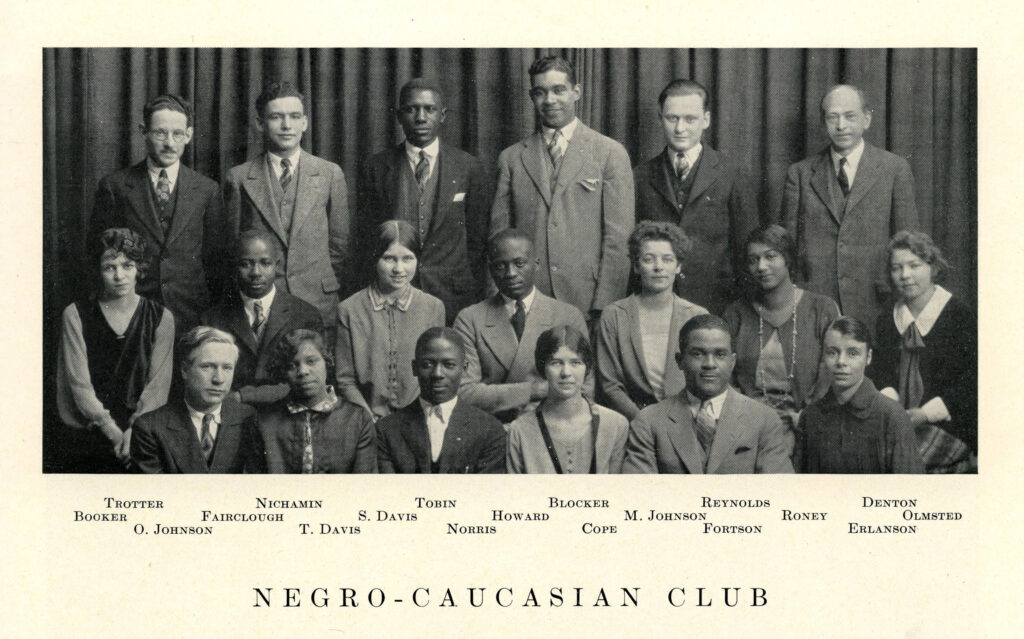
When the club petitioned for official recognition, U-M administrators insisted on some changes. Dean of Students Joseph Bursley told Johnson, who was serving as an adviser to the club, that while he was fine with the group having conversations about race relations, he was less keen on anti-discrimination activism.
The club’s stated purpose was eventually softened to language about “friendliness,” “fair-mindedness,” and impartial “study and discussion.” Even then, the faculty committee only approved the group for a one-year trial period and they would not allow the club name to include “… of The University of Michigan.”
Despite those constraints, the new Negro-Caucasian Club pursued an ambitious agenda. One of its first actions was surveying white students to gauge their contact with Black people and to surface any prevailing stereotypes. The results indicated that ignorance and beliefs about Black inferiority were central problems, so the club members invited prominent Black thinkers and leaders to campus.
Speakers included philosopher Alain LeRoy Locke, NAACP cofounder W.E.B. DuBois, and novelist Jean Toomer, along with meetings with labor leader A. Philip Randolph, Judge Frank Murphy and lawyer Clarence Darrow.
The Negro-Caucasian Club continued to grow its membership and was renewed annually for about five years. But the advent of the Great Depression caused the club to fade by the early 1930s.
The club’s alumni, however, carried its influence forward into careers in medicine, social work, academia and journalism. Smith (later Lenoir Smith Stewart) went on to earn her master’s degree at U-M, and from 1953-58, she led the serology section at University Hospital. Kaplan became an authority on ancient languages at the University of Chicago.
In 1969, the year after Martin Luther King Jr.’s death, surviving members of the Negro-Caucasian Club, including Langhorne, who graduated in 1928, gathered for a reunion in Washington, D.C., where they talked about the progress of the Civil Rights Movement and recalled the significance the club had played in their U-M experience.
“I think the N.C. Club served a distinct purpose then,” Langhorne said. “It was the only forum … for airing of Negro people’s views and students’ problems in Ann Arbor.”
This story was adapted from a story on the Heritage Project by James Tobin, which can be found online at myumi.ch/A1X4g.