Martha Cook’s piano: A grand tale
By Joanne Nesbit
News and Information Services
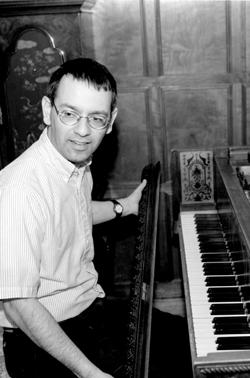
The piano in Martha Cook Residence Hall was meant to be seen as well as heard. And so it has for the past 87 years. The Model A Steinway is no longer made in the United States, and the instrument’s case is one of a kind—a piece of art in itself designed by a New York maker of crystal and fine furniture.
Constructed of Italian walnut with rosewood and mahogany inlays, the piano was commissioned in 1913 by William Cook, benefactor of the Law School and Martha Cook Residence Hall. With an original cost of about $1,500 for a “plain” grand piano plus $350 for the intricate design work, the instrument today is worth between $150,000 and $200,000, says Robert Grijalva, director of keyboard maintenance at the University.
Well used, and on occasion abused, the piano, commissioned by Cook for a close friend and opera diva, came to the U-M residence hall after Cook’s death. Once vibrant in both its sound and physical beauty, the soundboard, pinblock and bridge caps now need to be replaced, and the ornamental woodwork (including some missing rosettes) and veneer repaired, a project that could cost as much as $50,000 and take as long as a year. Most of the original inking that defined the faces of the figures and the strings of the tiny instruments of the wood inlay design has disappeared or lightened over time. Occasional spills on the art case have taken their toll.
“You’ll never see this kind of woodwork again,” Grijalva says. “All this inking was done by hand.”
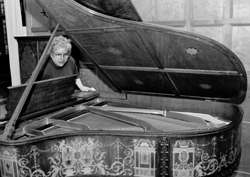
While other art case pianos are housed in museums as pieces of art, the Board of Governors at Martha Cook has deemed that this piano be available for the women in residence to play. And they do.
The U-M has a second art case piano—in the Museum of Art. Donated by Nancy Gould Britz to the School of Music in honor of her mother, U-M graduate and pianist/composer Elizabeth Gould Hochman, the 1930 Model B piano is styled after the first one Henry Steinway built in the kitchen of his home in Sessen, Germany. The year was 1838. The modern representation at the Museum of Art is shown in the Steinway catalog to be Colonial Style #326. At one time played upon by such virtuosos as Vladimir Horowitz and Andre Watts, it has been historically restored to its pre-World War II condition.
Once funds can be raised for the restoration of the Steinway at Martha Cook, Grijalva says there are great piano artisans in Michigan who could do the work. “Michigan used to produce pianos,” Grijalva says. “There are some great rebuilders in this area.”
Responsible for nearly 230 pianos owned by the School of Music, Grijalva also teaches classes in piano technology. While most of his students are piano majors at the School of Music who want to know how their instrument works, others also have benefited from his class. Among those have been electrical engineers, mathematicians, as well as engineers from the Ford Motor Co. interested in noise, vibration and harshness who wanted to study how piano systems are integrated.