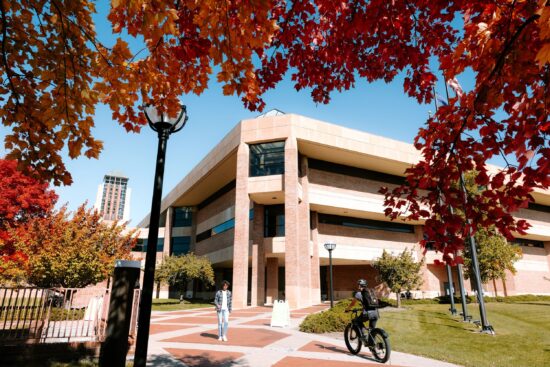
Library division celebrates 20 years of restoration and repair
Old books do not magically reappear on the shelves like new, say employees of the University Library’s Preservation Division. Repairing thousands of volumes requires hours of arduous labor in a building that few members of the U-M community know about or have visited.
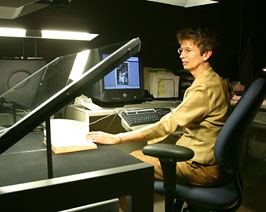
Now, as the division celebrates its 20th anniversary, it has the Zeutschel Omniscan 7000, a machine that will revolutionize how information is stored. Aging, frayed or damaged materials have a place on library shelves, and now, your computer screen.
The University is among the first in the country to own a Zeutschel, which digitizes books and documents by scanning images onto a computer. From there, images are sent through an optical character recognition program, using a search engine to locate specific words or passages. The images are catalogued and made accessible to the University community.
In the future, the Zeutschel will replace the microfilm camera as the primary preservation technique. By digitizing brittle or frayed books, the machine ensures that the University always will have a copy. With the proliferation of online course materials, the Zeutschel allows even the oldest sources to be available.
Carla Montori, head of the Preservation Division, sees the Zeutschel as a welcome addition to an already stellar facility.
“We’ve been fortunate that over the last 20 years, the library and the University have supported the preservation program,” she says. “It’s a huge commitment of money and expertise, but it’s also a huge psychological commitment to say, Çwe will have this top-notch preservation program.'”
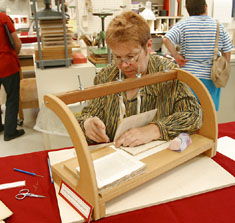
The Zeutschel is just one cog in the newly streamlined preservation division. While the camera operators create digital copies, other library staff members maintain the originals. Each year, some 54,000 volumes pass through commercial binding machines. In addition, dozens of staff members perform intricate detail work on damaged materials, which includes anything from the hand sewing of book bindings to removing stains.
The division also devotes considerable time to its papyrus collection, the largest in the Western Hemisphere. One of its jewels is a set of letters written by St. Paul to the Corinthians, dated from the first century B.C.
Damage to library materials is largely preventable, preservation staff members say. Shannon Zachary, head of Conservation Services, stresses their fragility and susceptibility to wear and tear.
“It’s common sense when you stop to think about it. There’s usually a point when you realize how easily things can be damaged,” Zachary says. “It’s even as easy as what jewelry you’re wearing when you’re handling a delicate document, because that can catch and tear.”
The community saw the many facets of the division at last week’s open house, held in celebration of its 20th anniversary. There, participants saw how damaged paper is preserved, books are re-bound and wet pages are dried. Camera operators were there to demonstrate the Zeutschel.
Zachary hopes the University community recognizes the library’s efforts to organize, distribute, and most of all, preserve thousands of materials. “It’s the kind of thing that most people who use the library take for granted,” she says. “They don’t realize how much meticulous work is involved in getting that product on the shelf.”